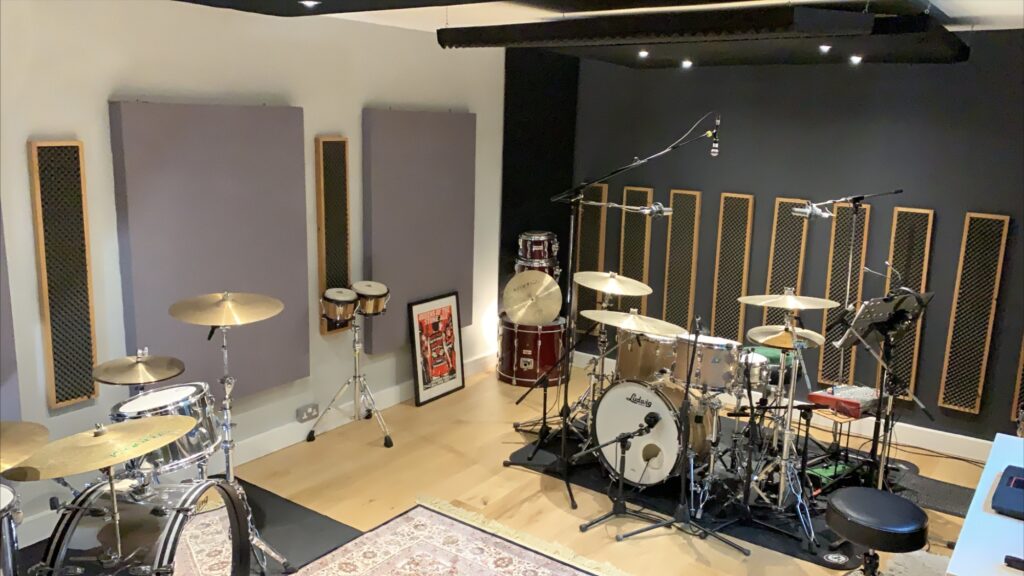
There’s a question that comes up constantly in Dubai’s growing home studio and content creator community, and it usually sounds something like this: “I’ve put foam panels everywhere and my room still sounds terrible. What am I doing wrong?”
Nothing — and everything.
The foam panels are doing exactly what foam panels do. The problem is that the issue those panels can’t fix was never the issue they were designed for. And nobody explained the difference before the purchase was made.
Bass traps and acoustic foam are both acoustic treatment. That’s where the similarity ends. They operate in completely different frequency ranges, address completely different room problems, and are genuinely not substitutes for each other. Using one when you need the other is like putting a ceiling fan in a room that needs air conditioning — it does something, but not the something you needed.
Dubai studios — whether home setups in apartment bedrooms, commercial recording spaces, podcast booths, or content creation rooms — face a specific set of acoustic challenges driven by room geometry, building construction, and the UAE’s unique climate conditions. Getting the treatment right requires understanding which problem is actually happening in your room. This article is that explanation.
The Frequency Split That Changes Everything
Sound exists across a broad frequency spectrum. Human hearing covers roughly 20Hz to 20,000Hz. For studio purposes, what matters is how different parts of that range behave physically in a room — because they behave very differently.
High and mid-frequency sound waves are short. A 2,000Hz wave is about 17 centimetres long. These waves reflect off surfaces like light bouncing off a mirror, creating the flutter echo and reverb tail that makes a room sound echoey and unclear. They’re also relatively easy to absorb because their short wavelength means even moderately thick porous material creates enough friction to capture their energy.
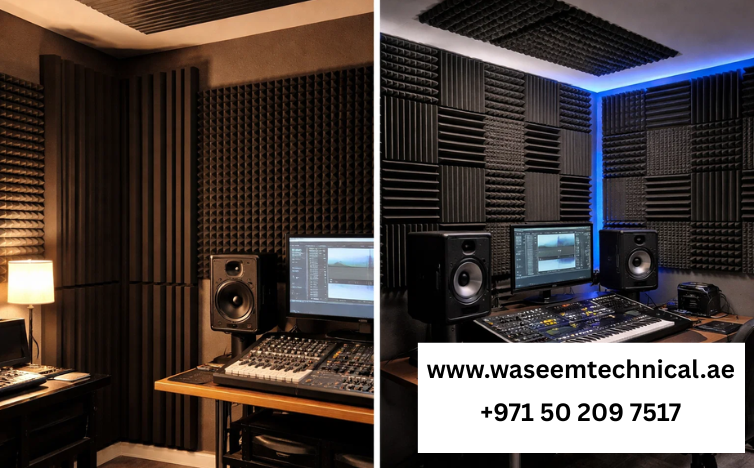
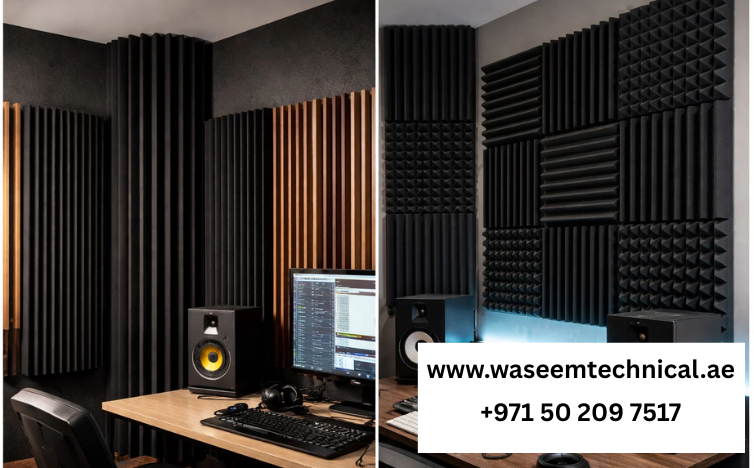
This is what acoustic foam does. Pyramid foam, wedge foam, eggshell foam — all of these work by creating a textured porous surface that intercepts high and mid-frequency reflections and converts their energy into negligible heat through viscous resistance. They work. Within their frequency range, they work well. Install enough of them correctly and the flutter echo in your room disappears, voice recordings tighten up, and the room stops sounding like a tiled bathroom.
Low-frequency sound waves are a fundamentally different physical problem. A 60Hz wave is nearly six metres long. It doesn’t bounce off walls — it passes through most materials as if they barely exist. Instead, low frequencies accumulate in room boundaries: the corners where two walls meet, the junctions where walls meet the floor and ceiling, and the room’s resonant modes — the specific frequencies where the room’s dimensions create standing waves that pile up and build into booming, uneven bass.
Foam cannot address this. A 5cm foam panel has an absorption coefficient below 0.15 at 125Hz. Below 100Hz, foam is acoustically transparent — the low-frequency energy passes through it without meaningful interaction. This is why a room covered wall-to-wall in foam still sounds boxy and uneven in the bass. The foam fixed everything it was capable of fixing. The low-frequency problem was never in its capability range.
Bass traps are built specifically for this problem. Dense mineral wool or rigid fiberglass cores — typically 10cm to 20cm thick — have the physical depth and density to create meaningful friction as long low-frequency waves pass through them. Positioned in corners where low-frequency pressure is highest, they absorb the accumulating bass energy before it builds into room modes, flattening the room’s low-frequency response and making the bass in your recordings and mixes genuinely representative of what’s actually there.
What a Typical Dubai Studio Room Is Doing to Your Low End
The physics of bass accumulation are universal, but the severity of the problem varies significantly depending on room dimensions and construction. Dubai apartments — which house the majority of the emirate’s home studios — have specific characteristics that make low-frequency problems worse than average.
Many Dubai apartment spare bedrooms, which get repurposed as studios, are built with dimensions that are either square or close to it. A 3.5 x 3.5 metre room is not unusual. Square rooms are acoustically catastrophic for bass because both opposing wall pairs produce the same resonant frequencies simultaneously, doubling the severity of bass buildup at those frequencies. The most common resonant mode in a 3.5 metre room sits around 49Hz — sitting right in the fundamental range of bass guitar, kick drum, and male voice chest resonance. Everything important.
Concrete block construction — standard in Dubai residential builds — has minimal natural damping of low-frequency energy. Unlike timber-frame construction which has some inherent flexibility and internal absorption, concrete is rigid and dense. It reflects low frequencies efficiently rather than absorbing any meaningful portion. The room is essentially a hard box with no natural allies for low-frequency control.
Add the AC factor — Dubai homes run aggressive air conditioning, which drops indoor humidity to levels that make wood furniture crack and also affects the acoustic behaviour of any porous materials in the room — and you have a situation where bass accumulation in untreated Dubai studios is measurably more severe than in rooms of equivalent dimensions in more temperate climates.
Research from the Audio Engineering Society consistently shows bass frequency response variations of plus or minus 15 to 20 decibels in untreated small rooms at different positions. That means the bass that sounds balanced from your chair might be 15 decibels louder or quieter two metres away. Your mixes are being made based on a position-specific lie.
The Visible Symptom That Tells You Which Problem You Have
Before spending money on either product, the room itself will tell you what it needs — if you know what to listen for.
Clap your hands sharply once in the centre of your studio. Listen carefully to what happens after. If you hear a distinct metallic or fluttering echo that decays over a second or more — a “zing” or a rapid series of reflections — that’s flutter echo from mid and high-frequency reflections between parallel walls. Acoustic foam addresses this.
Now play a bass-heavy track you know well through your monitors at moderate volume. Walk slowly from the front wall to the back wall while listening. If the bass noticeably swells and recedes — louder in some spots, thinner in others — that’s room modes. Bass traps address this. If you sit at your mix position and bass-heavy recordings consistently sound thick and boomy but play back thin and weak on other speakers, same diagnosis.
Most Dubai studios have both problems. The flutter echo is obvious because it’s audible to unaccustomed ears. The bass mode problem is more insidious because it’s invisible until you notice that every mix made in the room translates badly. This is why the typical answer to “bass traps or acoustic foam?” is not one or the other. It’s both — in the right sequence, with the right priority.
The Right Order: Why Bass Traps Come First
Here’s where most studio builders go wrong on sequence. They cover the walls in foam first because it’s cheap, accessible, and produces immediately satisfying visual evidence of “treatment.” Then they wonder why the room still sounds problematic, buy more foam, cover more walls — and arrive at a room that’s acoustically dead at high frequencies but completely untamed in the low end. The result is a studio that sounds worse than a room with no treatment at all: a cold, lifeless, over-dampened midrange sitting on top of an uncontrolled rumbling bass.
The acoustically correct sequence is bass traps first, foam second. Corner bass traps address the most severe low-frequency accumulation points. Once the bass is under control, the room’s actual character becomes audible — and the amount of mid and high-frequency treatment needed becomes assessable. Over-dampening a room at mid-high frequencies is easy and hard to reverse. Getting the low end right first prevents that mistake.
For a typical Dubai apartment studio, the minimum bass trap installation that makes a meaningful difference is floor-to-ceiling coverage in all four vertical room corners — the primary pressure accumulation zones. Ceiling-to-wall junction treatment at the front wall and rear wall adds significant additional improvement. Waseem Technical’s corner bass trap installations in Dubai are specified for the room dimensions common in UAE residential construction, which matters because a product optimised for a 4m x 5m European room may not be the right specification for a 3m x 3.5m Dubai spare bedroom.
Call us: Contact Waseem Technical Soundproofing Expert in Dubai: +971 50 209 7517
Where Acoustic Foam Earns Its Place — Used Correctly
Once the bass is addressed, acoustic foam becomes genuinely valuable — and considerably more so than it was before bass treatment was in place.
The primary application is controlling first reflections: the sound waves that leave the monitor speakers, bounce off the side walls and ceiling, and arrive at the listening position milliseconds after the direct sound. These early reflections cause comb filtering — interference patterns that colour your perception of the sound and make accurate monitoring harder. Foam panels positioned at the reflection points on the side walls (typically halfway between the monitors and the listening position) and on the ceiling above the mix position address this effectively.
What acoustic foam does not need to do — and what excessive application creates — is a room with no liveliness at all. A completely dead room is uncomfortable to work in and produces recordings that lack the natural air that makes them feel present and real. The target is controlled reflection, not elimination of all reflectivity. Industry guidance for small recording rooms suggests treating 25 to 35% of wall surface area — not every available surface.
The balance between bass trapping, foam absorption, and leaving enough reflective surface to maintain room character is what makes the difference between a professional-sounding studio and a room that’s technically treated but sonically unpleasant to work in.
Call us: Contact Waseem Technical Soundproofing Expert in Dubai: +971 50 209 7517
The Combination That Defines a Functioning Dubai Studio
The complete acoustic treatment picture for a Dubai home or commercial studio looks like this: floor-to-ceiling bass traps in all room corners, ceiling junction treatment at the front and rear walls, acoustic foam panels at the primary reflection points on side walls and ceiling, and enough untreated or lightly diffused surface remaining to prevent over-dampening.
That combination — not bass traps alone, not foam alone — produces a monitoring environment where the frequency response is flat enough to make mixing decisions that translate, where voice recordings are clean and intimate without sounding suffocated, and where extended working sessions don’t generate the listening fatigue that characterises poorly treated rooms.
The cost difference between getting this right and getting it wrong is surprisingly small. The output difference — in the quality of recordings, the accuracy of mixes, and the professional credibility of what the studio produces — is not small at all.
If your Dubai studio currently has acoustic foam but no bass traps, the most productive investment you can make is corners, not more panels. The room will tell you it was the right call the first time you play a bass-heavy reference track after installation and hear it from the same position, all the way to the back wall, at approximately the same level throughout.