
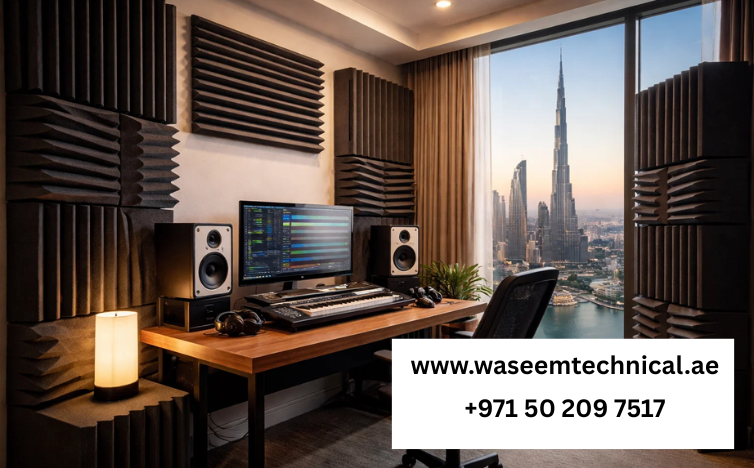
Picture this. You’ve spent months building your home studio in Dubai. Good monitors. A decent interface. Treated the walls with foam panels. You sit down to mix a track, feel good about how it sounds in the room — and then you play it in the car, on your phone, on a friend’s speakers — and the low end is a disaster. Too much bass in some places. Hollow in others. Nothing translates.
You haven’t made a mistake in the mix. You’ve made a mistake in the room. And that room is lying to you every single time you sit down to work.
This is the bass problem. And in Dubai’s typical apartment and villa layouts, it’s worse than almost anywhere else. The room dimensions, the hard concrete construction, the marble and tile floors — everything about how residential spaces are built in this city creates low-frequency acoustic nightmares that standard acoustic foam panels are completely powerless to fix.
Bass traps are the solution. Not a nice-to-have. The solution.
What’s Actually Happening in the Corners of Your Studio
Sound waves behave differently depending on their frequency. High and mid-frequency waves are relatively short — they bounce off surfaces, reflect around the room, and can be absorbed by reasonably thin foam panels. Standard acoustic treatment handles them well.
Low-frequency waves are a different animal entirely. They’re physically long — a 60Hz bass wave is nearly six metres from peak to trough — and they don’t reflect the way higher frequencies do. Instead, they accumulate. They pile up in the corners of rooms, in the floor-ceiling junctions, in the wall-to-wall boundaries. They create what acousticians call standing waves or room modes — specific frequencies that resonate and build up in predictable locations based on the room’s dimensions.
What this means practically: your room has spots where certain bass frequencies are dramatically louder than they should be, and other spots where they practically disappear. If your mix position happens to sit in a bass buildup zone — which in many typical square or near-square Dubai rooms, it does — you’ll consistently hear too much bass and compensate by pulling it down in the mix. Play that mix elsewhere and the bass is thin and weak. The opposite is also common: sit in a null zone and you’ll add bass that isn’t needed anywhere else.
This isn’t a gear problem. No amount of EQ fixes a room mode issue at the source. Only physical treatment does.
Why Dubai Apartments Are Particularly Brutal for Low Frequencies
The typical Dubai apartment — and this applies to everything from JVC studios to Business Bay two-bedrooms — was engineered for visual appeal and thermal performance. Not acoustics.
What that means structurally: concrete and block construction with minimal internal damping, marble or large-format tile flooring throughout, minimal soft furnishings in the building shell, and room shapes that frequently trend toward square or near-square proportions, particularly in spare bedrooms that most home studio builders repurpose for recording.
Square rooms are the single worst room shape for bass acoustics. When two opposite dimensions are identical, they reinforce the same room modes at the same frequencies, doubling the severity of the problem. A 4 x 4 metre room — extremely common in Dubai apartment layouts — produces powerful resonance at 85Hz and its harmonics. That’s sitting right in the critical range for kick drums, bass guitars, and male vocal fundamentals. Everything you’re trying to mix accurately.
Research published in the Journal of the Audio Engineering Society has shown that untreated small rectangular rooms can produce bass frequency response variations of plus or minus 20 decibels at different positions in the room. Think about that. Twenty decibels of difference — that’s the gap between barely audible and painfully loud — just from where you put your chair.
No wonder mixes done in untreated Dubai apartments never translate.
What Bass Traps Actually Do — The Physics Without the Jargon
A bass trap is a thick, dense absorptive structure, typically built from high-density mineral wool or rigid fiberglass, placed at the points where low-frequency energy accumulates most intensely: corners, floor-ceiling junctions, and wall-wall boundaries.
The absorption mechanism works through viscous resistance. As sound waves attempt to pass through the dense fibrous material, friction converts the wave’s kinetic energy into a tiny amount of heat. The wave loses energy. The resonance weakens. Do this at all the primary accumulation points and the room’s low-frequency response begins to flatten — meaning what you hear at the mix position more accurately represents what’s actually in the recording.
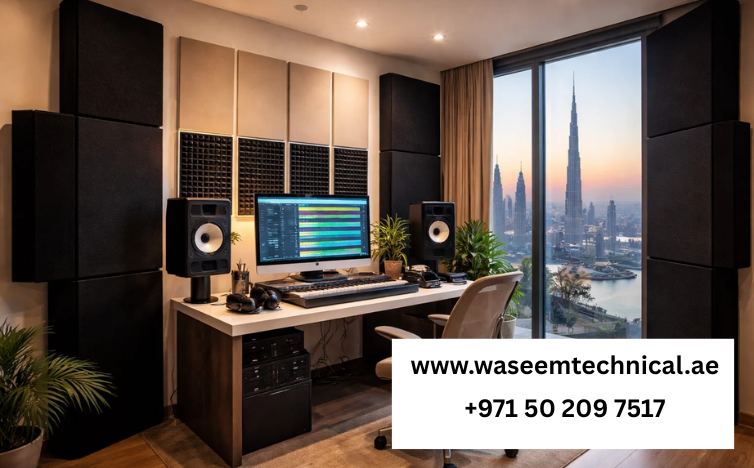
Thickness and density are everything here. This is why thin acoustic foam panels don’t touch the bass problem. To absorb a 100Hz wave meaningfully, you need absorptive material that is at minimum 10 to 15 centimetres thick, made from a material with the right flow resistivity. The typical 5cm pyramid foam tile has an absorption coefficient below 0.15 at 125Hz. A proper 15cm mineral wool panel exceeds 0.90 at the same frequency. That’s not a marginal difference — it’s an entirely different class of performance.
Corner placement multiplies effectiveness further. In a room corner, sound pressure is at its maximum — all three room dimensions converge. A bass trap placed floor-to-ceiling in a corner is working at the highest possible concentration of low-frequency energy, making every square centimetre of absorptive material do maximum work.
The Three Types of Bass Traps and Where Each One Earns Its Place
Corner bass traps are the starting point for every home studio treatment project. Floor-to-ceiling placement in all four vertical corners of the room delivers the most significant measurable improvement in the shortest time. This is non-negotiable first-phase treatment. If you do nothing else, do this.
Waseem Technical’s corner bass trap installations in Dubai are sized and specified to address the specific room mode frequencies common in typical apartment dimensions — which often differ from the European and North American room dimensions that off-the-shelf products are designed around. Getting the specification right for your actual room, rather than a generic room, matters more than most people realise.
Ceiling-wall junction traps address the often-overlooked horizontal boundary where bass accumulation is nearly as significant as in vertical corners. Many studio owners treat all four vertical corners and wonder why the low end still has a slightly cloudy quality — it’s the ceiling junction they haven’t addressed. Adding treatment at the front wall-ceiling junction behind the monitors and the rear wall-ceiling junction where rear reflections gather completes the three-dimensional bass treatment picture.
Freestanding bass traps offer the flexibility to experiment with placement without committing to permanent wall fixtures. In rental apartments — the majority of Dubai’s residential stock — this portability is practically important. Position them near the monitoring position first, then move methodically around the room while playing a reference track until the low-end clarity reaches its peak. The difference between well-placed and poorly placed freestanding traps is audible in ways that make the experimentation genuinely worthwhile.
The Listening Fatigue Nobody Connects to Their Room
There’s a less-discussed consequence of working in an acoustically untreated room that Dubai home studio producers frequently report without understanding the cause: listening fatigue that sets in unusually fast.
An uncontrolled bass-heavy environment forces the brain to work harder to process audio information. When certain frequencies are exaggerated, the auditory system compensates continuously — adjusting perception, filtering mentally for what’s real and what’s a room artifact. This unconscious processing is cognitively exhausting. Sessions that should run four to five hours productively collapse into two hours before ear fatigue makes critical listening impossible.
According to research from the Acoustical Society of America, uncontrolled low-frequency resonance in small monitoring environments increases subjective listening strain significantly compared to treated spaces with flat bass response. The room isn’t just making your mixes inaccurate. It’s physically wearing out your ears faster.
Bass traps extend productive session length as a direct consequence of making the environment easier for the auditory system to work in. That’s a benefit that doesn’t show up on spec sheets but shows up immediately in daily workflow.
The Dubai-Specific Consideration Most Installers Overlook
Here’s something worth knowing about bass trap selection specifically for Dubai’s environment. Mineral wool and fiberglass cores — the most effective absorptive materials — need to be properly encased and sealed from the ambient environment. In Dubai’s coastal climate, where humidity can swing significantly between seasons and between the indoor AC environment and outside air, exposed or poorly sealed bass trap cores can absorb moisture over time.
Moisture-compromised cores perform differently from dry ones — the added mass changes the absorption characteristics, and in extreme cases, mold growth becomes a hygiene concern in a space where you’re spending hours at a time in close proximity.
Properly fabricated bass traps for the UAE climate use sealed breathable membrane facings that allow sound wave penetration while protecting the core from ambient moisture. It’s a specification detail that matters more in Dubai than in the European climates most product standards are designed around. When commissioning bass trap installation from specialists like Waseem Technical, it’s worth explicitly confirming that the material specification accounts for Gulf climate conditions — not just the acoustic performance ratings.
Call us: Contact Waseem Technical Soundproofing Expert in Dubai: +971 50 209 7517
The Honest Conversation About What Bass Traps Won’t Fix
Bass traps dramatically improve the accuracy of your monitoring environment. They don’t make a bad room into a world-class studio by themselves.
They won’t stop external noise from entering the room — that’s soundproofing, which is a separate structural challenge. They won’t address mid and high-frequency reflection problems — that requires wall panels and ceiling treatment working alongside the bass treatment. And they won’t compensate for monitor placement issues or an incorrect mix position — positioning the listening spot at roughly 38% of the room’s length from the front wall remains important even in a well-treated room.
What they do — and do definitively — is give you an honest room. One where the mix decisions you make actually reflect the audio reality. Where the bass that sounds balanced at the desk sounds balanced in the car. Where you stop second-guessing every low-end decision and start trusting your ears again.