Sound shapes a child’s environment in ways that adults have largely learned to filter out. A toddler in a reverberant room hears everything at full intensity — the echo of their own voice, the television from the next room, the traffic outside, the neighbour’s door slamming. None of that filtering capacity has developed yet. The acoustic environment they’re placed in is the acoustic environment they experience, completely and without refuge.
This is not a minor consideration. It’s a developmental one.
What the Research Says About Children and Noise
The evidence connecting acoustic environments to child development outcomes is consistent and has been building for decades. A landmark study from Cornell University found that children living in noisier environments showed measurably elevated cortisol levels, higher blood pressure, and significantly impaired reading acquisition compared to peers in quieter environments. The noise didn’t have to be loud to cause impact — chronic moderate-level noise was sufficient to produce measurable physiological stress responses.
For Dubai specifically, this matters more than in quieter cities. Children in Dubai apartments are growing up in environments where traffic noise, construction, community noise from mixed-use developments, and the general acoustic character of a dense, fast-moving city are all present and largely unfiltered by standard residential construction. The nursery that looks beautiful, the kids room that’s been styled with care — neither is doing anything acoustically to protect the child inside it unless acoustic treatment has been deliberately built in.
The Sleep Problem Nobody Connects to the Room
A child who won’t settle, who wakes repeatedly through the night, who seems perpetually undertired despite adequate hours in bed — the acoustic environment of their room is one of the first variables worth examining and one of the last that parents typically consider.
Sleep architecture in young children is significantly more sensitive to acoustic disturbance than adult sleep. A 2018 study published in Sleep Medicine Reviews confirmed that partial arousal events triggered by environmental noise — events so brief the child doesn’t fully wake but still disrupt the sleep cycle — are far more frequent in children than adults at equivalent noise exposures. The child appears to sleep through the noise. The sleep quality data tells a different story.
Dubai apartments facing roads, with standard single or basic double-glazed windows and no acoustic door treatment, deliver an interior noise environment during the night that consistently disrupts this sensitive sleep architecture. Acoustic window treatment and door sealing are the two most impactful interventions for a child’s bedroom specifically — and together they represent a relatively modest investment against the compounding benefit of genuinely restorative nightly sleep across years of development.
Nursery Design in Dubai Gets the Aesthetics Right and the Acoustics Wrong
Walk into virtually any professionally designed Dubai nursery — the private nurseries in Jumeirah, Mirdif, Arabian Ranches, JLT — and the visual investment is obvious. Thought has gone into the colour palette, the furniture, the learning zones, the sensory elements. The acoustic environment receives almost no equivalent consideration.
The typical Dubai nursery has hard tile or vinyl flooring, plastered walls, a suspended ceiling grid, and windows facing whatever the building faces. This is a highly reverberant environment. Reverberation times in untreated nursery spaces commonly measure above 1.2 seconds — nearly double the 0.6 to 0.7 second target that acoustic researchers recommend for spaces where young children are developing speech and language. In a space with too much reverberation, spoken words lose their consonant definition. Children hear the vowels clearly but the consonants — the sounds that carry linguistic meaning and differentiate words — smear and blur.
This matters because language acquisition depends on auditory clarity. A child spending five to eight hours daily in an acoustically poor nursery environment is processing degraded speech input during the developmental window when speech pattern recognition is most active. The acoustic quality of the nursery is not a comfort consideration. It is a language development consideration.
What Acoustic Treatment for Kids Spaces Actually Looks Like
The specific concern in any space for children is material safety. Standard acoustic foam and some fiberglass products are not appropriate for environments where children are present, touching surfaces, and breathing in close proximity to walls and ceilings. This immediately narrows the specification to materials that are non-toxic, produce no VOC off-gassing, and are physically safe if touched or brushed against.
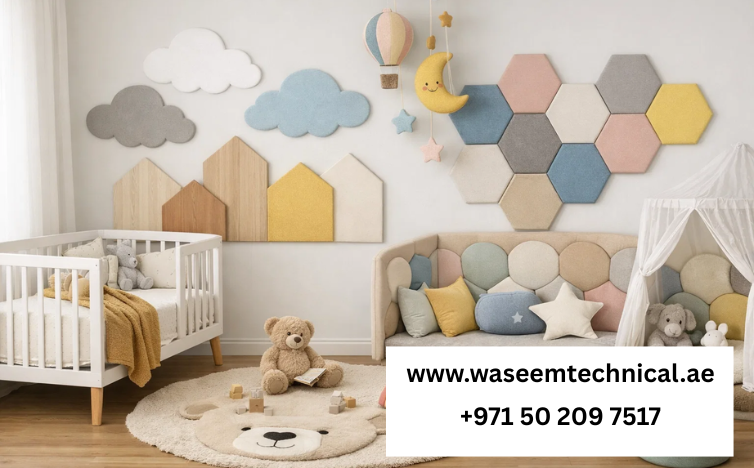
PET acoustic panels — made from recycled polyester fibre — satisfy all of these requirements. They’re the same material used in premium children’s products globally, they produce no harmful emissions, and they’re available in a wide enough range of colours and surface treatments to integrate into nursery and children’s room aesthetics rather than imposing an industrial acoustic appearance. A set of PET panels in soft primary colours or nature-inspired tones, mounted at appropriate height on the wall of a nursery, reads as a design element to a visitor while fundamentally changing the room’s acoustic character.
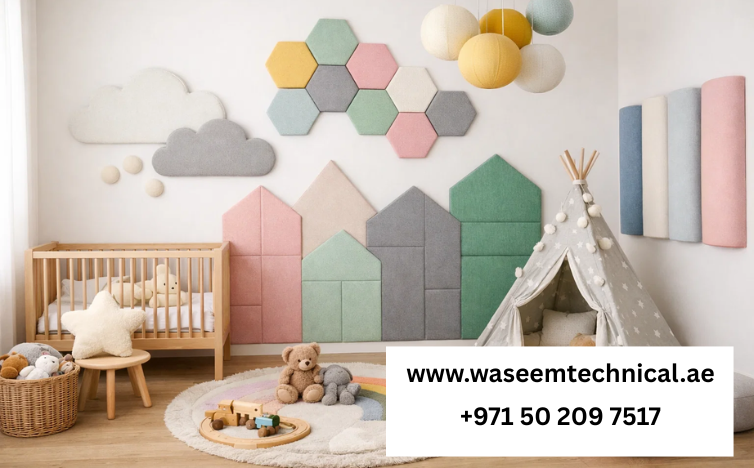
Acoustic stretch fabric panels offer even greater design flexibility for children’s spaces — the fabric surface can be specified in any colour, and the panels can be shaped and sized to fit wall configurations precisely. For nursery operators who have invested in a specific visual brand or aesthetic, stretch fabric panels allow acoustic treatment to become part of that brand rather than a compromise against it.
The Noise That Comes In — and the Noise That Goes Out
Parents with napping infants in Dubai apartments will immediately understand the second acoustic problem that nurseries and kids rooms face: not just what the room does to sound internally, but what passes through the walls and windows in both directions.
The baby is asleep. Someone in the adjacent room turns the television on at normal volume. The door to the nursery has a 6mm gap at the threshold. The sound path is direct and the nap is over. This is not a building defect — it’s a gap management problem. Acoustic door seals close that transmission path completely. An automatic drop seal that engages when the door closes and lifts when it opens — standard in any proper acoustic door specification — eliminates under-door transmission without requiring anyone to remember to place a draught excluder.
The outward direction matters too, particularly in apartment buildings where nurseries operating during daytime hours generate sustained noise that travels to neighbouring units and creates neighbour friction. Mass Loaded Vinyl applied to the shared wall between a nursery and an adjacent apartment adds significant blocking mass without structural work. For nursery operators in mixed-use or residential buildings in Dubai, this is often a non-negotiable intervention for maintaining good neighbour relations and avoiding complaints that affect operating permissions.
Kids Rooms in Dubai Villas — The Floor Impact Problem
Multi-storey Dubai villas — the three and four-bedroom family homes that house the majority of school-age children in communities like Springs, Meadows, Arabian Ranches, and Victory Heights — have a specific acoustic challenge that apartment dwellers don’t face in the same way: floor-to-floor impact transmission.
Children play on upper floors. They run, jump, drag furniture, drop things. All of that impact energy travels through the concrete slab and radiates into the ceiling of the room below. In a family home where a parent is working from home on the ground floor while children play upstairs, or where a younger sibling is napping on the lower floor while older children are active above, this impact transmission creates daily friction that outlasts every creative parenting strategy designed to manage it.
Acoustic floor underlay installed beneath the upper floor surface — under tiles, under timber, under carpet — decouples the floor finish from the structural slab and measurably reduces the impact energy that transfers downward. For Dubai villa families where this is a recognised daily problem, it’s one of the most targeted and effective acoustic interventions available. It doesn’t require structural modification, it works within a standard renovation scope, and the reduction in impact noise it delivers is perceptible on the first day of use.
The Specification Detail That Parents Should Ask About
When commissioning acoustic treatment for a nursery or child’s bedroom in Dubai, one question worth asking any supplier explicitly: are all materials specified safe for prolonged close-contact use by children?
The reason this question matters is that the acoustic treatment industry in the UAE includes products with a range of material safety profiles. Some foam products off-gas volatile organic compounds. Some fiberglass products release fine particulate if the facing is damaged. Neither of these is appropriate in a space where a child sleeps for ten to twelve hours a night with their face close to the wall surface.
Waseem Technical’s acoustic treatment services in Dubai use materials that can be specified to child-safe standards — non-toxic, non-allergenic, and appropriate for the proximity and duration of exposure that characterises a child’s bedroom or nursery environment. For any parent or nursery operator commissioning acoustic treatment, this specification confirmation is worth getting in writing before installation begins. The acoustic performance of a children’s space and the safety of the materials delivering that performance are not separate considerations — they’re the same decision.
Call us: Contact Waseem Technical Soundproofing Expert in Dubai: +971 50 209 7517
The Simplest Way to Think About This
A well-treated nursery or children’s room in Dubai does three things: it protects the child’s sleep from the acoustic chaos outside the room, it creates an internal environment where language and learning happen with acoustic clarity rather than in spite of acoustic confusion, and it ensures the noise children naturally generate doesn’t become a structural problem for everyone else in or near the building.
None of this requires a complete construction project. The right combination of window treatment, door sealing, wall panels, and floor underlay — specified correctly for child safety and Dubai’s climate — transforms the acoustic environment of a children’s space in ways that compound in benefit across every day that child spends in it.