
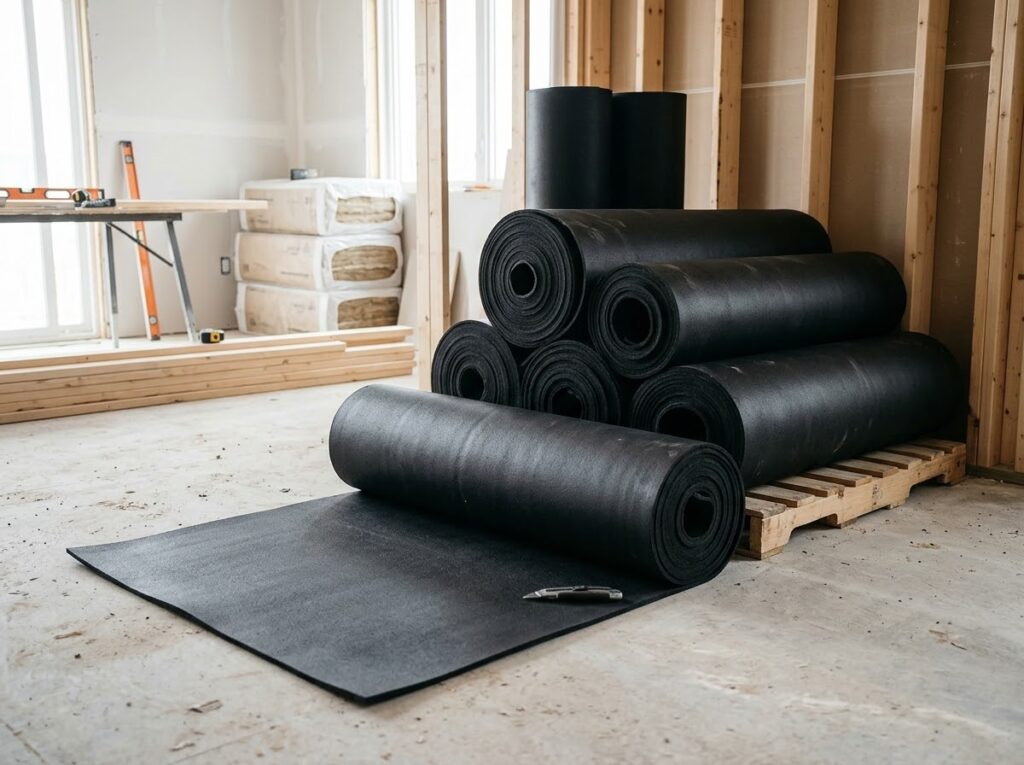
Soundproofing is often discussed as if adding a thick material to a wall is enough to stop unwanted noise. In reality, effective sound isolation depends on how an entire wall, ceiling or floor assembly responds to sound transmission.
For projects in Yaoundé, Cameroon, where residential buildings, offices, hotels, commercial properties and specialized spaces may all have different acoustic requirements, a flexible barrier such as Mass Loaded Vinyl (MLV) can become an important component of a properly designed soundproofing system.
Mass Loaded Vinyl is a dense, flexible membrane designed primarily to reduce the transmission of airborne sound. It adds substantial mass without requiring the same physical thickness as some conventional construction materials. Depending on the specific product, MLV can be incorporated into walls, ceilings, floors, ductwork, machinery enclosures and other areas where additional sound isolation is required.
The important point, however, is that MLV should not be treated as a standalone miracle solution. Its performance depends on the complete assembly, installation quality, surface density, sealing, decoupling and the type of noise being addressed.
What Is Mass Loaded Vinyl?
Mass Loaded Vinyl is commonly referred to as MLV, acoustic barrier, vinyl sound barrier or mass-loaded soundproofing membrane.
It is a dense and flexible sheet material designed to resist the transmission of sound through a building assembly.
Unlike conventional acoustic absorption materials, MLV is primarily used as a sound isolation barrier.
Its basic principle is relatively straightforward:
More mass + flexible construction + proper installation = greater resistance to airborne sound transmission.
Because MLV can provide substantial surface mass while remaining relatively thin and flexible, it can be incorporated into assemblies where adding large amounts of rigid material would be impractical.
For example, commercially available MLV products can be supplied in different surface weights such as approximately 0.5, 1 and 2 lb/ft², with thickness increasing as the weight increases.
Why MLV Is Useful for Soundproofing Projects in Yaoundé
A soundproofing problem can originate in many different places.
Noise may come from:
- Adjacent rooms
- Offices
- Television and entertainment systems
- Restaurants
- Hotel rooms
- Mechanical equipment
- HVAC systems
- Plumbing
- Generators
- Workshops
- Traffic
- Commercial equipment
- Shared ceilings and floors
The transmission path may also vary.
Sound can travel through:
- Walls
- Ceilings
- Floors
- Doors
- Windows
- Ducts
- Pipe penetrations
- Structural connections
- Gaps and cracks
- Flanking paths around the main partition
This is why professional soundproofing begins with identifying the source and transmission path rather than immediately selecting a material.
MLV Adds Mass Without Creating an Extremely Thick Wall
One of the main advantages of MLV is its relatively high mass-to-thickness ratio.
Traditional approaches to increasing sound isolation may involve adding additional layers of heavy board or constructing thicker assemblies.
MLV provides another option.
A thin membrane can be incorporated between layers of a wall or ceiling assembly to increase the barrier’s mass while maintaining a relatively compact construction.
This can be particularly useful when working with:
- Existing walls
- Retrofit projects
- Office partitions
- Hotel renovations
- Apartment renovations
- Ceiling systems
- Floor assemblies
- Mechanical rooms
Some manufacturers specifically describe MLV as a space-efficient solution for retrofits and tight construction spaces.
MLV Is Not the Same as an Acoustic Absorber
This distinction is essential.
An acoustic absorber is designed to reduce reflections inside a room.
Examples include:
- PET acoustic panels
- Fabric acoustic panels
- Wood wool panels
- Acoustic ceiling tiles
- Acoustic baffles
- Acoustic foam
MLV serves a different purpose.
It is primarily a barrier used to reduce sound transmission between spaces.
Therefore, installing MLV behind a wall is not intended to make that room less reverberant. Instead, the objective is to make it more difficult for sound to pass through the building assembly.
A project can require both functions.
For example, a recording room may require:
Sound isolation + internal acoustic treatment
The isolation system keeps unwanted sound from entering or leaving the room, while absorptive treatment manages reflections within the room.
MLV for Wall Soundproofing
Walls are one of the most common applications for Mass Loaded Vinyl.
A typical sound isolation wall may contain multiple layers, such as:
- Existing wall structure
- Stud framing
- Acoustic insulation
- MLV barrier
- Gypsum board
- Resilient or decoupled components
- Acoustic sealant
The exact assembly depends on the construction and required performance.
MLV can be installed as a continuous barrier within the wall system so that the finished construction has greater resistance to airborne sound transmission.
Some MLV systems are specifically designed for use inside gypsum, wood or metal partitions.
Retrofit Soundproofing for Existing Buildings
Not every soundproofing project starts with a new building.
Many projects involve existing:
- Apartments
- Offices
- Hotels
- Clinics
- Restaurants
- Studios
- Meeting rooms
- Residential properties
This creates a different challenge.
The existing wall cannot always be demolished and rebuilt.
A retrofit system may therefore need to achieve better acoustic isolation while minimizing changes to the existing structure.
MLV can be useful in these situations because it can be incorporated into relatively thin wall or ceiling build-ups.
However, the available space, existing construction and final finish must all be considered before specifying the system.
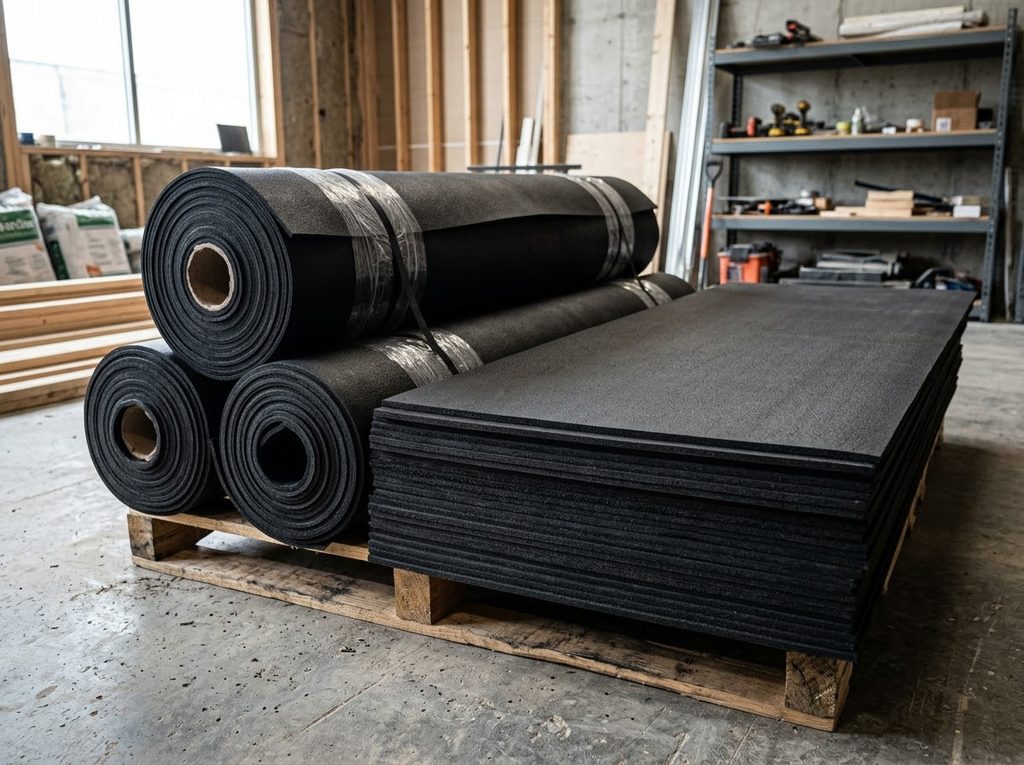
Mass Loaded Vinyl for Ceiling Soundproofing
Noise does not always travel through walls.
In multi-level buildings, sound can travel through ceilings and floor assemblies.
Examples include:
- Footsteps
- Furniture movement
- Voices
- Television
- Music
- Mechanical equipment
- Plumbing
- Building services
MLV can be incorporated into ceiling assemblies to provide an additional barrier layer.
It can also be used above suspended ceiling systems where the construction is designed to support the additional acoustic barrier.
Manufacturers list ceilings among the standard applications for MLV sound barriers.
However, ceiling soundproofing should consider both airborne and impact noise. A membrane alone may not solve impact or structure-borne noise caused by footsteps, machinery or vibration.
MLV for Floor Assemblies
Floors present another acoustic challenge.
In multi-story buildings, sound may move vertically between rooms.
A properly designed floor soundproofing assembly can incorporate MLV as one of several layers.
Depending on the project, the system may include:
- Structural slab
- MLV barrier
- Acoustic underlay
- Resilient layer
- Floating floor
- Finished flooring
The precise arrangement matters.
MLV should not simply be placed under a floor covering without considering the complete floor assembly and the type of noise being addressed.
Manufacturers identify floor assemblies as an important application for MLV barriers.
Dealing With Mechanical and Equipment Noise
Soundproofing is not limited to rooms.
Mechanical equipment can create significant airborne and structure-borne noise.
Potential sources include:
- HVAC equipment
- Pumps
- Generators
- Compressors
- Fans
- Machinery
- Industrial equipment
MLV can be used in some equipment enclosures and barrier assemblies.
Some acoustic barrier manufacturers specifically list machinery enclosures, ductwork, pipe wraps and HVAC equipment among MLV applications.
For vibration-producing equipment, however, additional vibration isolation may be required.
This is where acoustic design becomes more complicated than simply adding a barrier.
MLV Around Ducts and Pipes
Noise can travel through building services.
HVAC ducts and plumbing systems can create pathways between rooms.
A soundproofing system may therefore need to address:
- Ductwork
- Pipes
- Mechanical penetrations
- Service shafts
- Cable openings
- Ventilation paths
MLV can be incorporated into certain duct and pipe treatments to create a barrier around the transmission path.
However, ventilation systems require careful engineering. Blocking or improperly modifying an HVAC system can create functional problems.
Acoustic treatment should therefore be coordinated with mechanical services.
Understanding MLV Weight
Not all MLV is identical.
One of the most important specifications is surface weight.
A published MLV product range, for example, lists:
| Approx. Surface Weight | Approx. Thickness | Example Reported STC |
|---|---|---|
| 0.5 lb/ft² | 1/16 inch | 20 |
| 1 lb/ft² | 1/8 inch | 27 |
| 2 lb/ft² | 1/4 inch | 31 |
These are manufacturer-reported barrier test values and should not be confused with the STC of a complete building wall or ceiling.
Another technical sheet reports 0.6, 1 and 2 lb/ft² products with STC values of 22, 26 and 32 respectively. Again, these figures apply to the tested barrier products and do not automatically represent the final rating of an installed building assembly.
This is why simply asking for “the strongest MLV” is not always enough.
The correct specification depends on:
- Noise type
- Existing construction
- Available space
- Required performance
- Weight limitations
- Installation method
- Fire requirements
- Budget
Why Sealing Is Critical
Even a high-performance barrier can be undermined by small gaps.
Sound can exploit openings around:
- Electrical boxes
- Pipes
- Ducts
- Doors
- Windows
- Wall junctions
- Ceiling connections
- Floor penetrations
A soundproofing membrane should therefore be installed continuously wherever possible, with joints and penetrations properly detailed.
Some manufacturers specifically emphasize continuous installation and properly sealed joints for MLV systems.
This is one of the reasons professional installation matters.
The material itself is only one part of the system.
Decoupling and MLV Work Together
Mass is important, but sound isolation can involve more than mass.
A high-performance wall may combine:
Mass + cavity absorption + decoupling + airtightness + damping
For example:
- MLV adds barrier mass.
- Acoustic insulation reduces energy within the cavity.
- Resilient channels or clips can reduce structural coupling.
- Multiple board layers add additional mass.
- Acoustic sealant controls air leakage.
- Proper detailing reduces flanking paths.
This layered approach is generally more effective than relying on one material to solve every acoustic problem.
Airborne Noise vs Structure-Borne Noise
Before specifying MLV, the type of noise should be identified.
Airborne Noise
Airborne sound travels through the air before exciting a wall, ceiling or floor.
Examples include:
- Speech
- Television
- Music
- Conversations
- General room noise
MLV can be useful as part of an assembly designed to reduce airborne transmission.
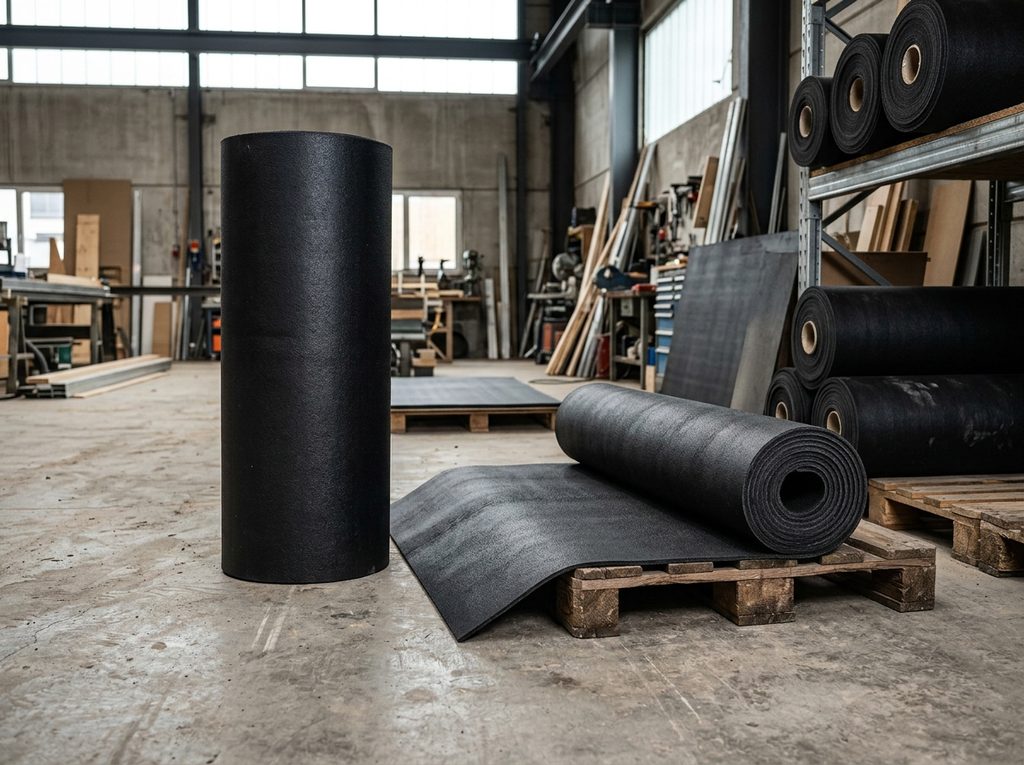
Structure-Borne Noise
Structure-borne sound travels through building elements.
Examples include:
- Footsteps
- Machinery vibration
- Impact noise
- Structural vibration
MLV may be part of a broader solution, but structure-borne problems often require decoupling or vibration isolation.
This distinction can prevent incorrect material selection.
Where MLV Can Be Used in Yaoundé
| Project Type | Potential Application |
|---|---|
| Apartments | Shared walls and ceilings |
| Offices | Privacy between workspaces |
| Hotels | Room-to-room sound isolation |
| Recording spaces | Wall and ceiling assemblies |
| Home theatres | Dedicated sound isolation |
| Restaurants | Mechanical and partition noise control |
| Clinics | Privacy between rooms |
| Commercial buildings | Partition sound isolation |
| Industrial spaces | Equipment and machinery barriers |
| Multi-story buildings | Floor and ceiling assemblies |
The correct system will vary according to the building and acoustic objective.
Common MLV Soundproofing Mistakes
1. Treating MLV as a Complete Soundproofing System
MLV is a barrier layer, not necessarily the complete solution.
2. Leaving Gaps Between Sheets
Unsealed gaps can create weak points in the barrier.
3. Ignoring Doors and Windows
A highly treated wall can still perform poorly if the door or window is acoustically weak.
4. Forgetting Flanking Paths
Sound may travel around rather than directly through the treated wall.
5. Using Absorption Instead of Isolation
Acoustic panels may make a room sound quieter internally without significantly stopping sound from passing through a wall.
6. Ignoring Structure-Borne Noise
MLV alone may not address vibration transmitted through the building structure.
7. Choosing MLV by Thickness Alone
Surface weight, construction, test data and installation all matter.
Professional MLV Installation
A professional soundproofing project should begin with an assessment rather than immediate installation.
The process can include:
Step 1: Identify the Noise Source
Determine where the unwanted sound originates.
Step 2: Identify the Transmission Path
Determine whether sound is travelling through a wall, floor, ceiling, duct, door or another route.
Step 3: Inspect Existing Construction
Understand what materials are already present.
Step 4: Develop the Acoustic Assembly
Select the appropriate combination of barrier, insulation, decoupling and finishing materials.
Step 5: Detail Penetrations and Joints
Make sure the soundproofing layer remains continuous.
Step 6: Install the System
Install MLV and supporting acoustic components according to the design.
Step 7: Complete the Finish
Install the final wall, ceiling or floor finish without compromising the acoustic barrier.
MLV Should Be Part of a Designed System
The most important concept when using Mass Loaded Vinyl is that the final acoustic result belongs to the assembly, not simply to the membrane.
For example, published testing can show an MLV barrier with an STC value in the 20s or low 30s, while complete wall systems incorporating MLV, framing, insulation and multiple layers can achieve substantially different results.
Therefore, an acoustic consultant or soundproofing specialist should evaluate the entire construction.
The question should not simply be:
“Which MLV should we install?”
A better question is:
“What complete sound isolation system will address this particular noise path?”
Building Better Acoustic Spaces in Yaoundé
A successful soundproofing project combines material selection with proper design.
MLV can be a valuable component because it provides a dense, flexible barrier that can be incorporated into walls, floors, ceilings and specialized enclosures without requiring excessive thickness.
But the membrane works best when combined with the right supporting measures.
Depending on the project, this may include:
- Acoustic insulation
- Decoupled framing
- Resilient channels
- Acoustic sealants
- Multiple board layers
- Floating floors
- Acoustic doors
- Soundproof windows
- Vibration isolation
- Duct treatment
The final system should be designed around the actual noise problem.
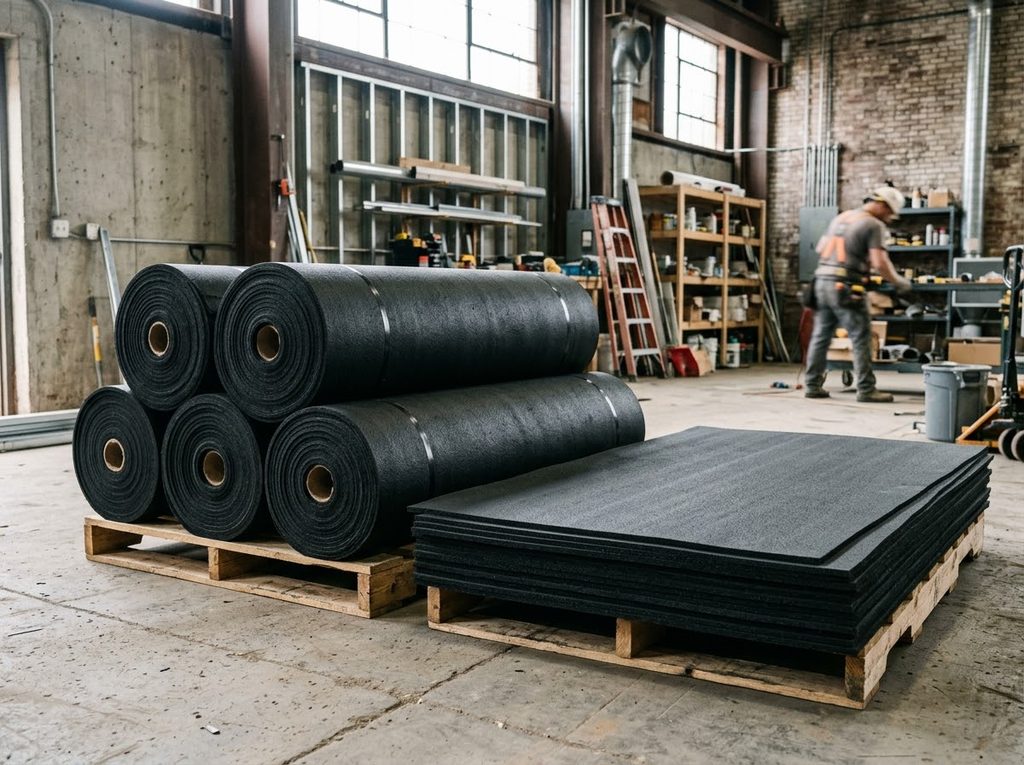
Final Thoughts
Mass Loaded Vinyl in Yaoundé, Cameroon can provide an effective component for modern sound isolation systems where additional mass is required without creating an excessively thick construction.
Its applications extend across walls, floors, ceilings, mechanical areas, ducts and equipment enclosures. However, its performance should always be considered within the context of the complete assembly.
Published technical data demonstrates that MLV performance varies with surface weight, while complete wall and ceiling performance depends on the entire construction.
For residential, commercial, hospitality, office and specialized acoustic projects in Yaoundé, a properly planned MLV system can help address airborne sound transmission while fitting into modern construction and retrofit requirements.
The key is not simply adding a heavy membrane.
The key is designing the complete soundproofing system around the noise source, transmission path and performance requirement.
Frequently Asked Questions
What is Mass Loaded Vinyl used for?
MLV is primarily used as a dense, flexible sound barrier to reduce airborne sound transmission through walls, ceilings, floors and other building assemblies.
Is MLV the same as acoustic foam?
No. Acoustic foam is primarily used for sound absorption inside a room, while MLV is primarily used for sound isolation between spaces.
Can MLV be used on walls?
Yes. MLV can be incorporated into wall assemblies, including stud partitions and retrofit soundproofing systems.
Can MLV be installed on ceilings?
Yes. It can be incorporated into ceiling assemblies where the structure and installation method are suitable.
Can MLV be used under flooring?
Yes. MLV can form part of floor and underlayment assemblies, although the complete floor construction must be designed according to the type of noise being addressed.
Does thicker MLV always mean better soundproofing?
Not necessarily. Surface weight, installation, wall construction, decoupling, sealing and the complete assembly all affect the final result.
Does MLV absorb sound?
Its primary function is sound isolation rather than room absorption. It acts as a dense barrier that resists sound transmission.
Can MLV stop low-frequency noise?
MLV can contribute to controlling airborne sound across a range of frequencies, but low-frequency and vibration problems can require additional measures such as decoupling and vibration isolation.
Can MLV be used around ducts?
Yes. Certain MLV acoustic barriers are specifically used for duct and pipe applications, but the installation must be compatible with the mechanical system.
Is professional installation necessary?
For straightforward applications, MLV can be relatively easy to handle and cut. However, professional acoustic design and installation become especially important when the project has strict sound isolation targets, multiple transmission paths or complex building services.