
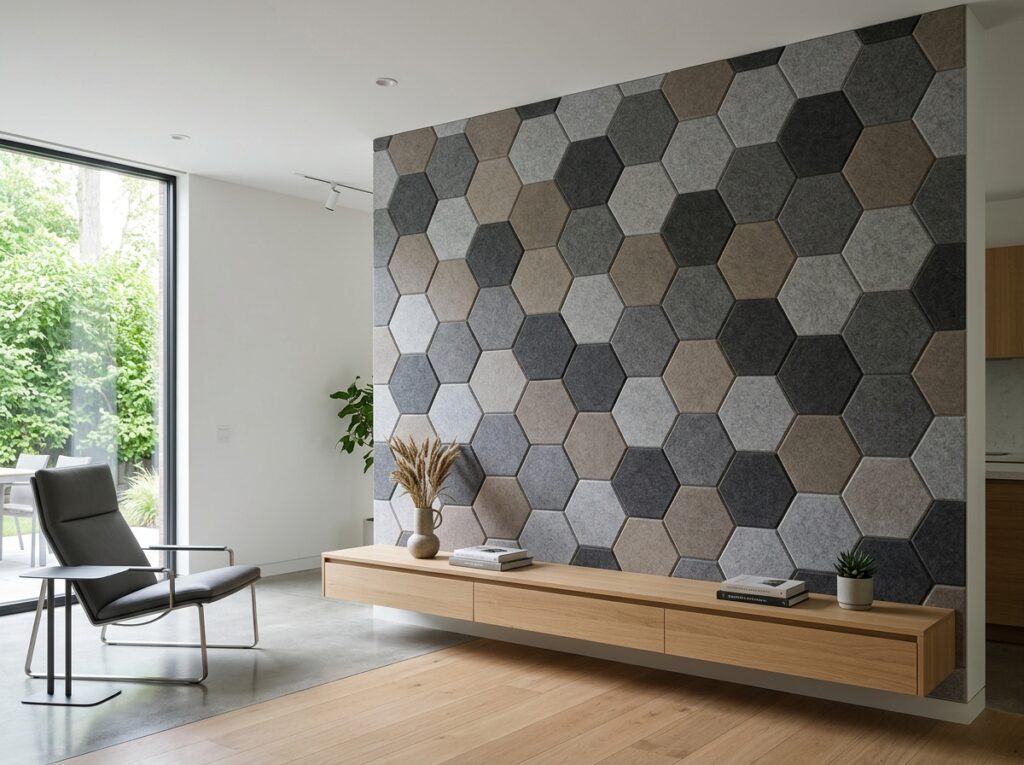
Modern interiors increasingly need to balance visual design with acoustic comfort. An office may have an attractive open layout, a restaurant may feature glass and hard flooring, or a hotel may use polished architectural surfaces throughout its public areas. While these materials can create a sophisticated appearance, they can also produce excessive sound reflection.
When voices, conversations, footsteps, and background sounds continue reflecting from hard surfaces, the room can become acoustically uncomfortable.
Acoustic PET panels provide a flexible way to introduce sound absorption into these environments. Manufactured from polyester fibre, with many products incorporating recycled PET content, these panels can be used on walls, ceilings, as suspended elements, and as custom acoustic features. Their primary purpose is to absorb reflected sound and help manage reverberation rather than provide conventional soundproofing between rooms.
For offices, hotels, restaurants, educational facilities, meeting rooms, commercial interiors, and other spaces in Port Louis, Mauritius, professionally designed PET acoustic treatment can combine acoustic performance with a clean architectural appearance.
When a Beautiful Room Sounds Uncomfortable
Acoustic problems are not always obvious when a room is being designed.
Architectural materials such as:
- Glass
- Concrete
- Stone
- Ceramic tile
- Metal
- Painted gypsum board
- Hard timber
can all contribute to sound reflection.
If too many reflective surfaces are present and there is not enough sound absorption, sound can remain active in the room for too long.
This can make conversations harder to follow, particularly when several people are speaking simultaneously.
The problem is especially noticeable in:
- Open-plan offices
- Restaurants
- Conference rooms
- Hotel lounges
- Reception areas
- Classrooms
- Training rooms
- Large residential spaces
PET acoustic panels provide an additional absorptive surface that can be strategically introduced into these interiors.
What Makes PET Panels Different?
PET acoustic panels are typically manufactured from polyester fibres formed into a dense felt-like material.
Many products use post-consumer recycled PET as part of their fibre composition. For example, published specifications from different manufacturers show products containing approximately 60%, 65%, or at least 75% recycled polyester, depending on the specific system.
The material can be lightweight while still providing useful sound absorption.
More importantly, PET felt is highly adaptable from a design perspective.
Panels can be:
- Flat
- Fluted
- Perforated
- Geometric
- Layered
- Printed
- CNC-cut
- Suspended
- Wall-mounted
- Ceiling-mounted
This allows acoustic treatment to become part of the interior architecture rather than looking like an added technical element.
PET Acoustic Panels and Room Acoustics
The primary purpose of PET acoustic panels is sound absorption.
When sound waves reach a suitable porous acoustic material, some of the sound energy enters the material and is dissipated rather than being reflected directly back into the room.
This can help reduce:
- Echo
- Reverberation
- Excessive reflections
- Background sound buildup
- Speech interference
The result can be a more controlled acoustic environment.
However, acoustic performance is not determined by the material name alone.
Thickness, density, mounting method, air gap, surface coverage, and panel configuration all influence the result.
Published testing illustrates this clearly. One PET felt product reports NRC values ranging from 0.40 for a 9 mm panel to 0.75 for a 24 mm panel, with higher values possible when an air gap is introduced.
Why the Air Gap Matters
One of the most useful considerations when designing PET acoustic treatment is the space between the panel and the wall.
A panel installed directly against a surface can behave differently from the same panel installed with an air cavity behind it.
For example, published data for one PET felt system show a 24 mm panel with an NRC of 0.75 when installed in one configuration, increasing to 0.85 with a 25 mm air gap and 0.90 with a 50 mm air gap.
This does not mean that every PET panel will produce the same results.
It demonstrates why the complete installation configuration matters.
Professional acoustic design should therefore consider the panel, substrate, air cavity, room geometry, and desired frequency range together.
Designing Quieter Open-Plan Offices in Port Louis
Open offices create an interesting acoustic challenge.
Removing walls creates flexibility and collaboration, but it can also allow conversations and other sounds to spread across large areas.
PET acoustic treatment can be used to divide an open office acoustically without necessarily constructing permanent walls.
Possible applications include:
- Wall panels
- Ceiling panels
- Hanging baffles
- Desk dividers
- Freestanding screens
- Acoustic room dividers
- Decorative ceiling elements
Some PET systems are specifically designed for wall and ceiling applications, while others can be used as suspended or freestanding acoustic elements.
This makes PET particularly useful when an office needs both acoustic control and spatial flexibility.
Meeting Rooms and Conference Areas
Meeting rooms need good speech intelligibility.
When multiple people are sitting around a table, sound reflections from walls and ceilings can interfere with speech.
Strategically positioned PET panels can provide absorption around the room.
A meeting-room design might incorporate:
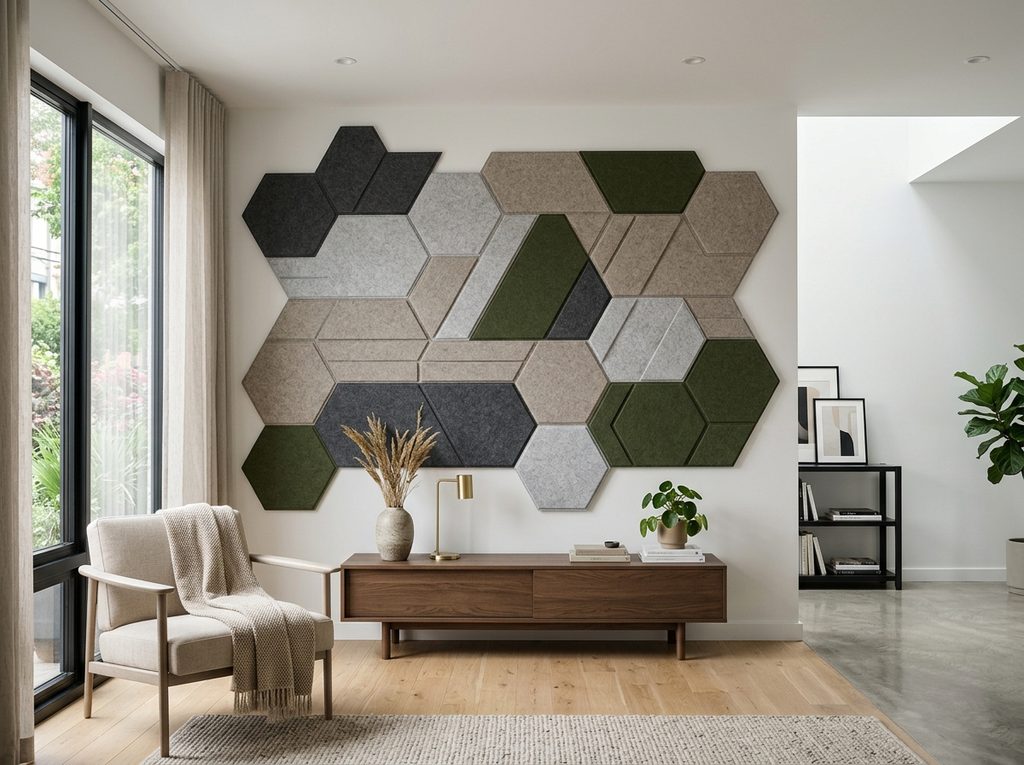
- A large PET feature wall
- Side-wall acoustic panels
- Ceiling-mounted PET elements
- Decorative geometric panels
- Acoustic treatment behind presentation areas
The goal is not necessarily to cover every surface.
Instead, treatment can be concentrated where it contributes most effectively to controlling reflections.
PET Panels for Hospitality Interiors
Restaurants, cafés, hotel lounges, reception areas, and other hospitality environments often use hard architectural finishes because they are visually attractive and practical.
But these same surfaces can create highly reflective acoustic environments.
PET panels offer designers a way to introduce absorption without abandoning the desired aesthetic.
A restaurant, for example, could use coloured PET panels as a decorative ceiling pattern.
A hotel could use custom-shaped panels behind reception.
A lounge could use acoustic wall art to create both visual interest and sound absorption.
PET systems can also be customized in shapes, patterns, sizes, and colours depending on the manufacturer.
Creating Acoustic Ceilings
Walls are not the only place where PET panels can be used.
Ceilings can provide a significant opportunity for acoustic treatment, particularly in large rooms where wall space is limited.
PET ceiling systems can include:
- Flat ceiling panels
- Suspended clouds
- Baffles
- Hanging shapes
- Modular acoustic elements
Some products are specifically designed for direct ceiling installation, while others are suspended from the structure.
Ceiling treatment can be particularly useful in open offices, restaurants, educational spaces, and large commercial interiors.
It can also introduce a visual rhythm into otherwise plain ceiling surfaces.
Acoustic PET Panels for Educational Spaces
Classrooms and training rooms depend heavily on clear communication.
When a teacher or presenter speaks, students need to distinguish the direct voice from reflected sound.
Excessive reverberation can make this more difficult.
PET panels can be strategically installed on walls and ceilings to introduce additional absorption.
Potential applications include:
- Classrooms
- Training rooms
- Libraries
- Study spaces
- Lecture rooms
- Activity rooms
The amount of treatment should be determined by the room dimensions, existing finishes, occupancy, and acoustic requirements.
PET Panels Are Not Conventional Soundproofing
This distinction should always be made clear.
PET acoustic panels primarily treat sound inside a room.
They are not a substitute for a soundproof wall assembly.
For example, if a conference room has excessive echo, PET panels can help control reflected sound.
If voices are passing through a partition from an adjacent room, the solution may instead require:
- Additional wall mass
- Acoustic insulation
- Decoupled framing
- Resilient systems
- Acoustic doors
- Acoustic glazing
- Sealing of gaps
- Sound isolation barriers
PET panels and soundproofing systems solve different acoustic problems.
Custom Acoustic Design With PET Felt
One of the strongest advantages of PET felt is its design flexibility.
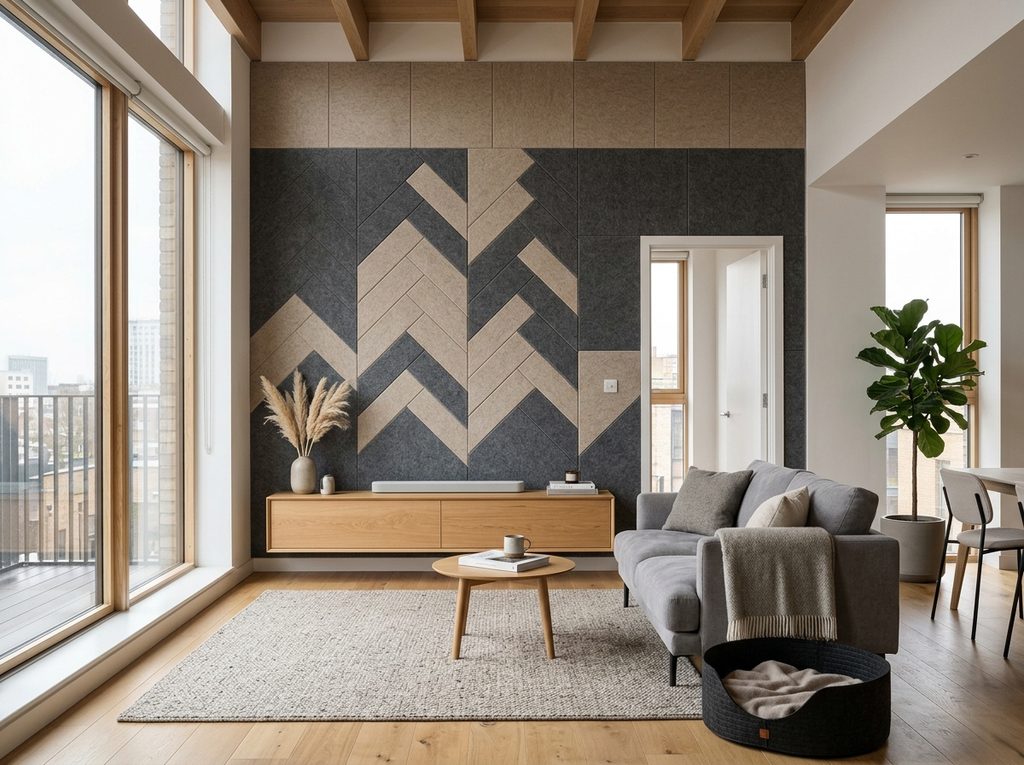
Panels can be shaped into architectural patterns instead of remaining simple rectangular boards.
Depending on the system, options can include:
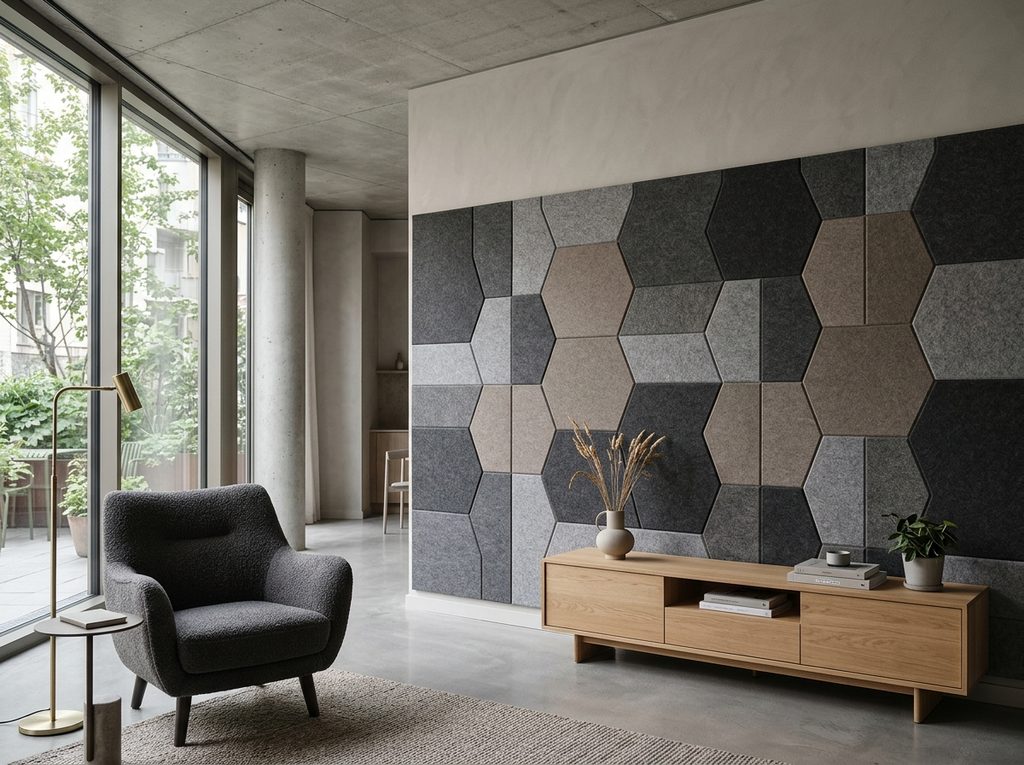
- Geometric patterns
- Curved shapes
- Fluted surfaces
- Perforated designs
- Layered forms
- Logos
- Decorative artwork
- Custom colours
Some manufacturers specifically offer PET panels that can be layered, bevelled, printed, etched, shaped, or moulded.
This means an acoustic treatment can become part of a company’s visual identity.
For a reception area, a branded acoustic wall can combine:
Branding + decoration + sound absorption
rather than requiring three separate interior elements.
Sustainability and Recycled PET
Another reason PET acoustic panels attract attention is their potential use of recycled material.
PET bottles can be processed into polyester fibres that are subsequently formed into acoustic products.
Recent research has also investigated recycled PET fibre and hybrid PET-based panels for acoustic and thermal applications, showing that material thickness and density can strongly influence sound absorption.
Commercial products vary considerably in their recycled content.
For example, published product specifications include systems with 60% certified post-consumer content and others specifying a minimum of 75% recycled polyester fibre.
For projects with sustainability requirements, the exact recycled content and environmental documentation should be checked for the selected product.
Choosing the Correct PET Panel Thickness
PET panels are available in multiple thicknesses.
Published product ranges include 9 mm, 12 mm, 18 mm, and 24 mm options, among others.
Thickness can affect acoustic performance, but it should not be considered in isolation.
The acoustic result also depends on:
- Panel density
- Room size
- Frequency range
- Coverage percentage
- Mounting method
- Air gap
- Additional backing
- Existing room surfaces
A thicker panel is not automatically the correct choice for every room.
The specification should be based on the acoustic objective.
PET Panels for Creative Workspaces
Creative offices and collaborative environments often benefit from acoustic zoning.
Different areas can have different functions:
| Area | Acoustic Approach |
|---|---|
| Individual workstations | PET screens or dividers |
| Collaboration zone | Ceiling or wall absorption |
| Meeting area | Wall and ceiling treatment |
| Presentation area | Speech-focused absorption |
| Breakout space | Decorative acoustic elements |
| Reception | Feature acoustic wall |
This allows acoustic treatment to support the way people actually use the space.
Factors to Check Before Installation
Before specifying PET acoustic panels for a project in Port Louis, several questions should be considered.
What is the actual acoustic problem?
Is it echo, reverberation, speech clarity, or sound transmission?
How large is the room?
Room volume strongly influences reverberation.
What surfaces are already present?
Glass, concrete, tile, and other hard finishes can increase reflection.
How much absorption is required?
Installing too little treatment may not solve the problem, while excessive treatment can unnecessarily change the character of the room.
Where will the panels be installed?
Walls and ceilings can produce different results.
Is there an air gap?
The distance between the panel and substrate can influence absorption.
Are there fire requirements?
Fire performance must be verified for the specific product. Different PET products have different classifications. For example, published products range from ASTM E84 Class A systems to EN 13501-1 Class B classifications.
Professional PET Acoustic Panel Installation in Port Louis
Installing acoustic panels is more than attaching boards to a wall.
A professional acoustic service can include:
- Site assessment
- Room measurement
- Identification of acoustic problems
- Surface analysis
- Acoustic treatment planning
- PET panel selection
- Layout development
- Colour and design coordination
- Wall or ceiling preparation
- Professional installation
- Final inspection
This process helps ensure that the acoustic treatment is selected according to the actual requirements of the space.
Where Acoustic PET Panels Can Be Used
PET acoustic systems can be adapted to a wide range of interiors in Port Louis and surrounding commercial environments.
| Space | Possible PET Application |
|---|---|
| Offices | Wall panels, ceiling treatment, partitions |
| Boardrooms | Speech-focused wall treatment |
| Restaurants | Ceiling elements and decorative walls |
| Hotels | Lobby and lounge treatment |
| Classrooms | Wall and ceiling absorption |
| Libraries | Reverberation control |
| Reception areas | Branded acoustic feature walls |
| Creative studios | Wall and ceiling treatment |
| Training rooms | Speech clarity improvement |
| Residential interiors | Decorative acoustic treatment |
Each project should be assessed individually because acoustic requirements vary considerably between spaces.
Combining PET Panels With Other Acoustic Systems
PET panels do not have to work alone.
A complete acoustic project may combine several different systems according to the problem.
For example:
PET panels can control room reverberation.
Acoustic ceilings can provide additional overhead absorption.
Acoustic doors can help reduce transmission through door openings.
Soundproof walls can address room-to-room transmission.
Acoustic glazing can improve isolation through windows.
Floor systems can help address impact-related noise.
This approach separates the different acoustic problems and assigns the appropriate solution to each one.
Why Professional Acoustic Planning Matters
The same PET panel can perform differently depending on how it is installed.
Published technical data demonstrate that panel thickness and air gaps can substantially change absorption performance.
Therefore, choosing a panel based only on its appearance is not enough.
A professional acoustic design considers:
- Room geometry
- Existing construction
- Noise sources
- Reverberation
- Occupancy
- Surface finishes
- Panel coverage
- Mounting configuration
- Required acoustic performance
This results in a system designed around the room rather than a generic product specification.
Final Thoughts
Acoustic PET panels provide a practical way to bring sound absorption and architectural flexibility into modern interiors.
For offices, hotels, restaurants, classrooms, meeting rooms, reception areas, and creative spaces in Port Louis, Mauritius, they can help reduce excessive reflections while giving designers considerable freedom over colour, shape, pattern, and installation.
Their recycled-material potential adds another dimension to the material, while their lightweight construction makes them suitable for many wall and ceiling applications. Published commercial systems demonstrate that PET products can achieve substantial sound absorption when correctly specified and installed.
The important point is that PET panels should not be treated as generic decorative boards.
Their acoustic performance depends on the complete system — including thickness, density, coverage, mounting method, air gap, and room conditions.
With professional acoustic planning, PET panels can become much more than a wall finish. They can become an integrated part of a comfortable, functional, and visually distinctive interior.
Frequently Asked Questions
What are acoustic PET panels?
Acoustic PET panels are sound-absorbing panels manufactured from polyester fibre, often incorporating recycled PET material. They are primarily used to control reflected sound and reverberation inside rooms.
Are PET acoustic panels soundproof?
Not in the conventional sense. PET panels primarily absorb sound within a room. They should not be treated as a replacement for a soundproof wall, ceiling, floor, door, or glazing system.
Can PET panels be installed on ceilings?
Yes. Depending on the product, PET panels can be installed directly on ceilings or suspended as clouds and baffles.
Are PET acoustic panels environmentally friendly?
Many products use recycled PET content, but the exact percentage varies by manufacturer. Published examples include products with 60%, 65%, and 75% or more recycled polyester content.
Can PET panels be customized?
Yes. Certain PET systems can be cut, shaped, layered, printed, etched, or moulded into custom designs.
Do thicker PET panels absorb more sound?
Thickness is an important factor, but acoustic performance also depends on density, mounting, air gap, coverage, and frequency. Therefore, thickness alone does not determine the final performance.
Can PET panels improve speech clarity?
Yes. By reducing reflected sound and reverberation, properly designed PET treatment can help create conditions where speech is easier to understand.
Can PET panels be used in restaurants?
Yes. Restaurants can use PET wall panels, ceiling systems, acoustic screens, and decorative elements to introduce sound absorption into spaces containing large numbers of people and reflective surfaces.
What is the difference between PET panels and MLV?
PET panels are primarily used to absorb sound inside a room, while Mass Loaded Vinyl is primarily used as a sound-isolation barrier within building assemblies. They address different acoustic problems.
Should PET panels be professionally installed?
For commercial and demanding acoustic projects, professional assessment and installation are recommended. Correct panel placement, coverage, thickness, mounting, and air gaps can significantly affect the final acoustic result.