
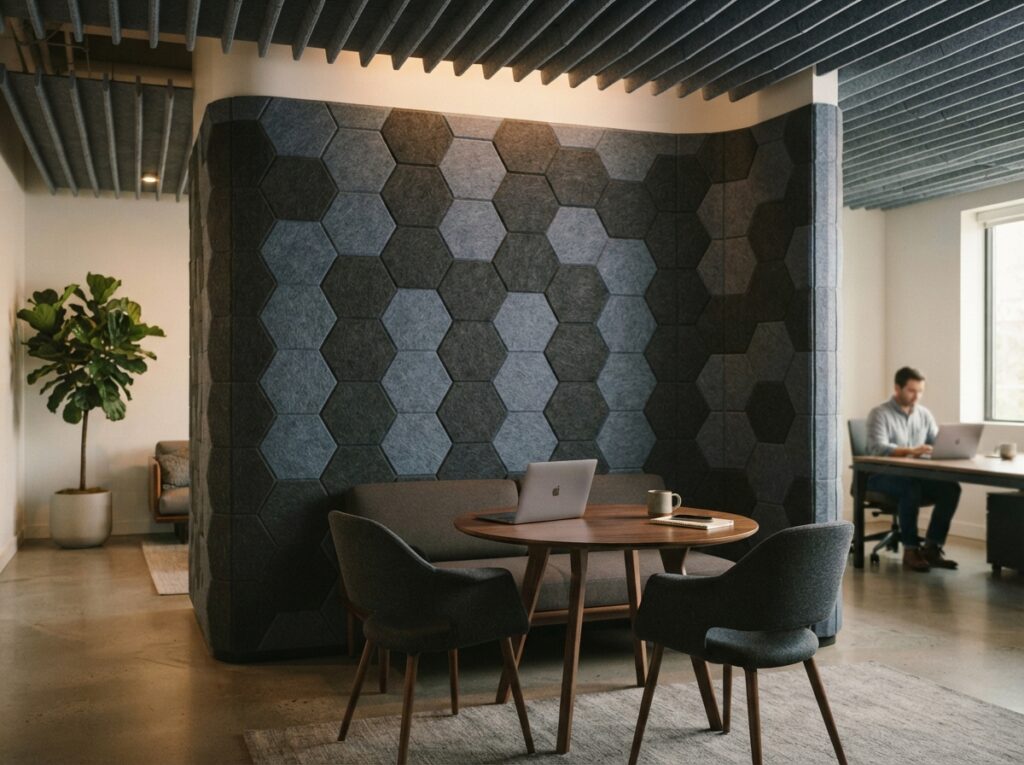
Modern interiors need to perform as well as they look.
An office can have a sophisticated layout and still feel distracting when conversations echo across the room. A restaurant can have beautiful finishes but become uncomfortable when background noise builds up. A hotel lobby can look impressive while voices and footsteps continue reflecting from hard surfaces.
For projects in Conakry, Guinea, acoustic PET panels provide a practical way to improve these interior conditions while offering considerable freedom in colour, shape, layout and installation.
Made from polyester, often using recycled PET fibres, these panels are designed primarily for sound absorption. Their porous structure helps absorb reflected sound and reduce reverberation rather than simply reflecting sound back into the room. Current PET acoustic systems are available in different thicknesses and configurations for walls, ceilings, baffles, screens and custom interior features.
This combination of acoustic performance and design flexibility makes PET panels particularly useful when acoustic treatment needs to become part of the interior architecture rather than looking like an added technical component.
What Are Acoustic PET Panels?
PET acoustic panels are made from polyester fibres formed into a semi-rigid acoustic board.
PET stands for polyethylene terephthalate, the same polymer commonly used in plastic beverage bottles. Many acoustic PET products use recycled PET as part of their material composition.
During manufacturing, the polyester fibres are processed into a dense felt-like panel with an open structure capable of absorbing sound energy.
The result is a lightweight acoustic material that can be:
- Installed on walls
- Suspended from ceilings
- Used as acoustic baffles
- Fabricated into screens
- CNC-cut into patterns
- Formed into decorative shapes
- Printed with graphics
- Layered into three-dimensional designs
Some current PET systems specifically highlight recycled content, CNC fabrication and custom colours as major design features.
Why Acoustic Treatment Matters in Conakry
Interior acoustic problems can occur in almost any modern building.
Large areas of glass, concrete, plaster, stone, tile and other hard materials reflect sound strongly.
When there is not enough absorption, sound can continue bouncing around the room.
This can lead to:
- Excessive echo
- Poor speech clarity
- Distracting background noise
- Increased reverberation
- Reduced concentration
- Uncomfortable meeting environments
- A louder-feeling room
The solution is not always to make the room completely quiet.
Instead, the goal is to create an appropriate acoustic balance.
PET panels can contribute to that balance by adding absorptive surfaces to strategic locations.
PET Panels Are Designed for Sound Absorption
One of the most important things to understand about PET acoustic panels is what they are designed to do.
Their primary purpose is sound absorption inside a room.
They can help reduce:
- Reflected sound
- Echo
- Reverberation
- Excessive room reflections
They are not automatically a complete soundproofing system.
For example, if a client wants to stop sound travelling from one office into another, the solution may require a sound-isolation system involving wall construction, insulation, barriers, decoupling and acoustic sealing.
PET panels address a different problem.
They improve the acoustic environment inside the space.
This distinction helps ensure that the correct acoustic solution is specified for each project.
The Acoustic Performance Depends on the Installation
There is no single acoustic performance value that applies to every PET panel.
Performance can change according to:
- Thickness
- Density
- Panel construction
- Surface coverage
- Mounting method
- Air gap
- Room geometry
- Frequency
For example, one current PET acoustic panel reference lists an NRC range of approximately 0.40–0.90 depending on thickness and installation. Another PET system lists products reaching NRC values around 0.70–0.90.
This is why published acoustic data should always be checked for the specific panel and mounting configuration being considered.
A 9 mm panel mounted directly to a wall should not automatically be assumed to perform like a thicker panel installed with an air cavity.
Why PET Is Useful for Open-Plan Offices
Open-plan offices create a particular acoustic challenge.
There may be dozens of conversations happening within the same space.
Even if each individual conversation is relatively quiet, the combined sound can create a constant background level.
PET panels can be positioned strategically around:
- Workstations
- Collaboration areas
- Meeting zones
- Reception areas
- Phone booths
- Breakout spaces
- Circulation areas
Instead of creating permanent walls, acoustic treatment can help establish quieter zones within an open floor plan.
This allows designers to maintain the visual openness of the office while improving acoustic comfort.
Acoustic PET Panels for Meeting Rooms
Meeting rooms depend heavily on speech clarity.
When sound reflects repeatedly from walls and ceilings, voices can become less distinct.
This can be particularly noticeable during:
- Team meetings
- Presentations
- Video conferences
- Training sessions
- Client discussions
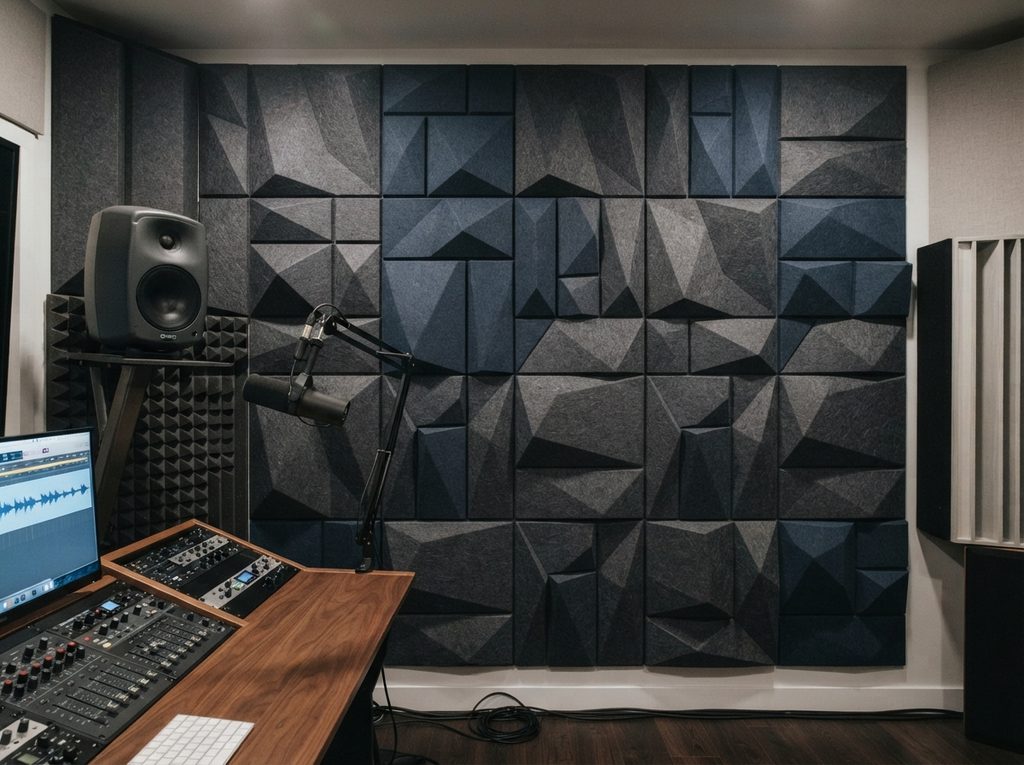
PET panels can be installed on selected wall areas or incorporated into ceiling treatments.
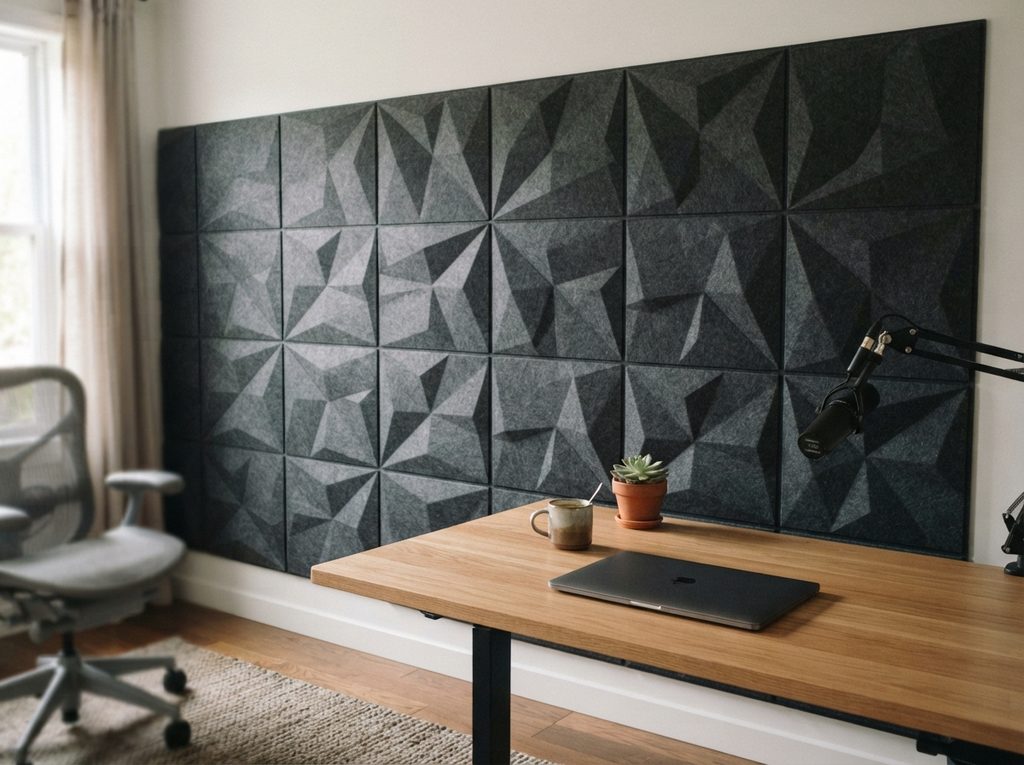
A patterned wall panel behind a meeting table can also become part of the visual identity of the room.
This allows acoustic treatment to perform two roles:
Acoustic improvement + interior design
Custom Shapes Make PET Different
One of the major advantages of PET is its fabrication flexibility.
Unlike some rigid acoustic products, PET felt can be processed into numerous shapes.
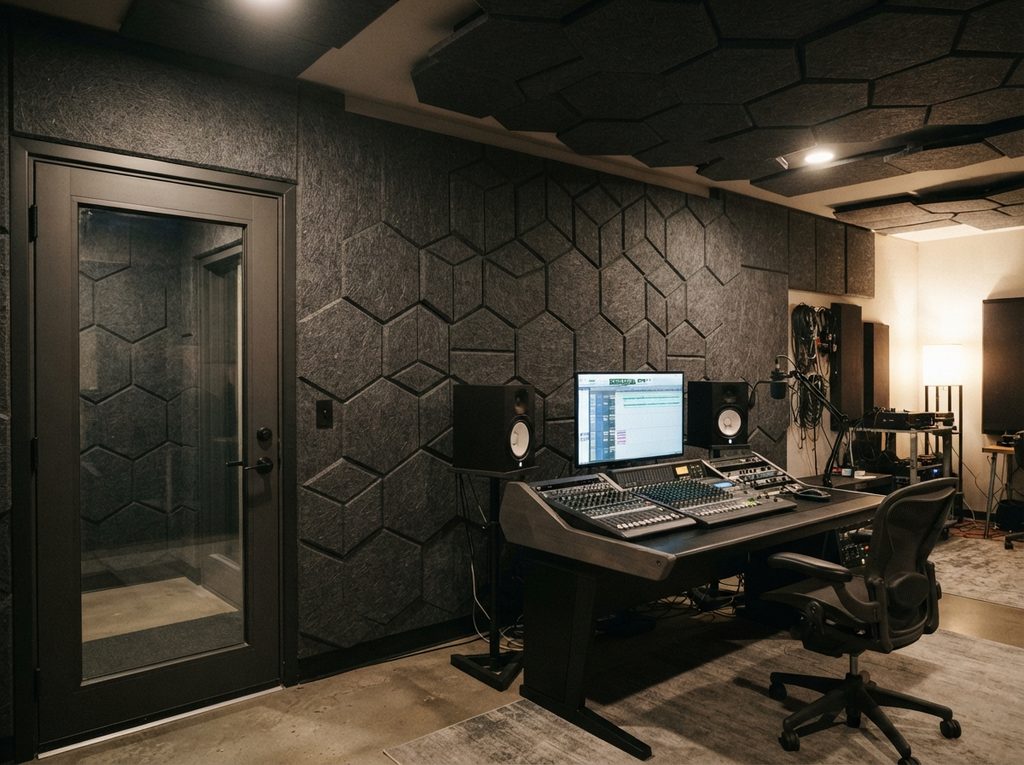
CNC cutting can create:
- Geometric patterns
- Curved forms
- Linear designs
- Logos
- Abstract artwork
- Decorative screens
- Repeating patterns
Manufacturers and suppliers currently offer CNC-cut PET products and custom-shaped acoustic elements for offices, hospitality and public interiors.
This makes PET particularly useful when the architect does not want a conventional rectangular acoustic panel.
Creating Branded Acoustic Walls
Corporate interiors often need to communicate a company’s identity.
Instead of placing a plain acoustic panel on the wall, PET can be cut into custom forms that reflect the company’s branding.
Possible applications include:
- Company logos
- Geometric brand patterns
- Decorative graphics
- Wayfinding elements
- Feature-wall designs
Printed PET panels can also combine acoustic treatment with visual graphics. Current custom printed PET systems are marketed specifically for branding, artwork and wayfinding in offices, education, hospitality and public environments.
This turns an acoustic requirement into a design opportunity.
PET Panels for Hotel Interiors
Hotels need acoustic comfort in many different areas.
Potential applications include:
Hotel Lobbies
Large open spaces can contain extensive hard surfaces that reflect sound.
PET wall panels or suspended acoustic elements can help control the acoustic environment.
Corridors
Acoustic treatment can be integrated into selected wall sections without overwhelming the architecture.
Lounge Areas
Decorative PET elements can help create comfortable seating zones.
Meeting Areas
Panels can support speech clarity in conference and business spaces.
Hospitality interiors often require acoustic materials that look refined rather than industrial, making colour and custom fabrication particularly valuable.
Restaurants and Cafés
Restaurant noise can build rapidly as occupancy increases.
People talk louder when the surrounding environment becomes loud, which can further increase the overall sound level.
PET panels can be used on:
- Walls
- Ceilings
- Dining zones
- Private dining spaces
- Bar areas
- Waiting areas
Instead of covering an entire restaurant with acoustic material, designers can create carefully positioned acoustic zones.
This allows the material to become part of the restaurant’s visual identity.
PET Acoustic Ceiling Solutions
Acoustic treatment does not have to remain on the walls.
PET can also be fabricated into:
- Ceiling panels
- Clouds
- Baffles
- Suspended shapes
- Floating acoustic elements
Suspended PET elements are particularly useful when wall space is limited.
They can hang above:
- Open-plan offices
- Reception desks
- Restaurant seating
- Meeting tables
- Collaboration areas
Because they can be viewed from multiple angles, ceiling elements can also become strong architectural features.
Current PET ceiling systems are available for offices and other commercial environments, with acoustic performance depending on the particular construction.
Using PET as Acoustic Room Dividers
Open interiors often need some degree of visual separation without permanent construction.
PET panels can be fabricated into screens and partitions.
These can help divide:
- Workstations
- Collaboration areas
- Waiting areas
- Lounge spaces
- Meeting zones
A PET screen can therefore provide a combination of:
Visual separation + acoustic absorption + flexible space planning
This can be especially useful when the interior layout may change in the future.
Colours Can Become Part of the Acoustic Design
PET acoustic panels are available in a wide range of colours.
This allows designers to use acoustic treatment as part of a larger colour strategy rather than hiding it.
For example:
- Neutral panels can blend into minimalist offices.
- Dark panels can create a dramatic feature wall.
- Bright colours can define children’s or educational spaces.
- Corporate colours can reinforce brand identity.
- Multiple shades can create geometric patterns.
Current PET panel ranges can include dozens of colours, depending on the manufacturer.
The acoustic material therefore becomes part of the interior design language.
Educational Spaces in Conakry
Schools, training centres and educational facilities need clear communication.
Teachers and students need to hear one another without excessive reverberation.
Hard classroom surfaces can create strong reflections, particularly in larger rooms.
PET acoustic panels can be used on walls and ceilings to introduce additional sound absorption.
Potential applications include:
- Classrooms
- Lecture rooms
- Training rooms
- Libraries
- Study areas
- Multipurpose halls
The exact acoustic treatment should depend on the room size, occupancy and required speech conditions.
PET Panels for Creative and Media Spaces
Modern creative spaces can also benefit from acoustic treatment.
Examples include:
- Podcast rooms
- Content studios
- Small recording spaces
- Video production rooms
- Editing rooms
- Creative offices
PET panels can help reduce unwanted reflections within the room.
However, professional recording environments often require more detailed acoustic design than simply installing decorative panels.
Low-frequency control, isolation, room modes and background noise may require additional treatment.
PET panels should therefore be considered one part of the overall acoustic strategy.
Sustainability and Recycled PET
Sustainability is another reason PET acoustic materials have become popular.
Many PET panels use recycled polyester derived from post-consumer plastic.
For example, one current PET system states that its panels are manufactured from post-consumer PET and incorporates approximately 88 recycled plastic bottles per square metre.
Other manufacturers specify different recycled-content percentages.
This variation is important.
A project should not assume that every PET acoustic panel has the same recycled content.
Instead, sustainability claims should be checked against the technical documentation of the selected product.
Lightweight Construction
PET panels are generally lightweight compared with many rigid construction materials.
This can simplify:
- Handling
- Transportation
- Cutting
- Installation
- Ceiling suspension
- Retrofitting
Some PET felt products can also be cut on-site using standard tools, depending on the product.
This flexibility can be particularly useful when working around existing architectural elements.
Moisture and Indoor Applications
Certain PET acoustic products are designed to offer moisture resistance and dimensional stability.
However, this should always be verified against the specific product.
For example, a current PET acoustic panel specification reports that polyester showed very low moisture absorption under a particular laboratory exposure test.
That does not mean every PET panel is suitable for exterior or continuously wet environments.
Most architectural PET acoustic applications remain focused on controlled interior environments.
Fire Performance Must Be Product-Specific
Fire performance is another important consideration.
PET products can have different fire classifications depending on their composition, density, thickness and testing standard.
For example, one PET panel system is documented with a B-s1,d0 classification, while another manufacturer lists ASTM E84 Class A for a particular product.
These ratings should not be generalized to all PET panels.
For a commercial or public project, the exact product’s fire documentation should be reviewed before specification.
PET Panels vs Soundproofing Materials
It is useful to understand where PET belongs within a complete acoustic project.
| Acoustic Requirement | Potential Solution |
|---|---|
| Reduce room echo | PET acoustic panels |
| Improve speech clarity | PET panels / ceiling treatment |
| Reduce reverberation | PET panels |
| Create acoustic zones | PET screens / wall panels |
| Stop sound through a wall | Sound isolation system |
| Reduce airborne transmission | Mass + insulation + sealing + decoupling |
| Reduce impact noise | Floor isolation / resilient systems |
| Control equipment vibration | Vibration isolation system |
This distinction prevents a common mistake: expecting an absorptive PET panel to perform the job of a soundproofing barrier.
Designing a Complete PET Acoustic Installation
A professional PET acoustic project should begin with the room rather than the product.
The design process can consider:
- Room dimensions
- Ceiling height
- Existing wall finishes
- Flooring
- Furniture
- Glass surfaces
- Occupancy
- Noise sources
- Desired reverberation
- Panel coverage
- Mounting method
- Fire requirements
This information can then be used to determine where acoustic treatment will provide the greatest benefit.
Installation Options
Depending on the selected system, PET panels can be installed using different methods.
Possible approaches include:
- Adhesive mounting
- Mechanical fixing
- Clips
- Brackets
- Suspension systems
- Ceiling grids
- Custom frames
The correct method depends on panel thickness, substrate, panel size, orientation and application.
CNC-cut panels can also require careful alignment so that patterns remain continuous across the installation.
Professional installation helps maintain clean joints and consistent visual results.
Where Acoustic PET Panels Can Be Used in Conakry
| Space | Potential Application |
|---|---|
| Offices | Feature walls and acoustic zoning |
| Meeting rooms | Speech-focused wall treatment |
| Hotels | Lobbies, lounges and corridors |
| Restaurants | Walls and ceilings |
| Schools | Classrooms and training rooms |
| Healthcare | Waiting and administrative spaces |
| Retail | Branded acoustic features |
| Studios | Interior sound absorption |
| Residential spaces | Living and entertainment areas |
| Public buildings | Decorative acoustic treatment |
The appropriate application depends on the room’s acoustic requirements and the selected PET product.
Common Mistakes When Choosing PET Panels
Choosing Only by Colour
A beautiful colour does not guarantee suitable acoustic performance.
Ignoring Thickness
Thickness can significantly affect absorption characteristics.
Assuming All PET Has the Same NRC
NRC varies with product construction and installation.
Treating PET as Soundproofing
PET primarily absorbs sound within the room rather than blocking transmission through a wall.
Ignoring the Ceiling
In many rooms, the ceiling provides a large reflective surface and should be considered as part of the acoustic strategy.
Installing Too Little Treatment
A few decorative panels may not provide enough absorptive area for a large, highly reflective room.
Ignoring Fire Requirements
Commercial projects may require specific fire classifications that must be verified for the exact product.
Why Professional Acoustic Planning Matters
The best-looking acoustic panel will not automatically solve an acoustic problem.
A professional assessment can determine:
- Where sound is reflecting
- How much absorption is required
- Which surfaces should be treated
- Whether walls or ceilings should receive treatment
- Which panel thickness is appropriate
- Whether an air gap is beneficial
- Whether additional acoustic systems are required
This prevents unnecessary material use while improving the likelihood of achieving the desired acoustic environment.
Final Thoughts
Acoustic PET panels in Conakry, Guinea offer a combination of sound absorption, design flexibility and lightweight construction that makes them suitable for many modern interiors.
Their ability to be cut, shaped, coloured and fabricated into custom architectural elements allows acoustic treatment to become part of the design rather than an element that has to be hidden. Current PET systems are being used across offices, education, hospitality, healthcare and other commercial environments.
However, successful acoustic treatment depends on more than the material itself.
Panel thickness, mounting, air gaps, room geometry, coverage and existing surfaces all influence the final result.
Most importantly, PET panels should be understood as sound-absorbing acoustic treatment, not a replacement for a complete soundproofing system.
When properly planned and professionally installed, they can help transform reflective interiors into spaces that are more comfortable, clearer for conversation and visually distinctive.
Frequently Asked Questions
What are acoustic PET panels?
Acoustic PET panels are sound-absorbing panels manufactured from polyester fibres, often using recycled PET. They are designed to reduce reflections, echo and reverberation inside interior spaces.
Are PET panels soundproof?
No. PET panels primarily absorb sound within a room. They do not replace a complete sound-isolation system designed to prevent sound travelling between rooms.
Are PET panels made from recycled plastic?
Many PET acoustic panels use recycled polyester derived from plastic bottles, although the exact recycled-content percentage varies between manufacturers.
Can PET panels be used on ceilings?
Yes. Certain PET products are specifically designed for ceiling applications, including suspended panels, clouds and baffles.
Can PET panels be customized?
Yes. Depending on the manufacturer, PET can be CNC-cut, shaped, printed, layered and fabricated into custom designs.
Are PET panels suitable for offices?
Yes. They are widely used in offices, particularly open-plan workspaces, meeting rooms and collaboration areas where reducing reverberation and improving speech clarity are important.
Can PET panels be used in restaurants?
Yes. Wall and ceiling applications can help manage reflected sound in dining spaces while also contributing to the restaurant’s visual design.
What thickness of PET panel is best?
There is no universal best thickness. The appropriate thickness depends on the room, desired acoustic performance, mounting arrangement and available space.
Does an air gap improve PET panel performance?
An air gap can improve absorption for certain panel constructions, particularly at lower frequencies. The improvement depends on the exact product and installation arrangement.
Are PET acoustic panels fire rated?
Some PET products have published fire classifications, but ratings vary by product and test standard. The exact technical documentation should be checked before specifying a panel for a commercial project.
Where can PET acoustic panels be used?
They can be used in offices, meeting rooms, schools, hotels, restaurants, healthcare spaces, studios, public buildings and residential interiors, depending on the selected product and environmental conditions.