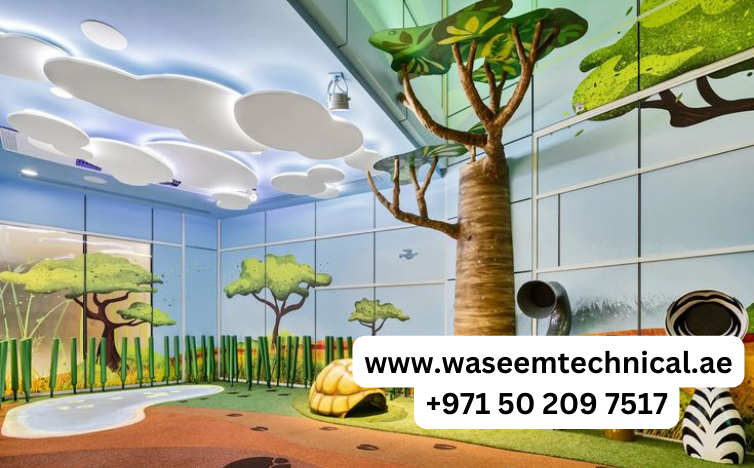
Modern interiors in Lusaka, Zambia are increasingly combining open layouts, hard architectural surfaces, glass partitions, exposed ceilings, large work areas, and contemporary decorative finishes.
These design choices can create beautiful spaces, but they can also create an acoustic problem.
When sound reflects repeatedly from walls, ceilings, floors, glass, and other hard surfaces, conversations can become less clear and rooms can feel unnecessarily loud. In an open-plan office, several conversations may overlap. In a restaurant, background noise can build throughout the room. In a classroom or training facility, excessive reverberation can make it harder to understand the person speaking.
This is where acoustic PET panels can become part of the solution.
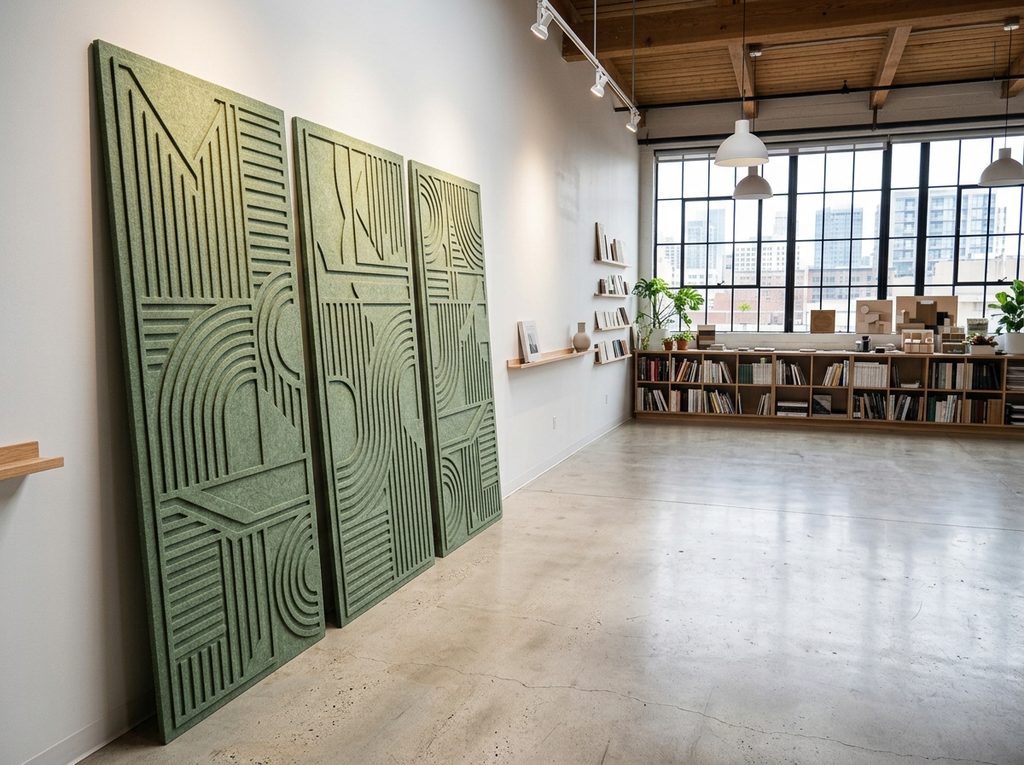
Made from polyester, often incorporating recycled PET content, these panels are designed primarily to absorb sound energy and reduce reflections and reverberation. Modern PET systems can also be manufactured in different colours, shapes, surface patterns, wall configurations, ceiling clouds, and suspended baffles, allowing acoustic treatment to become part of the interior design rather than simply an afterthought.
For projects in Lusaka, the real advantage is the combination of acoustic performance, visual flexibility, and architectural integration.
What Are Acoustic PET Panels?
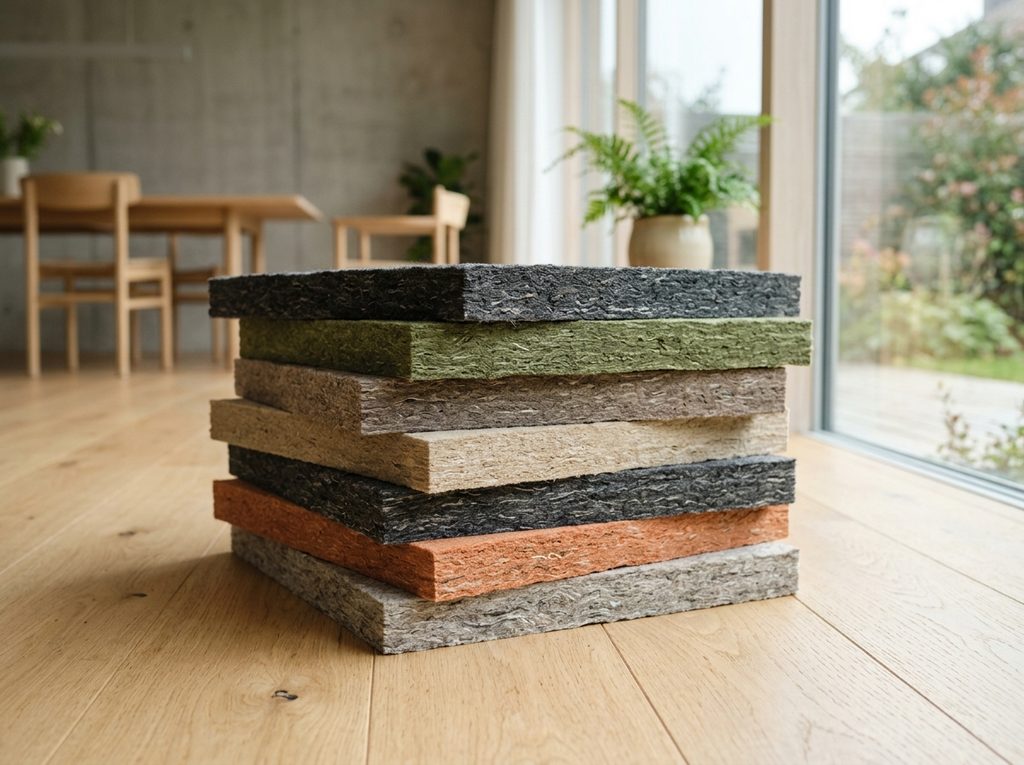
PET acoustic panels are generally manufactured from polyethylene terephthalate (PET) polyester fibres, which can be processed into rigid or semi-rigid acoustic felt boards.
Some modern products use recycled PET as their primary material. For example, one current PET panel system reports using post-consumer plastic bottles to manufacture recycled polyester acoustic boards, while offering multiple wall and ceiling profiles.
The material works through porous sound absorption.
Instead of allowing sound to repeatedly bounce between hard surfaces, the fibrous structure of the panel helps absorb a portion of the sound energy.
This makes PET panels particularly useful for controlling:
- Echo
- Reverberation
- Speech reflections
- Background noise
- Sound buildup
- Poor speech intelligibility
They are therefore especially useful in rooms where people need to hear and communicate clearly.
Acoustic Treatment Is Not the Same as Soundproofing
This distinction is extremely important when choosing acoustic materials.
PET panels are primarily sound-absorbing products.
They improve the acoustic environment inside a room, but they should not be described as a complete soundproofing barrier between rooms.
For example:
Problem 1: Echo inside a meeting room
People can hear their own voices reflecting from hard walls and ceilings.
PET acoustic panels can help.
Problem 2: Noise from the next office
A conversation from the neighbouring office is travelling through a partition.
PET panels alone will not solve the transmission problem.
That situation may require a sound isolation assembly involving mass, cavity insulation, decoupling, sealing, doors, glazing, or other construction measures.
Understanding this difference helps ensure PET panels are used for the problem they are actually designed to address.
Why PET Panels Work Well in Modern Lusaka Interiors
Many contemporary interiors use materials such as:
- Glass
- Concrete
- Tile
- Metal
- Plasterboard
- Stone
- Timber
- Large glazed surfaces
These materials can create significant sound reflection.
A room may look sophisticated but still sound uncomfortable.
PET panels provide an opportunity to introduce sound absorption without completely changing the architectural character of the space.
Instead of covering every wall with traditional acoustic treatment, designers can use strategically positioned panels as:
- Feature walls
- Decorative patterns
- Ceiling elements
- Floating clouds
- Suspended baffles
- Geometric installations
- Branded acoustic artwork
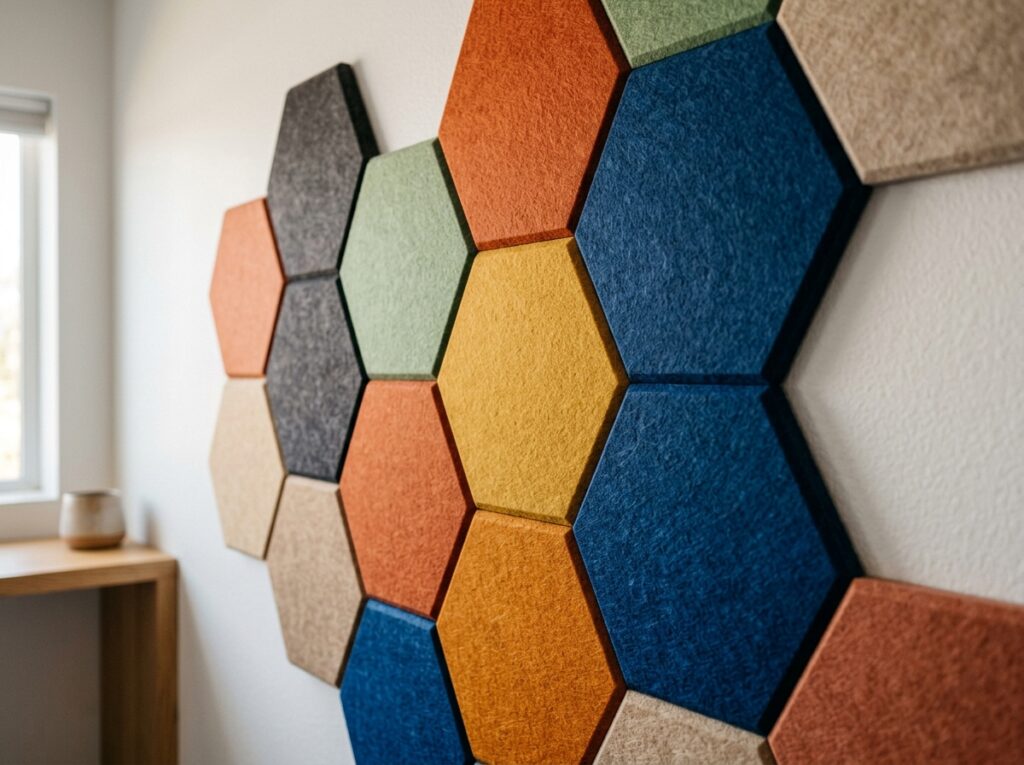
Some PET systems offer perforated, fluted, grooved, printed, three-dimensional, modular, and suspended formats.
PET Panels for Open-Plan Offices
Open-plan offices can be particularly challenging acoustically.
Employees may be working only a few metres apart while simultaneously:
- Making phone calls
- Attending online meetings
- Speaking with colleagues
- Receiving visitors
- Working on computers
- Conducting group discussions
Without sufficient absorption, sound can travel across the room and continuously reflect from hard surfaces.
The result can be a constant layer of background noise.
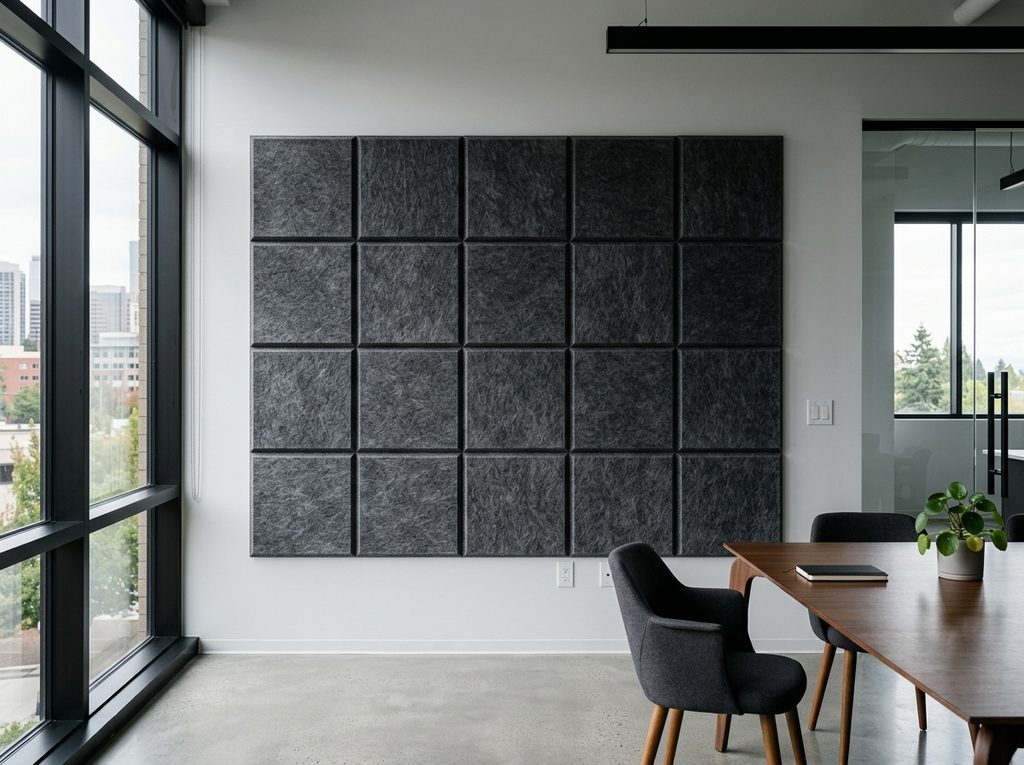
PET acoustic panels can be strategically placed on walls or suspended from ceilings to reduce reflected sound.
A balanced office acoustic design might include:
Wall PET panels + ceiling absorption + acoustic furniture/partitions + appropriate space planning
The objective is not necessarily to make the office completely silent.
Instead, the objective is to create an environment where sound does not continually build up throughout the room.
Meeting Rooms Need More Than a Good Table
A modern meeting room may contain a large table, glass walls, a display screen, and minimal furniture.
Visually, this can create a clean professional environment.
Acoustically, however, it can create a highly reflective room.
This can affect:
- Speech clarity
- Video conferencing
- Presentations
- Group discussions
- Telephone calls
PET panels can be installed on selected wall areas or incorporated into ceiling treatments to reduce excessive reflections.
Fluted, grooved, perforated, and other decorative PET surfaces can also create a more distinctive architectural finish while serving an acoustic purpose.
Acoustic PET Panels for Restaurants and Hospitality Spaces
Restaurants have a unique acoustic problem.
Customers create sound continuously, while hard tables, floors, walls, ceilings, and glass surfaces can reflect that sound.
As occupancy increases, the acoustic environment can become progressively louder.
This can affect the overall dining experience because customers may need to raise their voices to communicate.
PET acoustic treatment can be introduced without making the restaurant look like a conventional recording studio.
Possible applications include:
- Decorative wall panels
- Ceiling clouds
- Suspended baffles
- Feature wall designs
- Geometric installations
- Acoustic artwork
Suspended PET ceiling clouds are available in various shapes and sizes, providing absorption while also creating a visual ceiling feature.
PET Panels for Hotels and Guest Areas
Hospitality interiors need to balance aesthetics and acoustic comfort.
PET panels can be considered for:
- Hotel lobbies
- Reception areas
- Conference rooms
- Restaurants
- Lounges
- Corridors
- Business centres
- Event spaces
A lobby, for example, may contain polished flooring, glass, stone, and large open volumes.
Instead of treating these surfaces purely as decorative elements, acoustic PET installations can be integrated into selected areas to introduce absorption.
The same material can potentially be used across walls and ceilings while changing the shape, pattern, colour, or configuration.
Acoustic PET Panels in Classrooms and Training Rooms
Speech intelligibility is one of the most important acoustic requirements in educational spaces.
If a teacher speaks in a highly reverberant classroom, the sound can reach students through multiple reflections.
This can make speech less distinct.
Acoustic treatment helps reduce those unwanted reflections.
PET panels can be used on walls or ceilings in:
- Classrooms
- Training rooms
- Lecture rooms
- Seminar rooms
- Educational offices
- Learning centres
The goal is simple:
Make the speaker easier to hear without requiring excessive volume.
PET Acoustic Panels for Large Spaces
Large rooms can present a greater acoustic challenge because sound has more space to travel and reflect.
Examples include:
- Auditoriums
- Multipurpose halls
- Conference spaces
- Event venues
- Worship spaces
- Sports-related interiors
- Large corporate spaces
In these environments, wall treatment alone may not be enough.
Ceiling treatment can become particularly important.
Suspended PET baffles and acoustic clouds provide additional surface area for sound absorption while allowing designers to target specific areas of a large room. Current PET systems include both vertically suspended baffles and horizontal floating cloud configurations.
Why Ceiling Treatment Matters
One mistake in acoustic planning is concentrating all treatment on walls.
In many modern interiors, the ceiling is one of the largest available surfaces.
If the ceiling is:
- Concrete
- Plasterboard
- Metal
- Glass-adjacent
- Other hard reflective construction
sound can continue bouncing across the room.
PET ceiling elements can therefore complement wall treatment.
Three common configurations include:
| Configuration | Typical Purpose |
|---|---|
| Wall PET Panels | Reduce reflections from vertical surfaces |
| Ceiling Clouds | Absorb sound above occupied areas |
| Suspended Baffles | Increase absorption from multiple surfaces |
A combination can be particularly useful in open-plan and high-ceiling environments.
Turning Acoustic Treatment Into Interior Design
One of the biggest advantages of PET panels is that acoustic treatment does not have to look industrial.
PET felt can be shaped and machined into different patterns.
Possible designs include:
- Linear grooves
- Geometric perforations
- Waves
- 3D surfaces
- Layered shapes
- Brand patterns
- Custom artwork
- Colour combinations
Some PET panel ranges currently offer dozens of colour choices and multiple surface profiles, while certain products allow custom shapes or printed designs.
This makes it possible to coordinate acoustic treatment with:
Brand identity + interior architecture + furniture + lighting + colour palette
The acoustic system becomes part of the visual concept.
Custom PET Acoustic Walls
A large blank wall does not necessarily need to remain blank.
A PET acoustic installation can transform it into a visual feature.
For example, a corporate office could use:
Company colours + geometric PET shapes + acoustic coverage
A hospitality venue could use:
Decorative pattern + warm colour palette + strategically positioned absorption
An educational facility could use:
Colour-coded panels + acoustic treatment + durable wall design
The advantage is that the acoustic requirement can be incorporated into the architecture rather than added after the interior has already been completed.
PET Panels and Sustainability
The environmental aspect of PET acoustic panels is another reason they are being considered for modern interior projects.
PET is the same polymer used in many common plastic bottles and packaging products.
Some acoustic panel manufacturers process post-consumer PET into polyester fibres and then form those fibres into acoustic boards. One current system states that its panels use recycled PET bottles and are designed as a recyclable single-material product.
However, sustainability claims should always be evaluated on a product-specific basis.
Not every PET acoustic panel contains the same recycled content, and not every product has identical end-of-life characteristics.
When sustainability is an important project requirement, documentation should be requested from the manufacturer.
How Thick Should PET Acoustic Panels Be?
There is no single thickness that is correct for every room.
PET panels are available in different thicknesses and configurations.
For example, one current product range lists wall panels from 9 mm to 24 mm, while some three-dimensional designs reach 36 mm. Its published NRC range varies by profile and thickness.
The appropriate specification depends on:
- Room size
- Reverberation characteristics
- Frequency range
- Required absorption
- Panel coverage
- Mounting method
- Air gap
- Ceiling height
- Existing finishes
A thicker panel or additional air gap can influence absorption performance, particularly at lower frequencies.
Therefore, panel thickness should be selected as part of an acoustic design rather than simply choosing the thickest available product.
What Is NRC?
When comparing acoustic PET panels, you may encounter the term NRC, or Noise Reduction Coefficient.
NRC is commonly used to describe the sound absorption performance of an acoustic material.
For example, a current PET panel range publishes NRC values from approximately 0.70 to 0.90, depending on the panel profile and thickness.
However, an NRC value should not be interpreted as a guarantee that an entire room will achieve the same performance.
The final acoustic result depends on:
- How much surface is covered
- Where the panels are installed
- Room dimensions
- Ceiling height
- Existing materials
- Furniture
- Panel thickness
- Air gaps
- Sound frequency
In other words:
A panel specification is not the same thing as a room specification.
PET Panels With Air Gaps
Mounting acoustic panels directly against a wall is not always the only option.
An air gap can be introduced between the panel and the wall.
This changes the acoustic behaviour of the system and can improve absorption at certain frequencies.
One current PET acoustic system specifically recommends a 25–50 mm air gap behind the felt substrate for improved low-frequency absorption.
The appropriate gap should still be determined according to the specific panel and acoustic requirements.
PET Panels vs Traditional Decorative Wall Finishes
A traditional decorative wall may look attractive but contribute little sound absorption.
PET acoustic panels can provide both:
Visual treatment + acoustic absorption
This makes them especially interesting for spaces where designers do not want to sacrifice aesthetics to improve acoustics.
| Decorative Surface | PET Acoustic Panel |
|---|---|
| Primarily visual | Visual + acoustic |
| Often reflective | Sound-absorbing |
| Limited acoustic function | Designed for absorption |
| Usually fixed finish | Can be shaped/customized |
| Acoustic performance depends on substrate | Manufactured specifically for acoustic use |
The objective is not to replace every decorative material.
Instead, PET panels can be introduced where acoustic performance is needed.
PET Panels for Corporate Branding
Modern offices increasingly want interiors to communicate brand identity.
Acoustic PET systems can support this through:
- Brand colours
- Custom shapes
- Geometric patterns
- Logos
- Printed graphics
- Feature walls
- Colour zoning
Some current PET systems offer printed and custom-shaped panels in addition to standard acoustic profiles.
This creates an opportunity to solve two problems simultaneously:
Improve the acoustic environment while strengthening the visual identity of the space.
PET Panels in Healthcare and High-Use Interiors
Acoustic design is also important in environments where excessive background noise can become uncomfortable.
PET systems may be considered for selected:
- Healthcare interiors
- Reception areas
- Waiting spaces
- Consultation areas
- Training facilities
- Institutional buildings
However, healthcare and high-use environments require more than acoustic performance.
The specific product should also be assessed for:
- Cleaning requirements
- Fire performance
- Moisture exposure
- Durability
- Disinfectability
- Maintenance
For example, some current PET products specify fog, spray, and wipe cleaning compatibility, but this should always be verified for the exact product being specified.
Fire Performance Must Be Checked Product by Product
Acoustic materials should never be selected solely because they are labelled “PET.”
Different manufacturers and product constructions can have different fire classifications.
For example, one current PET acoustic range lists a Class B1 fire rating under BS 476 Part 7 for its specified products.
That does not mean every PET panel on the market has the same classification.
For commercial projects in Lusaka, the appropriate product documentation should be reviewed against the project’s applicable building and fire requirements.
Where Acoustic PET Panels Can Be Used in Lusaka
PET acoustic panels can be considered for a wide range of interiors across Lusaka, including:
- Corporate offices
- Open-plan workplaces
- Boardrooms
- Meeting rooms
- Restaurants
- Cafés
- Hotels
- Schools
- Training centres
- Healthcare interiors
- Reception areas
- Conference rooms
- Home offices
- Media rooms
- Auditoriums
- Multipurpose spaces
The correct configuration depends on the room’s acoustic behaviour rather than simply its function.
Designing the Right PET Panel Layout
More panels do not automatically mean better acoustic design.
Placement matters.
For example, if the strongest reflections occur between two parallel walls, treating those surfaces may be more useful than randomly covering another wall.
Likewise, a high-ceiling room may benefit from suspended elements rather than relying entirely on wall panels.
An acoustic assessment can consider:
Room dimensions → Existing finishes → Noise sources → Reflection paths → Required absorption → Panel coverage → Panel placement
This turns PET panels from a decorative purchase into an actual acoustic strategy.
Professional Acoustic PET Panel Installation in Lusaka
The installation process should begin before the panels arrive on site.
A professional project can include:
1. Site Assessment
Evaluate the room dimensions, finishes, ceiling height, furniture and acoustic problems.
2. Acoustic Planning
Determine the required amount and location of absorption.
3. Design Development
Select colours, shapes, thicknesses, profiles and mounting systems.
4. Panel Preparation
Cut, shape or manufacture the required panels according to the approved design.
5. Installation
Panels can be installed using appropriate fixing methods such as concealed clips, adhesive systems, battens, or suspended systems depending on the product. Current PET systems provide several installation approaches, including concealed clips and direct adhesive mounting.
6. Final Inspection
Check alignment, joints, colour consistency, fixing quality and overall coverage.
Why Professional Acoustic Planning Matters
Buying a box of acoustic panels and placing them randomly around a room is not the same as designing an acoustic environment.
A professional approach considers the room as a whole.
For example, a meeting room with excessive reverberation may require treatment on both walls and ceiling.
An open office may require suspended ceiling absorption combined with strategically placed wall panels.
A restaurant may need absorption distributed throughout the occupied zone.
A large hall may require ceiling clouds or baffles to address the vertical sound field.
The correct solution depends on the actual acoustic behaviour of the room.
Final Thoughts
Acoustic PET panels offer an adaptable way to improve the sound quality of modern interiors in Lusaka, Zambia.
Their primary role is to absorb unwanted sound reflections and help control reverberation, making them particularly useful in offices, meeting rooms, restaurants, hotels, classrooms, healthcare spaces, and other environments where communication and acoustic comfort matter.
Modern PET systems can go far beyond a simple rectangular wall panel. Fluted surfaces, geometric patterns, 3D designs, printed graphics, ceiling clouds, and suspended baffles allow acoustic treatment to become part of the architectural language.
Most importantly, PET panels should be selected according to the room’s acoustic requirements, not simply because they look attractive.
When the correct product, thickness, coverage, mounting method, and placement are combined, PET acoustic panels can transform a hard, reflective interior into a space that feels more controlled, comfortable, and easier to use.
Frequently Asked Questions
1. What are acoustic PET panels?
Acoustic PET panels are sound-absorbing panels made from polyester/PET fibres. Many modern products use recycled PET as part or all of their material composition.
2. Do PET panels soundproof a room?
Not by themselves. PET panels primarily absorb sound reflections and reduce reverberation inside a room. Sound isolation between rooms requires a different construction strategy.
3. Are PET panels suitable for offices?
Yes. They can be used on walls, ceilings, as baffles, or as floating acoustic elements to help control reverberation in open-plan and enclosed office environments.
4. Can PET panels be used on ceilings?
Yes. PET acoustic systems are available as suspended baffles, floating clouds, open-cell systems, and other ceiling configurations.
5. Can PET panels be customized?
Many manufacturers offer customization such as different colours, shapes, surface profiles, printed designs, and geometric patterns. The exact options depend on the product.
6. Are PET acoustic panels made from recycled plastic?
Some are. Certain manufacturers use post-consumer PET bottles to produce recycled polyester acoustic felt. However, recycled content should be verified for the specific product.
7. What NRC do PET acoustic panels have?
Performance varies by product, thickness, profile and mounting. One current PET range publishes NRC values between approximately 0.70 and 0.90 across its specified products.
8. Can PET panels reduce echo?
Yes. Their primary purpose is sound absorption, making them suitable for reducing reflections and reverberation within rooms.
9. Can PET panels be installed with an air gap?
Yes. Depending on the product, an air gap can be used behind the panel to modify and potentially improve absorption, particularly at lower frequencies. One current system recommends a 25–50 mm gap for this purpose.
10. Where can PET acoustic panels be used in Lusaka?
They can be considered for offices, boardrooms, restaurants, hotels, classrooms, training rooms, healthcare interiors, reception areas, conference spaces, home offices, media rooms, and other spaces where reverberation control is required.