Modern interiors in Riyadh, Saudi Arabia often combine concrete, glass, gypsum, stone, metal, tiled floors, and other hard finishes. These materials can create a clean architectural appearance, but they can also produce a difficult acoustic environment.
In a large office, voices may continue reflecting across the room. In a school, teachers may need to speak louder than necessary. In a restaurant, conversations can become increasingly difficult as occupancy rises. In an auditorium, excessive reverberation can reduce speech clarity and affect presentations or performances.
This is where acoustic wood wool panels can provide a practical combination of sound absorption, durability, and architectural character.
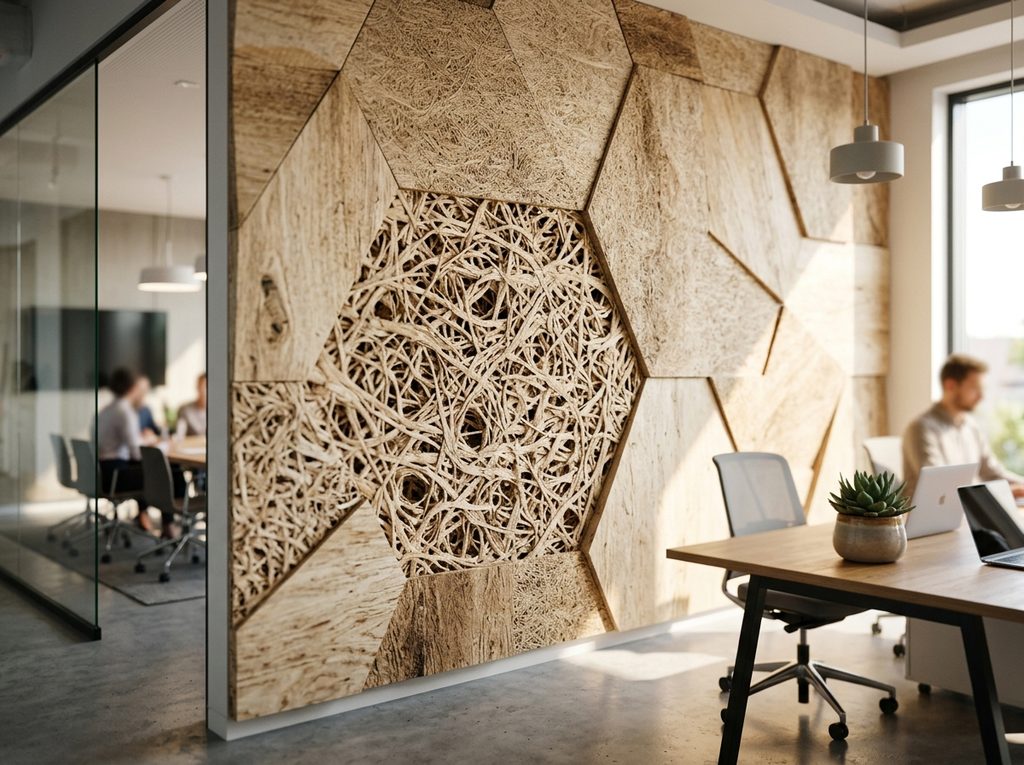
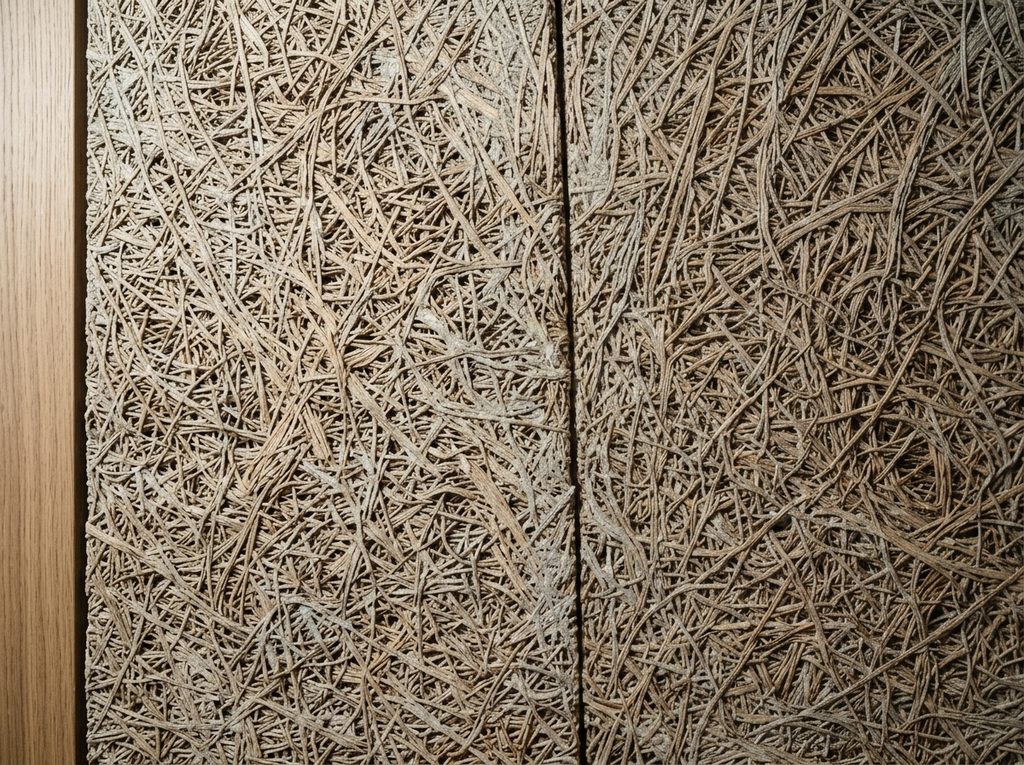
Wood wool panels are generally manufactured from wood fibres bonded with a mineral or cement-based binder. Their textured surface can absorb and scatter sound while also creating a distinctive natural-looking finish. They can be installed on walls or ceilings and are used in spaces including offices, schools, conference halls, auditoriums, restaurants, sports facilities, and other public interiors.
For projects in Riyadh, the appeal is not simply acoustic performance. Wood wool can also provide a durable visible finish, making it possible to integrate acoustic treatment directly into the architecture.
What Are Acoustic Wood Wool Panels?
Acoustic wood wool panels are rigid boards made from long wood fibres combined with a mineral binder, commonly cement.
Unlike soft fabric-covered acoustic panels, wood wool has a textured and relatively robust surface.
This construction provides several useful characteristics:
- Sound absorption
- Natural visual texture
- Structural rigidity
- Wall and ceiling installation
- Compatibility with direct fixing
- Compatibility with suspended systems
- Potential for painted finishes
- Durable surface for high-use interiors
The material is primarily used for sound absorption and reverberation control, rather than as a standalone soundproofing barrier.
That distinction is important.
If the objective is to reduce echo inside a room, wood wool can be highly relevant.
If the objective is to stop sound travelling through a wall into another room, the project may instead require a complete sound isolation assembly involving mass, decoupling, cavity insulation, sealing, and potentially materials such as MLV.
Why Wood Wool Is Different From Ordinary Decorative Wood
A decorative timber wall and an acoustic wood wool wall may look completely different when examined closely.
Ordinary wood finishes are generally designed primarily for appearance.
Wood wool panels are engineered with a fibrous, open-textured structure intended to interact with sound.
The surface helps absorb sound energy rather than behaving like a large hard reflective surface.
This makes wood wool particularly interesting when the design brief requires:
Acoustic performance + durability + visible architectural texture
Instead of hiding the acoustic material behind another finish, the wood wool itself can become the finished surface.
The Acoustic Problem in Large Riyadh Interiors
Large rooms can be particularly challenging acoustically.
Imagine a conference hall with:
- A hard floor
- Concrete or gypsum walls
- Large glazed areas
- A high ceiling
- Minimal soft furnishings
When someone speaks, the sound doesn’t simply travel directly to the listener.
It reflects from multiple surfaces.
Those reflections can arrive shortly after the direct sound, making speech less distinct and increasing reverberation.
The result can be:
- Reduced speech clarity
- Increased background noise
- Difficulty understanding presentations
- Poorer meeting-room communication
- A louder perceived environment
Wood wool panels can help by introducing sound absorption into these reflective spaces.
Wood Wool Panels for Offices in Riyadh
Modern offices increasingly use open layouts.
While open-plan designs can encourage collaboration, they also create acoustic challenges.
Employees may simultaneously be:
- Talking to colleagues
- Making phone calls
- Attending online meetings
- Working in groups
- Speaking with visitors
If the surrounding surfaces are highly reflective, these sounds can accumulate.
Wood wool panels can be installed on selected walls or ceilings to reduce reflections and improve the acoustic environment.
A common design strategy is to combine:
Wood wool wall treatment + acoustic ceiling treatment + soft furnishings + appropriate space planning
The objective isn’t to eliminate every sound.
It is to prevent unnecessary reverberation from turning ordinary workplace activity into persistent background noise.
Wood Wool in Meeting and Boardrooms
A boardroom may appear acoustically simple, but large tables, glass walls and hard ceilings can create significant reflections.
This can become particularly noticeable during:
- Presentations
- Video conferences
- Group discussions
- Negotiations
- Client meetings
Wood wool panels can be positioned on selected walls or incorporated into the ceiling to provide additional absorption.
The location of the panels matters.
For example, treating a large reflective wall behind speakers or participants may be more useful than simply covering an arbitrary wall area.
Acoustic planning should therefore consider reflection paths, not just the amount of material.
Acoustic Wood Wool for Schools
Educational spaces require good speech intelligibility.
Students need to understand the teacher, while teachers need to communicate without constantly increasing their voice level.
This becomes more challenging when classrooms, lecture rooms, corridors, and halls contain hard reflective surfaces.
Wood wool is already used in educational environments because it combines acoustic absorption with a relatively robust panel construction. CEWOOD, for example, documents wood wool acoustic panels used in school interiors, while other acoustic suppliers list classrooms, lecture halls, and educational institutions among their applications.
For Riyadh educational projects, wood wool can be considered for:
- Classrooms
- Lecture rooms
- Libraries
- Training rooms
- School halls
- Corridors
- Auditoriums
- Multipurpose spaces
Wood Wool Panels for Auditoriums
Auditoriums present a more complex acoustic challenge because of their size and volume.
The sound must reach people throughout the room while remaining sufficiently clear.
Too much reverberation can cause:
- Speech overlap
- Reduced intelligibility
- Longer reverberation
- Poor presentation clarity
- Difficulty hearing distant speakers
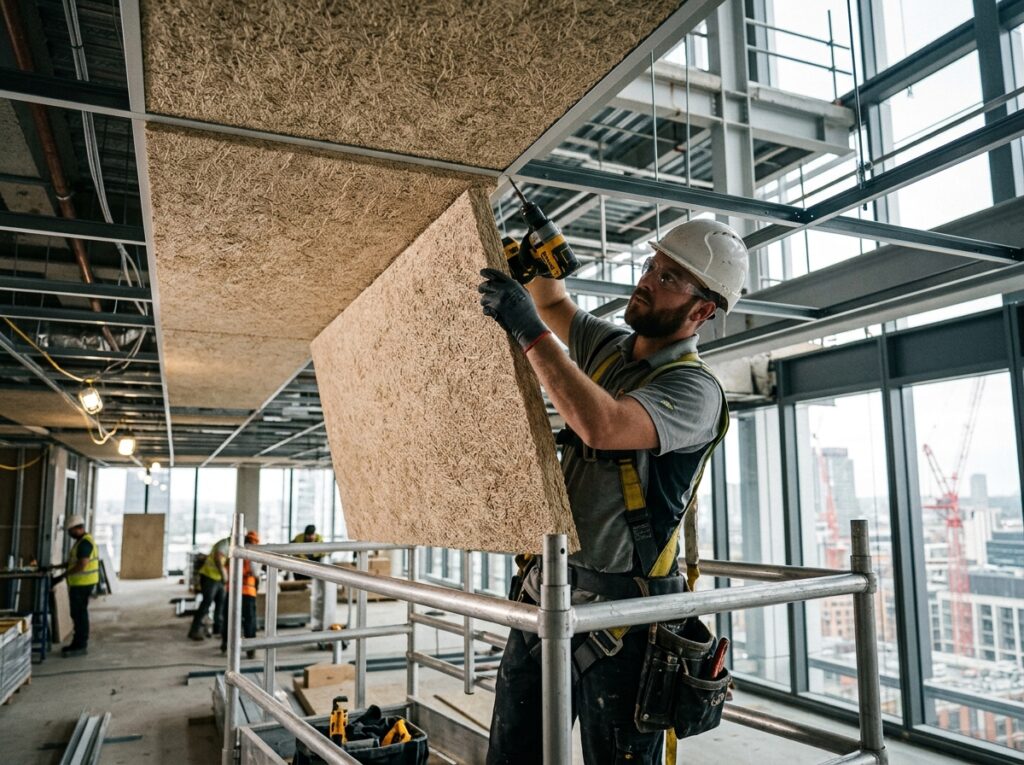
Wood wool panels can be incorporated into wall and ceiling systems to introduce controlled absorption.
For larger rooms, however, the complete acoustic design becomes more important than the panel alone.
A system may combine:
Wood wool + acoustic backing + ceiling absorption + architectural geometry
Adding mineral wool or another suitable porous backing behind a wood wool panel can substantially change its absorption performance, particularly at lower frequencies.
Direct Fixing vs Acoustic Backing
One of the most important factors when specifying wood wool is the installation assembly.
A panel fixed directly against a hard wall does not necessarily perform the same way as the same panel installed with an air cavity or acoustic backing.
For example, published product data for wood wool systems shows that acoustic performance can change significantly depending on thickness, mounting configuration, and backing.
Direct installation
The panel is fixed directly onto a suitable substrate.
Advantages can include:
- Simple installation
- Lower overall wall depth
- Clean appearance
- Suitable for selected acoustic applications
Battens and air gap
The panel is mounted away from the substrate.
This creates a cavity behind the panel.
An air gap can improve absorption at certain frequencies and can also provide space for services.
Acoustic backing
Mineral wool or another porous absorber can be placed behind the wood wool.
This can significantly improve broadband absorption.
For projects where acoustic performance is critical, the tested assembly should be specified rather than looking only at the panel’s standalone rating.
Understanding NRC in Wood Wool Panels
You may encounter NRC, or Noise Reduction Coefficient, when comparing acoustic panels.
NRC provides a simplified indication of sound absorption performance.
But the value depends on the particular:
- Panel thickness
- Density
- Mounting
- Air gap
- Backing
- Test configuration
For example, one wood wool product range lists NRC values from approximately 0.45 to 0.95 depending on thickness and mounting configuration.
Other current systems publish values around 0.60–0.65 for direct installation, with substantially higher values when acoustic infill is added.
These figures should not be treated as universal performance numbers for every wood wool product.
The complete tested assembly is what matters.
Wood Wool Panels in Restaurants and Cafés
Restaurants are often acoustically challenging because they combine:
- Hard floors
- Tables
- Glass
- Decorative surfaces
- Background music
- Kitchen activity
- Multiple conversations
As customers enter and occupancy increases, background sound can rise considerably.
Wood wool panels provide an opportunity to introduce absorption without abandoning the visual character of the restaurant.
Possible applications include:
- Feature walls
- Ceiling panels
- Suspended acoustic elements
- Dining-area walls
- Decorative ceiling patterns
The natural fibre texture can also complement interiors using wood, stone, neutral colours, and other natural finishes.
Hotels and Hospitality Interiors
Hotels need acoustic comfort without compromising the visual quality of the interior.
Wood wool can be considered for:
- Lobbies
- Restaurants
- Conference rooms
- Event halls
- Lounges
- Business centres
- Corridors
- Reception areas
In a large hotel lobby, for example, a combination of stone, glass and a high ceiling can create substantial reverberation.
Wood wool panels can introduce absorption while functioning as part of the architectural design.
Wood Wool for High-Traffic Spaces
One of the practical advantages of mineral-bonded wood wool is its relatively rigid construction.
This can make it suitable for environments where softer acoustic surfaces could be more vulnerable to physical contact.
Applications can include:
- School corridors
- Sports facilities
- Public buildings
- Stairwells
- Multipurpose halls
- Institutional spaces
- Large circulation areas
Some manufacturers specifically market wood wool panels for schools, sports halls and public spaces where durability is an important consideration.
The exact impact-resistance rating should still be confirmed for the selected product.
Acoustic Wood Wool for Sports Facilities
Sports halls are among the spaces where acoustics can easily become problematic.
Large volumes, hard floors and walls, and high ceilings create enormous reflective surfaces.
The result can be a highly reverberant environment.
Wood wool panels can be used on walls or ceilings to introduce absorption.
For sports facilities, product selection should consider:
- Impact resistance
- Ball impact classification
- Fire performance
- Moisture conditions
- Mounting method
- Maintenance requirements
Certain wood wool products are specifically tested for impact resistance, but this should always be verified against the exact product specification rather than assumed for every panel.
Ceiling Applications: More Than Just Wall Treatment
Walls are not the only place where wood wool can be installed.
The ceiling can be one of the most important acoustic surfaces in a large room.
Wood wool can be incorporated into:
- Suspended ceilings
- Modular ceiling systems
- Floating acoustic elements
- Ceiling clouds
- Continuous ceiling designs
This becomes particularly valuable in open-plan offices, schools, restaurants and halls where wall space may be limited.
Suspended systems can also introduce an air cavity behind the panels, which can contribute to improved acoustic performance depending on the construction.
Natural Texture Without Sacrificing Performance
A major design advantage of wood wool is its recognizable fibre texture.
Rather than appearing like a conventional soft acoustic panel, it can create a more architectural surface.
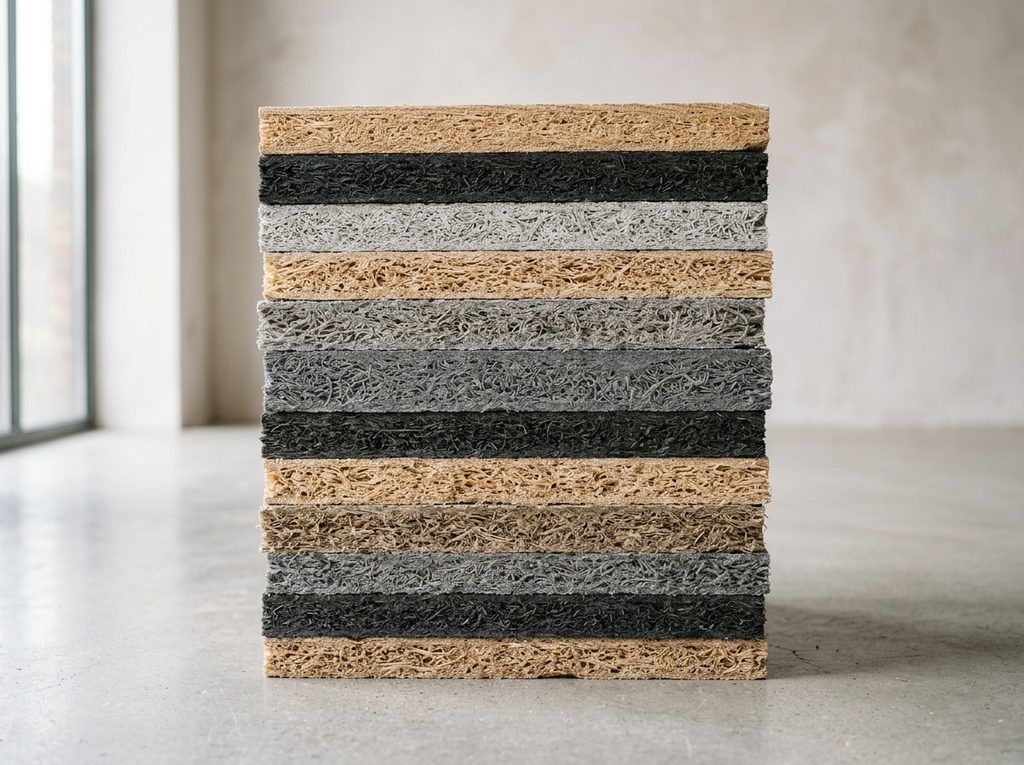
Depending on the manufacturer, panels may be available in:
- Natural finishes
- Painted colours
- Different fibre widths
- Different thicknesses
- Square formats
- Rectangular formats
- Custom shapes
This allows architects and interior designers to use acoustic treatment as a visible part of the interior.
Wood Wool vs PET Acoustic Panels
Both materials can provide sound absorption, but they have different characteristics.
| Wood Wool | PET Acoustic Panels |
|---|---|
| Mineral/cement-bonded wood fibres | Polyester/PET fibres |
| Rigid board construction | Lightweight felt-like board |
| Natural textured appearance | Smooth or patterned felt appearance |
| Suitable for robust environments | Highly flexible design options |
| Can be direct-fixed or suspended | Wall, ceiling, baffle and cloud systems |
| Can provide architectural texture | Excellent for geometric/custom designs |
| Generally heavier | Generally lighter |
The choice depends on the project.
If the design requires a rigid, durable, textured surface, wood wool can be attractive.
If the priority is lightweight customization and complex felt designs, PET may be more appropriate.
Wood Wool vs Decorative Timber
Decorative timber and wood wool can both create warm interiors, but their acoustic roles are different.
Decorative timber generally reflects a considerable amount of sound unless it is designed as a perforated or slatted acoustic system.
Wood wool is manufactured specifically with an absorptive fibre structure.
Therefore, if a project needs a visible natural-looking finish and sound absorption, wood wool can serve both roles.
Fire Performance Must Be Product Specific
Fire performance should always be checked using the technical documentation for the exact panel being specified.
Different wood wool products, thicknesses, coatings and backing assemblies can have different classifications.
For example, current product documentation from Knauf’s HERADESIGN range includes specific wood wool products with classifications such as B-s1,d0, while other products may have different ratings or test configurations.
Therefore, it is important to request:
- Fire classification
- Test certificate
- Product data sheet
- Installation assembly
- Backing material specification
rather than assuming that every wood wool panel has identical fire performance.
Sustainability and Wood Wool
Wood wool can also fit into projects where natural or renewable materials are part of the design brief.
The material generally combines wood fibres with a mineral binder such as cement or magnesite.
This gives it a different material profile from petroleum-based acoustic foams and polyester products.
However, sustainability should still be evaluated using actual product documentation.
Depending on the project, relevant information can include:
- Wood source
- Environmental product declarations
- Recycled or renewable content
- Binder composition
- Product lifespan
- End-of-life considerations
- Manufacturing certifications
Where Wood Wool Panels Can Be Used in Riyadh
Acoustic wood wool panels can be considered for many types of Riyadh interiors:
- Corporate offices
- Boardrooms
- Schools
- Universities
- Training centres
- Auditoriums
- Conference halls
- Restaurants
- Hotels
- Sports halls
- Libraries
- Public buildings
- Multipurpose rooms
- Studios
- Residential interiors
The right configuration depends on the room’s acoustic requirements, not simply its function.
Designing the Panel Layout
A successful wood wool installation is not necessarily the one with the most panels.
Placement matters.
An acoustic designer can consider:
Room volume → reflective surfaces → sound sources → listening positions → reverberation → required absorption → panel location
For example, a large hall may benefit from a combination of wall and ceiling absorption.
A smaller boardroom may need targeted wall treatment combined with ceiling absorption.
A classroom may benefit from strategically positioned wall panels and ceiling treatment.
The objective is to place absorption where it contributes meaningfully to the room’s acoustic behaviour.
Professional Wood Wool Acoustic Installation in Riyadh
A professional acoustic project should begin with an assessment rather than immediately selecting a panel.
The process can include:
1. Site Assessment
Evaluate room dimensions, finishes, ceiling height, furniture and current acoustic problems.
2. Acoustic Planning
Determine whether the main problem is reverberation, speech clarity, noise buildup, or another acoustic issue.
3. Product Selection
Select the appropriate wood wool thickness, finish, backing and mounting method.
4. Layout Design
Develop the wall and ceiling pattern while coordinating with lighting, HVAC, sprinklers and other services.
5. Installation
Install the panels using the approved fixing or suspension system.
6. Final Inspection
Check alignment, joints, colour, mounting and overall finish.
Why Professional Installation Makes a Difference
A wood wool panel can have excellent laboratory performance and still produce disappointing results if it is installed differently from its tested configuration.
For example:
Product test: panel + mineral wool backing + air cavity
Actual installation: panel directly fixed to concrete
These are not acoustically equivalent assemblies.
Published acoustic guidance specifically notes that the installation assembly, including air gaps and mineral wool backing, can substantially affect performance.
This is why the specification should cover the complete system, not just the panel.
Final Thoughts
Acoustic wood wool panels offer a combination that is particularly useful for modern interiors: sound absorption, architectural texture, durability, and flexible wall and ceiling applications.
For projects in Riyadh, Saudi Arabia, they can be considered for offices, schools, auditoriums, restaurants, hotels, sports facilities, conference spaces and other interiors where excessive reverberation affects comfort or communication.
Their role is primarily to control sound inside the room, rather than provide complete sound isolation between rooms.
When the correct thickness, backing, air gap, coverage and mounting configuration are selected, wood wool panels can become much more than an acoustic product. They can become an integral part of the interior architecture.
For a professional project, the most effective approach is to start with the room’s acoustic problem, determine where sound is reflecting, and then design the wood wool system around the required performance.
Frequently Asked Questions
1. What are acoustic wood wool panels?
They are rigid acoustic boards made from wood fibres bonded with a mineral or cement-based binder. They are primarily designed to absorb sound and control reverberation.
2. Do wood wool panels soundproof a room?
Not by themselves. They primarily provide sound absorption inside a room. Sound isolation between rooms requires a properly designed wall, ceiling or floor assembly.
3. Where can wood wool panels be installed?
They can be installed on walls and ceilings, including direct-fixed, battened, suspended and other specialized systems.
4. Are wood wool panels suitable for offices?
Yes. They can help reduce reverberation and improve speech clarity in offices, meeting rooms and open-plan workplaces.
5. Can wood wool panels be used in schools?
Yes. Educational spaces such as classrooms, lecture rooms, libraries and auditoriums are common applications for wood wool acoustic treatment.
6. Does adding mineral wool behind wood wool improve performance?
It can. The complete assembly, including backing and air cavity, can significantly increase sound absorption compared with direct mounting.
7. What NRC can wood wool panels achieve?
It varies substantially by product and installation. Published products show values ranging from approximately 0.45 to 0.95, while some tested systems achieve higher values when acoustic backing is included.
8. Can wood wool panels be painted?
Many wood wool products are available in painted or colour-finished options, but the approved paint type and application method should be confirmed with the manufacturer.
9. Are wood wool panels durable?
Their rigid mineral-bonded construction makes many products suitable for high-use environments. However, impact resistance and durability ratings vary by product and should be verified for the intended application.
10. Can wood wool panels be used for soundproofing in Riyadh?
They can be part of a broader acoustic system, but they should not be treated as a standalone soundproofing barrier. For room-to-room isolation, wood wool may need to be combined with other sound isolation materials and construction techniques.