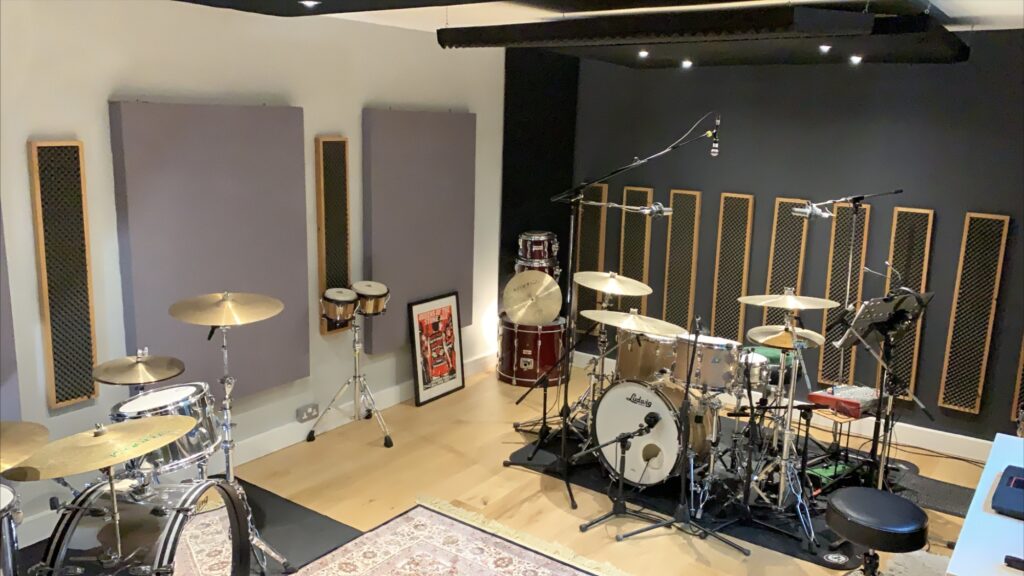
Not every sound problem can be solved by putting an acoustic panel on a wall.
Sometimes the real problem is happening inside the wall.
Noise may be travelling between offices. Conversations may be passing through apartment partitions. Mechanical equipment may be transmitting unwanted sound into occupied rooms. Noise from one floor may be reaching another. A lightweight partition may simply not provide enough resistance to airborne sound.
In these situations, the visible interior finish may not be the main issue.
The problem is the sound transmission path through the building assembly.
This is where Mass Loaded Vinyl (MLV) can become an important part of a professional sound isolation system.
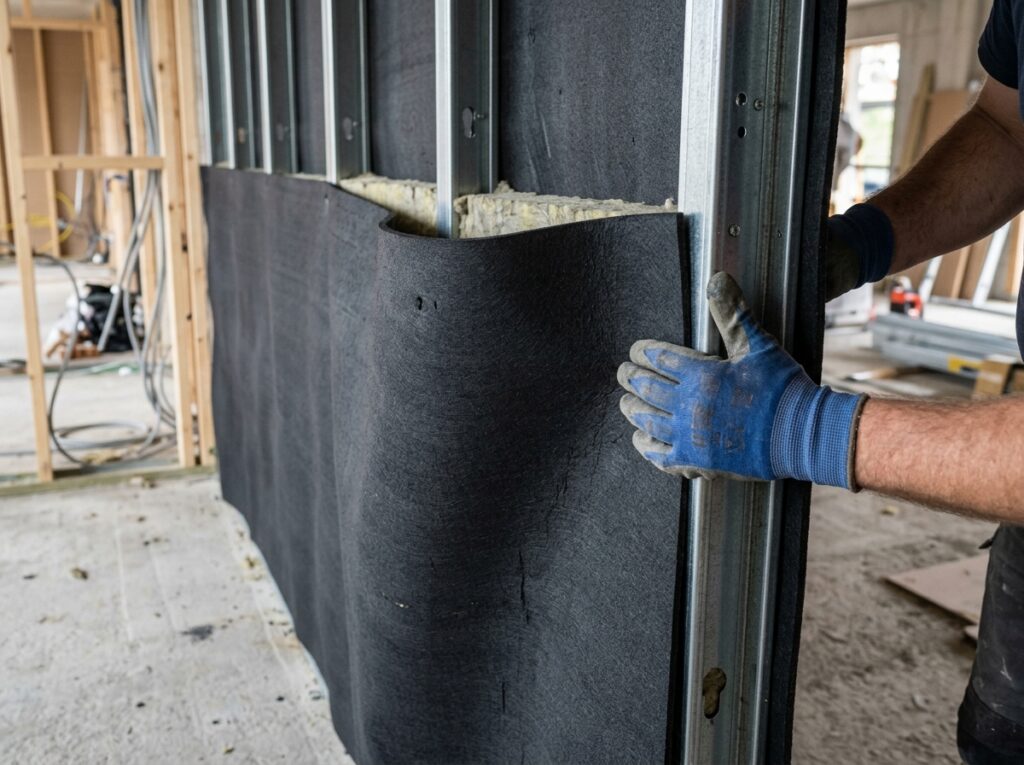
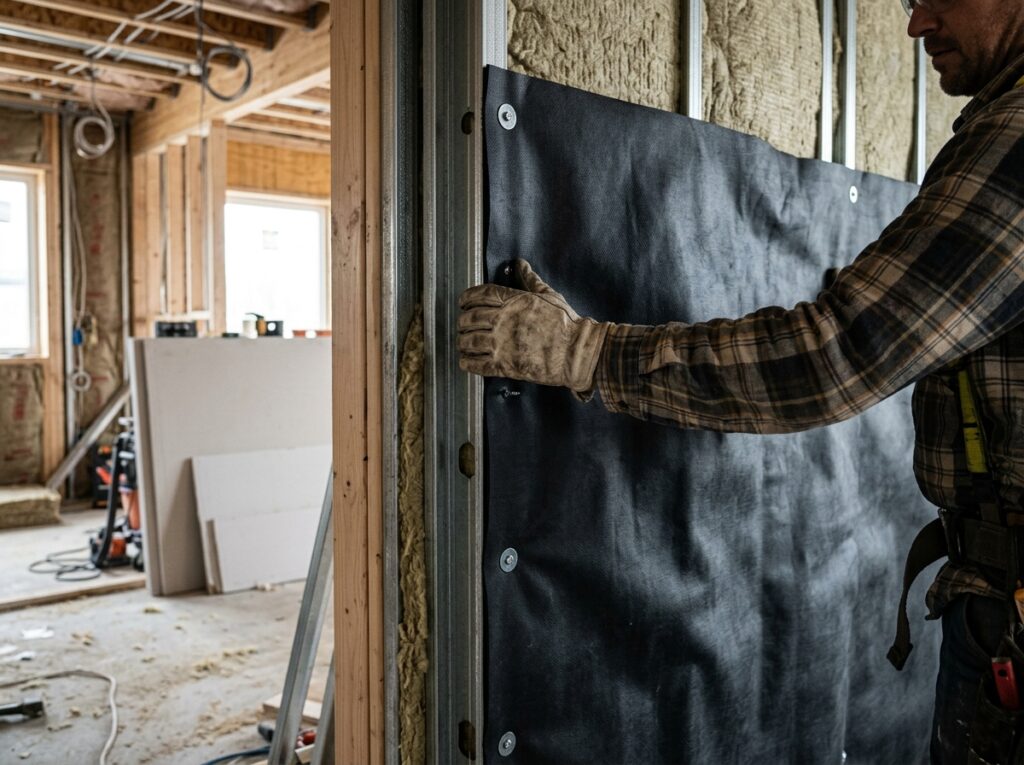
MLV is a dense, flexible, limp-mass barrier designed to reduce sound transmission. Unlike conventional acoustic panels, which primarily absorb reflected sound inside a room, MLV is used as a barrier layer within walls, ceilings, floors, ducts, machinery enclosures, and other assemblies.
For commercial, residential, industrial, hospitality, and institutional projects in Abidjan, Côte d’Ivoire, MLV can provide an additional layer of sound isolation without requiring the same thickness as simply adding large amounts of rigid mass.
The Soundproofing Layer You Usually Don’t See
One of the most interesting things about Mass Loaded Vinyl is that it often disappears after the project is completed.
You don’t necessarily walk into a finished room and see the MLV.
Instead, it sits behind the finished wall, above a ceiling, beneath flooring, around ductwork, or within an equipment enclosure.
The visible wall may still be:
- Painted drywall
- Wood
- Fabric
- Decorative panels
- Tile
- Other architectural finishes
But behind that surface can be a carefully engineered acoustic assembly.
This makes MLV particularly useful when the objective is to improve sound isolation without dramatically changing the appearance or dimensions of the finished interior.
Why Adding Mass Matters
Sound transmission is influenced by the construction separating one space from another.
Lightweight partitions can allow airborne sound to pass through relatively easily.
Increasing the mass of an assembly can make it more resistant to sound transmission.
MLV takes advantage of this principle while remaining flexible.
A commercial MLV product, for example, may be supplied at different surface weights such as 0.5, 1, or 2 lb/ft², with performance varying according to the particular barrier and test configuration.
The important point is not that one weight is automatically correct for every project.
The correct specification depends on:
- Existing wall construction
- Target acoustic performance
- Available space
- Other layers in the assembly
- Noise frequency
- Installation method
- Required fire performance
- Project regulations
MLV for Shared Walls in Apartments and Residential Buildings
Shared walls can become one of the biggest sources of acoustic complaints.
Residents may hear:
- Conversations
- Television
- Music
- Children playing
- Household equipment
- General activity
The problem is particularly frustrating when the wall looks solid but still allows considerable sound transmission.
MLV can be incorporated into a wall sound-isolation assembly to increase the barrier’s mass.
However, the vinyl should not be viewed as a standalone magic layer.
A high-performing wall may combine:
MLV + Acoustic Insulation + Decoupling + Multiple Board Layers + Acoustic Sealant
The exact configuration should be engineered around the existing wall and the desired result.
Office Privacy in Abidjan
Sound isolation is not only about loud noise.
Sometimes the problem is privacy.
A modern office may contain meeting rooms, management offices, consultation rooms, conference spaces, and open work areas.
If conversations travel too easily through partitions, confidential discussions may become audible outside the room.
MLV can be incorporated into office partition systems to increase resistance to airborne sound transmission.
Potential applications include:
Meeting Rooms
Reduce speech transmission between meeting rooms and surrounding offices.
Executive Offices
Improve privacy around sensitive conversations.
Consultation Spaces
Create greater acoustic separation between adjacent rooms.
Conference Rooms
Support speech privacy while maintaining the existing interior design.
Shared Office Partitions
Strengthen lightweight partition systems where additional sound isolation is required.
The goal is not simply to make an office quieter.
It is to make the office more acoustically private.
Why Acoustic Panels Cannot Replace MLV
This is one of the most important distinctions in sound control.
An acoustic PET panel, fabric panel, wood wool panel, or similar absorber primarily works by absorbing sound reflections inside a room.
MLV works differently.
It is primarily a sound transmission barrier.
Consider two different problems.
Problem A
A conference room has excessive echo.
The voices keep reflecting around the room.
→ Acoustic absorption is needed.
Problem B
People in the conference room can hear conversations from the office next door.
The sound is passing through the partition.
→ Sound isolation is needed.
MLV may be part of the solution to Problem B, but simply covering the conference-room wall with acoustic panels does not automatically stop sound travelling through the wall.
Understanding this difference is essential when designing acoustic systems.
MLV for Ceiling Sound Isolation
Sound doesn’t only travel through walls.
Ceilings can become an important transmission path, especially in multi-storey buildings and spaces with suspended ceiling systems.
Noise from an upper floor may travel downward.
Office conversations can travel through ceiling plenums.
Mechanical equipment can transmit sound through overhead structures.
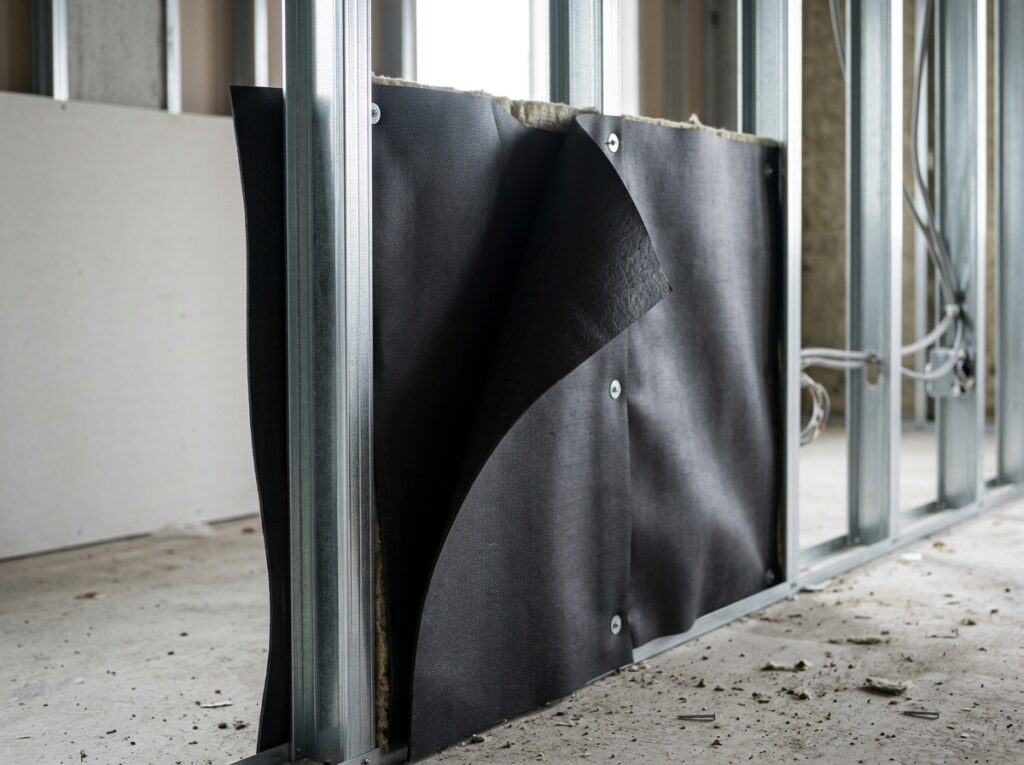
MLV can be incorporated into ceiling assemblies to provide an additional barrier against airborne sound transmission. Commercial MLV systems are specifically marketed for ceiling applications, including installation over suspended ceilings, studs, or joists.
In some situations, barrier-decoupler products combine MLV with a foam layer to improve acoustic separation while also providing a decoupling function.
The appropriate system depends on whether the problem is primarily airborne sound, impact noise, vibration, or a combination.
Controlling Noise Between Floors
Imagine an office below a busy commercial space.
The occupants may hear:
- Footsteps
- Equipment
- Moving furniture
- Voices
- Music
- General activity
MLV can be incorporated into floor assemblies as part of a broader sound-control strategy.
However, this is where it becomes especially important to identify the type of noise.
Airborne Noise
Voices, television, music, and similar sounds travelling through the building.
Impact Noise
Footsteps, dropped objects, furniture movement, and other physical impacts.
MLV can contribute to floor sound isolation, but impact noise may require resilient underlayments, floating floors, decoupling, or other vibration-control measures.
One material should not be expected to solve every form of building noise.
MLV for Mechanical and Equipment Noise
Commercial and industrial buildings often contain equipment that produces unwanted sound.
Examples include:
- Pumps
- HVAC equipment
- Generators
- Compressors
- Machinery
- Mechanical systems
- Ductwork
- Pipes
A machine enclosure may require both sound absorption and sound isolation.
MLV can serve as a barrier layer in equipment enclosures and around certain mechanical systems. Commercial MLV products are also specified for machinery enclosures, ductwork, pipes, and HVAC applications.
For mechanical noise, however, vibration isolation is equally important.
If equipment is physically transmitting vibration into the structure, simply adding a heavy barrier around it may not address the main transmission path.
MLV Around Ducts and Pipes
Ductwork can become an unexpected pathway for noise.
Sound generated in a mechanical area can travel through ducts and emerge somewhere else.
Similarly, pipes can transmit or radiate unwanted noise.
MLV-based barrier systems can be incorporated around certain ducts and pipes to help reduce sound transmission.
Commercial barrier products are specifically offered for HVAC ducts, PVC waste pipes, machinery, and similar applications.
The design needs to account for:
- Access requirements
- Temperature
- Mechanical movement
- Fire requirements
- Service penetrations
- Seams
- Attachment
- Maintenance
This is why mechanical soundproofing should be designed as part of the overall building system rather than treated as a simple wrapping exercise.
The Importance of Sealing
A sound barrier can be heavy and technically impressive, but an opening can undermine its effectiveness.
Sound can travel through:
- Electrical boxes
- Pipe penetrations
- Duct openings
- Wall joints
- Ceiling edges
- Door gaps
- Service penetrations
This is why professional sound isolation focuses heavily on continuity and airtight detailing.
Current technical guidance from acoustic specialists emphasizes that MLV performs best as part of a complete assembly with properly sealed seams and penetrations rather than as an isolated material.
In practical terms:
A barrier is only as effective as the weakest major opening in the system.
MLV and Wall Construction
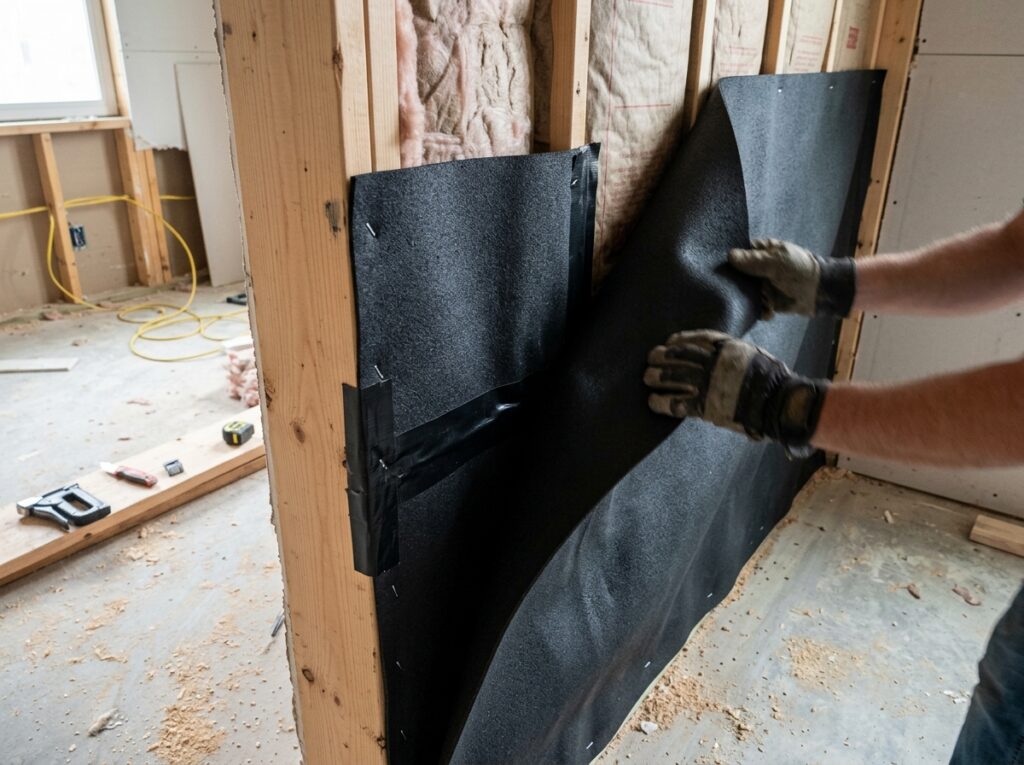
A common professional wall strategy might look conceptually like this:
Existing Structure
↓
Framing / Cavity
↓
Acoustic Insulation
↓
MLV Barrier
↓
Gypsum or Other Rigid Board
↓
Finish Layer
The exact arrangement can vary substantially.
Another project may use:
Stud Wall → MLV → Resilient Channel → Gypsum Board → Second Gypsum Layer
The purpose is to combine several acoustic principles.
Mass
MLV and board layers increase resistance to airborne transmission.
Absorption
Cavity insulation reduces sound energy within the wall cavity.
Decoupling
Resilient systems reduce direct structural connections.
Damping
Specialized compounds can reduce vibration within rigid layers.
Sealing
Acoustic sealants close unwanted air paths.
This layered approach is why MLV is most effective when treated as one component of a soundproofing system.
A Thin Material With a Serious Job
One reason MLV is attractive for renovation projects is its relatively thin profile.
Adding another heavy structural wall can consume valuable floor space.
MLV can provide additional mass without requiring a wall to become dramatically thicker.
This can be useful in:
- Apartments
- Hotels
- Offices
- Recording spaces
- Existing commercial buildings
- Renovation projects
- Interior partitions
However, “thin” should not be confused with “light.”
MLV is intentionally dense.
That density can make larger rolls physically demanding to handle during installation.
MLV in Hotels and Hospitality Projects
Hotels need acoustic privacy.
Guests expect to sleep without hearing excessive noise from neighbouring rooms, corridors, equipment, or service areas.
MLV can be incorporated into wall, ceiling, and floor assemblies as part of a broader sound-isolation strategy.
Potential applications include:
- Guest-room partitions
- Corridor walls
- Conference rooms
- Restaurant areas
- Mechanical rooms
- Service areas
- Floor assemblies
The objective is to prevent the hotel’s acoustic environment from becoming a source of complaints.
MLV for Recording and Media Spaces
Studios require particularly careful sound isolation.
The room may need to prevent sound from escaping.
External noise may also need to be kept outside.
MLV can be incorporated into wall, ceiling, and floor assemblies as one of several isolation layers.
However, a recording room should not rely on MLV alone.
A complete design may also require:
- Decoupled walls
- Multiple board layers
- Acoustic insulation
- Damping compounds
- Acoustic doors
- Sealed windows
- Ventilation silencers
- Floating floors
The MLV acts as a barrier layer, while the rest of the construction addresses other transmission paths.
Why Low-Frequency Noise Requires More Than One Material
Low-frequency noise can be particularly difficult to control.
Bass from music, generators, machinery, and other sources can travel through building structures and can produce noticeable vibration.
Mass can help resist airborne transmission, which is one reason dense barriers such as MLV are used in sound-isolation assemblies.
But low-frequency and structure-borne problems can require additional strategies.
These may include:
- Decoupling
- Vibration isolation
- Floating floors
- Resilient mounts
- Damping
- Increased structural mass
- Mechanical isolation
MLV can therefore be useful, but it should not be marketed as a universal solution for every low-frequency problem.
MLV vs Acoustic Insulation
These materials perform different roles.
| Material | Primary Function |
|---|---|
| Mass Loaded Vinyl | Sound transmission barrier |
| Mineral Wool | Cavity absorption |
| Acoustic PET | Room sound absorption |
| Wood Wool | Room sound absorption |
| Acoustic Foam | Sound absorption |
| Resilient Channel | Structural decoupling |
| Acoustic Sealant | Airtight sealing |
The strongest assemblies often combine multiple materials.
For example:
MLV + Mineral Wool + Decoupled Gypsum
can perform very differently from MLV installed alone.
This is why choosing a “best acoustic material” without understanding the actual sound path can lead to poor results.
MLV for Commercial Projects in Abidjan
For businesses, acoustic privacy can directly influence the quality of the working environment.
Potential applications include:
Corporate Offices
Improve privacy between departments and meeting spaces.
Healthcare Facilities
Support privacy between consultation and treatment rooms.
Hotels
Improve separation between guest rooms and service spaces.
Restaurants
Help isolate dining spaces from kitchens and mechanical areas.
Studios
Support sound isolation around recording and media rooms.
Industrial Facilities
Help contain equipment and machinery noise.
Residential Buildings
Strengthen partitions between neighbouring spaces.
Each application requires a different approach.
What Makes an MLV Installation Successful?
The material itself is only part of the equation.
A successful installation depends on:
Continuous Coverage
Avoid unnecessary breaks in the barrier.
Correct Overlaps
Joints should be detailed according to the selected system.
Proper Fastening
The material needs to remain securely positioned.
Sealed Penetrations
Electrical, plumbing, and mechanical penetrations need attention.
Correct Integration
The MLV should work with the other layers of the wall, floor, or ceiling.
Appropriate Finishing
The barrier should be protected by the specified finish assembly where required.
Professional Coordination
Doors, windows, HVAC, electrical systems, and other weak points should be considered.
A Better Way to Approach Soundproofing Projects
Instead of starting with:
“How much MLV do we need?”
Start with:
“Where is the sound coming from, and how is it reaching the room?”
That question changes the entire project.
A professional assessment may identify several transmission routes.
For example:
Noise Source
↓
Wall
↓
Ceiling Plenum
↓
Adjacent Room
or:
Mechanical Equipment
↓
Vibration
↓
Building Structure
↓
Occupied Space
In the first example, a barrier-based wall or ceiling assembly may be appropriate.
In the second, vibration isolation may be much more important.
MLV becomes valuable when it is specified according to the actual transmission path.
MLV Is Not a Visible Acoustic Decoration
This is another major difference between MLV and many acoustic products.
PET panels can become feature walls.
Wood wool can become a visible ceiling.
Slatted wood panels can become architectural elements.
MLV is different.
Its value is primarily inside the construction.
Once installed correctly, it may disappear behind the final finish.
That makes it especially useful for projects where the client wants improved sound isolation without changing the appearance of the completed interior.
Planning an MLV Soundproofing Project
A professional project can follow a structured process.
01 — Identify the Noise
Determine whether the problem is airborne, impact, structural vibration, or a combination.
02 — Locate the Transmission Path
Inspect walls, ceilings, floors, doors, windows, ducts, and penetrations.
03 — Evaluate the Existing Construction
Understand what materials are already present.
04 — Develop the Acoustic Assembly
Select MLV, insulation, decoupling, damping, and board layers as required.
05 — Detail Weak Points
Pay particular attention to doors, electrical outlets, pipes, ducts, joints, and edges.
06 — Install the Barrier
Maintain continuity and follow the product manufacturer’s installation requirements.
07 — Complete the Finish
Install the final wall, ceiling, or floor surface.
08 — Review the Result
Where appropriate, verify performance against the project’s acoustic objectives.
Frequently Asked Questions
What is Mass Loaded Vinyl?
Mass Loaded Vinyl is a dense, flexible barrier material designed primarily to reduce airborne sound transmission through building assemblies.
Is MLV the same as an acoustic panel?
No. Acoustic panels primarily absorb sound reflections inside a room, while MLV is primarily used as a sound transmission barrier.
Where can MLV be installed?
It can be incorporated into walls, ceilings, floors, machinery enclosures, ductwork, pipes, and other sound-isolation applications.
Can MLV be used in office walls?
Yes. It can be incorporated into partition assemblies to help reduce airborne sound transmission and improve speech privacy.
Can MLV help with ceiling noise?
Yes. MLV can be incorporated into ceiling assemblies and suspended-ceiling systems to reduce airborne sound transmission, depending on the construction.
Does MLV absorb sound?
Its primary function is blocking/reducing sound transmission, not absorbing reflected sound within a room. Additional absorptive materials may be required.
Does MLV completely soundproof a room?
No. Effective sound isolation usually requires a complete assembly addressing mass, absorption, decoupling, damping, airtightness, and potential flanking paths.
Can MLV stop footsteps?
Not necessarily. Footstep noise is impact/structure-borne noise and may require resilient underlayments, floating floors, or vibration-isolation techniques in addition to barrier layers.
Is thicker MLV always better?
Greater mass can improve barrier performance, but the correct specification depends on the entire wall, ceiling, or floor assembly. More material is not automatically the best solution.
Building Quieter Spaces From the Inside Out
The most effective soundproofing solutions are often the ones you never see.
Behind a finished wall, a dense flexible barrier can provide another layer of resistance against unwanted sound.
Above a ceiling, it can help strengthen the separation between spaces.
Within a floor assembly, it can contribute to a broader sound-control strategy.
Around equipment and mechanical systems, it can become part of a containment solution.
That is the role of Mass Loaded Vinyl.
For offices, apartments, hotels, studios, commercial buildings, mechanical areas, and other projects in Abidjan, Côte d’Ivoire, MLV can provide an important layer within a professionally designed sound-isolation system.
But the strongest results come from treating it as part of a complete solution rather than expecting one material to solve every noise problem.
The goal isn’t simply to add more mass. It’s to build the right acoustic barrier around the way sound actually travels.