
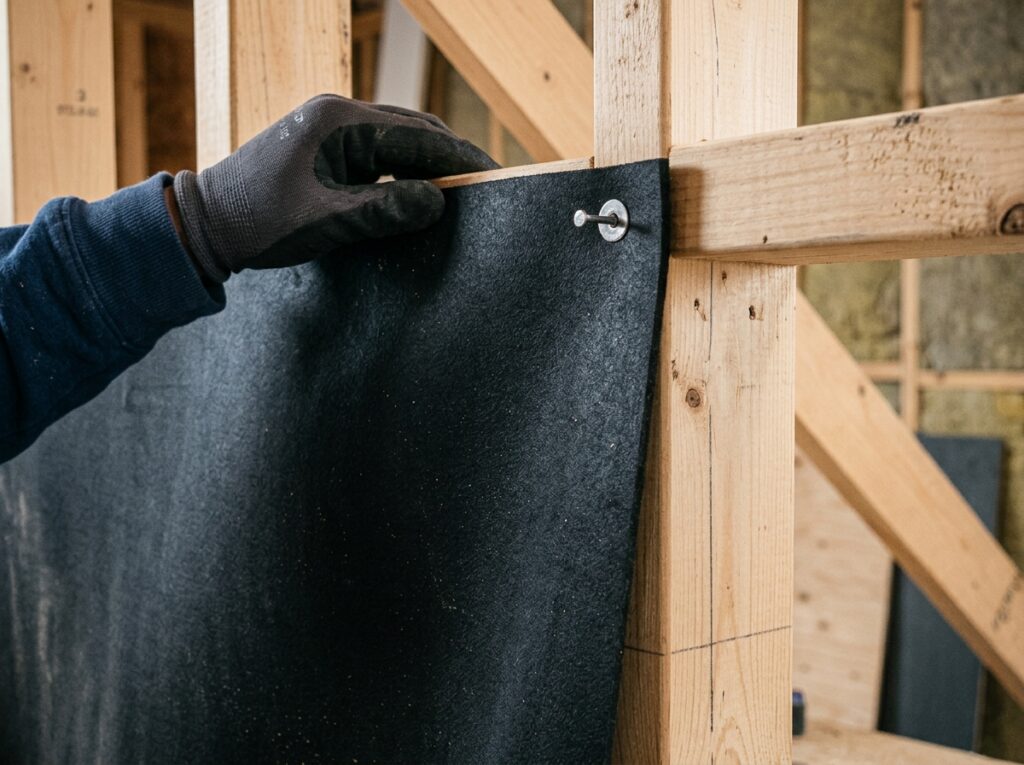
Sound can travel through a building in more ways than people often realize. A conversation from an adjacent room, television noise through a shared wall, mechanical equipment vibration, or noise moving through a ceiling can all affect the comfort and privacy of an interior space.
When conventional construction does not provide enough resistance to airborne sound transmission, Mass Loaded Vinyl (MLV) can become an important component of a professionally designed sound isolation system.
MLV is a dense, flexible barrier specifically designed to reduce sound transmission. Unlike acoustic wall panels that primarily absorb reflections inside a room, MLV is installed within or around building assemblies to help prevent airborne sound from passing from one area to another.
For residential, commercial, hospitality, office, studio, and mechanical applications in Maseru, Lesotho, MLV can provide additional mass without requiring the same thickness as many conventional rigid materials.
However, its effectiveness depends heavily on how it is incorporated into the complete construction assembly.
Why Sound Isolation Requires More Than a Heavy Wall
A common assumption is that simply making a wall heavier will solve every noise problem.
Mass certainly plays an important role in sound isolation, but buildings contain many potential sound paths.
Noise can travel through:
- Shared walls
- Ceilings
- Floors
- Doors
- Windows
- HVAC systems
- Pipes
- Electrical penetrations
- Structural connections
- Gaps around partitions
- Building service openings
This means that a wall can have a substantial sound barrier but still perform poorly if sound finds an easier path around it.
MLV is therefore best understood as one layer within a larger sound isolation strategy.
Professional systems may combine MLV with gypsum board, acoustic insulation, resilient channels or clips, damping compounds, acoustic sealants, and other construction techniques depending on the noise problem.
What Is Mass Loaded Vinyl?
Mass Loaded Vinyl is a high-density, flexible sheet material used as an acoustic barrier.
Its basic principle is relatively straightforward:
Add significant mass without adding excessive thickness.
The material is flexible rather than rigid, allowing it to function differently from conventional boards.
When properly incorporated into a wall or ceiling assembly, its mass helps resist airborne sound transmission while its flexible construction contributes to the overall barrier system.
Commercial MLV products are available in different weights and thicknesses. For example, published specifications from Acoustical Surfaces list products at approximately 0.5, 1, and 2 lb/ft², with corresponding thickness variations. Their published laboratory data also show that transmission loss varies by frequency and barrier weight.
This illustrates an important point:
There is no single MLV specification that is automatically correct for every project.
The appropriate barrier depends on the construction, available space, noise source, required performance, and installation method.
MLV and the Difference Between Sound Absorption and Sound Isolation
One of the most important concepts in acoustic construction is understanding the difference between absorption and isolation.
Acoustic PET panels, wood wool panels, fabric panels, and similar treatments are generally used to absorb reflected sound within a room.
MLV serves a different purpose.
Its primary role is to help reduce sound transmission through a building assembly.
For example:
Acoustic treatment
A large office has excessive echo and conversations sound unclear.
The solution may involve sound-absorbing ceiling or wall treatment.
Sound isolation
Noise from one office is travelling through the partition into another office.
The solution may require improving the wall’s sound isolation using mass, decoupling, cavity treatment, sealing, and potentially MLV.
The two problems can exist simultaneously, but they require different solutions.
Using MLV in Wall Assemblies
Walls are one of the most common applications for Mass Loaded Vinyl.
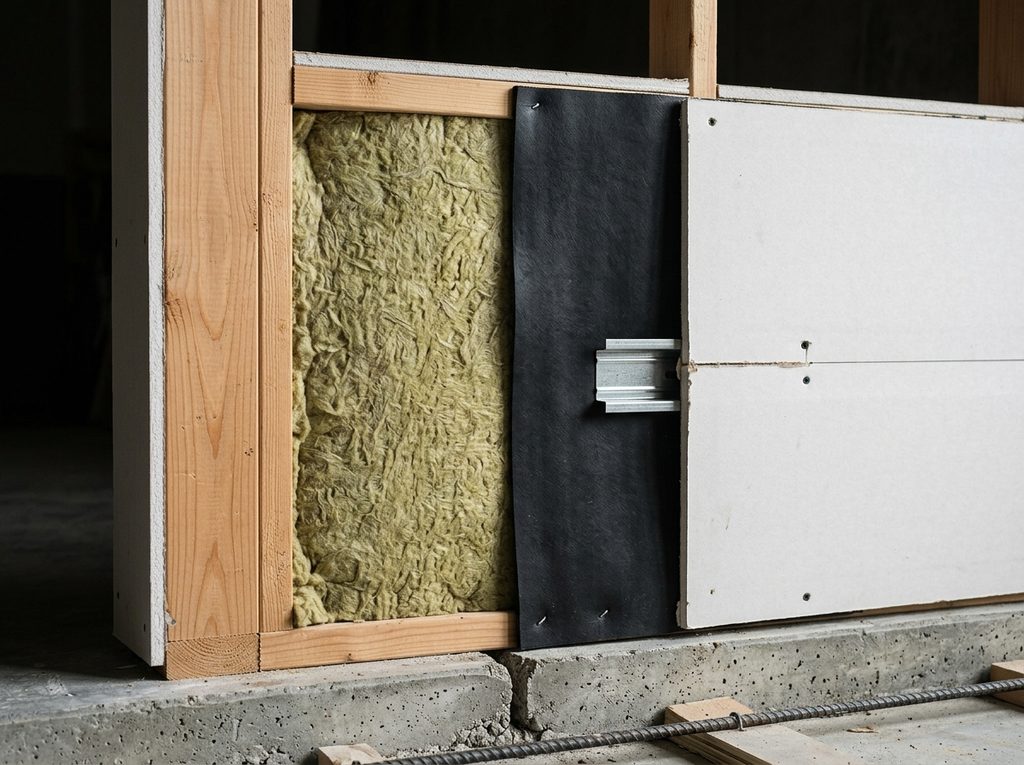
A typical sound isolation strategy may involve placing MLV within a wall assembly before the final drywall layers are installed.
Depending on the construction, a system may include:
- Structural framing
- Acoustic insulation within the cavity
- Mass Loaded Vinyl
- Gypsum board
- Additional mass or damping layer
- Acoustic sealant around critical joints
The exact arrangement should be designed according to the required acoustic performance.
MLV can also be incorporated into retrofit projects where existing walls need additional sound isolation and available wall thickness is limited.
Published installation guidance shows MLV being installed over studs or existing surfaces, with particular attention given to seams, penetrations, and perimeter sealing.
Shared Walls and Privacy
Shared walls can create significant privacy problems.
In residential environments, sound may pass between neighbouring rooms or units.
In commercial buildings, conversations can travel from:
- Meeting rooms
- Private offices
- Consultation rooms
- Management offices
- Conference spaces
Improving the sound isolation of the partition can help reduce airborne transmission.
MLV may be incorporated as an additional barrier within such assemblies.
However, the entire wall must be considered.
If the wall is improved but sound can still travel through the ceiling void, floor, door, or adjacent partition, the overall result may remain disappointing.
This is why professional acoustic assessment is valuable before specifying the material.
MLV for Ceiling Sound Isolation
Noise does not only travel horizontally.
In multi-level buildings, sound can also move through ceiling and floor assemblies.
Examples include:
- Footstep-related noise
- Voices
- Television
- Music
- Equipment noise
- General airborne sound
MLV can be incorporated into ceiling assemblies to increase resistance to airborne sound transmission.
Published MLV installation information includes applications over ceiling joists and suspended-ceiling systems, with mechanical fastening recommended for certain ceiling installations.
But ceiling projects require careful detailing.
The barrier needs to maintain continuity around:
- Light fixtures
- HVAC openings
- Pipes
- Electrical services
- Ceiling edges
- Structural penetrations
A poorly sealed ceiling can undermine an otherwise substantial sound isolation upgrade.
Floors and Building Noise
MLV can also be incorporated into floor assemblies.
Depending on the construction, it may be installed below floor finishes or within a layered floor system.
However, floor noise requires careful diagnosis.
There is a major difference between:
Airborne noise
and
Impact or structure-borne noise.
A voice travelling through a floor is an airborne transmission problem.
Footsteps or an object striking the floor create impact energy that travels through the building structure.
MLV may form part of a floor sound-control system, but impact noise may require additional measures such as resilient underlay, floating floors, isolation layers, or other vibration-control methods.
The correct solution depends on the type of noise rather than simply the location of the problem.
Controlling Mechanical and Equipment Noise
MLV has applications beyond conventional walls.
Dense flexible barriers can be incorporated into:
- Machinery enclosures
- Mechanical rooms
- HVAC systems
- Ductwork
- Pipe assemblies
- Equipment barriers
- Generator enclosures
- Production areas
Manufacturers list MLV applications involving machinery, HVAC equipment, ducts, pipes, equipment enclosures, and industrial noise barriers.
This makes the material particularly useful when the objective is to contain airborne noise generated by equipment.
However, machinery often creates both airborne noise and vibration.
In such cases, the acoustic design may also require:
- Vibration isolation mounts
- Flexible connectors
- Resilient supports
- Equipment enclosures
- Damping
- Acoustic barriers
Simply wrapping equipment with a dense barrier does not necessarily solve structure-borne vibration.
MLV for Offices in Maseru
Modern offices require both communication and privacy.
An open office can have excessive background noise, while private offices and meeting rooms can have unwanted sound transfer between spaces.
MLV can be incorporated into selected partition assemblies where airborne sound isolation is an important objective.
Potential applications include:
| Office Area | Potential Sound-Control Objective |
|---|---|
| Executive office | Improve speech privacy |
| Meeting room | Reduce sound transmission |
| Conference room | Strengthen partition isolation |
| Consultation room | Improve confidentiality |
| Private workspace | Reduce neighbouring noise |
| Training room | Control transmission to adjacent spaces |
| Mechanical room | Contain equipment noise |
The appropriate construction depends on the building and the specific acoustic requirement.
MLV in Hospitality Spaces
Hotels and hospitality environments require careful consideration of acoustic privacy.
Guests may be affected by noise from:
- Adjacent rooms
- Corridors
- Mechanical systems
- Service areas
- Common spaces
MLV may be incorporated into wall, ceiling, or equipment assemblies where additional airborne sound isolation is required.
For example, a partition between a guest room and a noisy service area may require more than conventional drywall construction.
A properly designed acoustic assembly can combine:
Mass + cavity absorption + decoupling + sealing + flexible barrier layers
rather than relying on MLV alone.
MLV for Studios and Media Rooms
Studios and media rooms can have demanding acoustic requirements.
The objective may include reducing sound transmission between the room and adjacent spaces.
MLV can be integrated into walls and ceilings as part of a layered isolation system.
However, studios require special attention to low frequencies.
Bass energy can be particularly difficult to isolate because low-frequency wavelengths are long and can interact strongly with building structures.
For this reason, a studio soundproofing system may require:
- Multiple layers of mass
- Decoupled walls
- Isolated ceilings
- Acoustic insulation
- Damping
- Sealed doors
- Special acoustic glazing
- Floor isolation
MLV can contribute to the system but should not be presented as a complete studio soundproofing solution by itself.

Why Sealing Is So Important
One of the most overlooked aspects of soundproofing is sealing.
Imagine building a wall with a continuous acoustic barrier and then leaving openings around electrical boxes, pipes, ducts, or perimeter joints.
Sound can exploit those openings.
That is why MLV installations require careful attention to seams, edges, penetrations, and transitions.
Published installation guidance specifically recommends sealing seams, perimeter areas, cracks, and penetrations with appropriate acoustic sealants.
A professional installation should therefore focus not only on putting the MLV onto the wall but also on maintaining the continuity of the sound barrier.
The Importance of Decoupling
Mass and sealing are important, but some projects require another principle:
Decoupling.
If two surfaces are rigidly connected, vibration can travel through those connections.
Decoupling systems can reduce direct mechanical connections between layers.
Examples include:
- Resilient channels
- Isolation clips
- Independent framing
- Resilient mounts
Commercial soundproofing systems frequently combine mass, damping, and decoupling because each addresses a different part of the transmission problem.
MLV can then become another layer within the assembly.
MLV Is Not a Standalone Miracle Material
The popularity of MLV sometimes creates unrealistic expectations.
Installing MLV does not automatically make a room completely soundproof.
Its performance depends on:
- Barrier weight
- Wall construction
- Number of layers
- Framing
- Decoupling
- Cavity insulation
- Sealing
- Doors
- Windows
- Flanking paths
- Noise frequency
- Installation quality
Even published MLV transmission-loss data vary with barrier weight and frequency, demonstrating why the material should be specified according to the actual project rather than treated as a universal solution.
Choosing the Right MLV Specification
MLV products are available in different weights and thicknesses.
A heavier barrier can provide greater transmission resistance in appropriate assemblies, but increasing weight also affects handling, structural considerations, and installation requirements.
For example, one published product range lists:
| Approx. Barrier Weight | Approx. Thickness |
|---|---|
| 0.5 lb/ft² | 1/16 inch |
| 1 lb/ft² | 1/8 inch |
| 2 lb/ft² | 1/4 inch |
These are examples from one manufacturer’s product range rather than universal specifications.
The correct selection should therefore be based on the complete acoustic assembly and project requirements.
Common MLV Installation Mistakes
Even a suitable material can perform poorly if installed incorrectly.
Incomplete coverage
Leaving significant areas uncovered can interrupt the barrier.
Unsealed seams
Gaps between sheets can become sound transmission paths.
Poor perimeter detailing
Edges around walls and ceilings require careful sealing.
Unsealed penetrations
Electrical boxes, pipes, ducts, and other services need appropriate treatment.
Ignoring flanking paths
Sound may bypass the improved wall through ceilings, floors, or adjacent structures.
Treating MLV as acoustic absorption
MLV is primarily a sound isolation barrier, not an echo-control panel.
Ignoring vibration
Mechanical equipment may require vibration isolation in addition to airborne sound barriers.
Professional MLV Soundproofing in Maseru
A successful sound isolation project should begin with identifying where the noise originates and how it travels.
A professional service can include:
- Site inspection
- Noise-source assessment
- Identification of airborne and structure-borne transmission
- Wall and ceiling analysis
- Soundproofing system design
- MLV specification
- Acoustic insulation selection
- Decoupling strategy
- Acoustic sealing
- Installation
- Final inspection
This approach avoids simply adding materials without understanding the actual transmission path.
Applications Across Maseru
Mass Loaded Vinyl can be considered for a variety of environments in Maseru where airborne sound transmission is a concern.
| Environment | Potential Application |
|---|---|
| Residential buildings | Shared walls and ceilings |
| Apartments | Neighbouring-room sound isolation |
| Offices | Privacy partitions |
| Meeting rooms | Speech containment |
| Hotels | Guest-room partitions |
| Studios | Wall and ceiling isolation |
| Media rooms | Sound containment |
| Mechanical rooms | Equipment noise barriers |
| HVAC systems | Duct noise control |
| Industrial spaces | Machinery enclosures |
The final system should always be designed according to the building construction and acoustic objective.
Building a Complete Sound Isolation System
The strongest results usually come from combining several acoustic principles.
A professionally designed wall might use:
Framing → cavity insulation → MLV barrier → resilient isolation → gypsum board → acoustic sealant
The exact arrangement can vary considerably depending on the required performance.
The same principle applies to ceilings, floors, equipment enclosures, and mechanical systems.
The objective is not simply to install more material.
The objective is to create a continuous and appropriately engineered barrier between the noise source and the receiving space.
Final Thoughts
Mass Loaded Vinyl provides a useful way to introduce high-density, flexible sound-barrier material into walls, ceilings, floors, mechanical enclosures, ductwork, and other sound isolation assemblies.
For projects in Maseru, Lesotho, it can be considered where airborne sound transmission is affecting privacy, comfort, communication, or the performance of a specialized space.
But MLV should be viewed as part of a system rather than a standalone answer.
The most important factors include the type of noise, transmission path, barrier weight, construction method, sealing, decoupling, cavity treatment, and overall assembly.
When these elements are properly coordinated, MLV can become an important component of a professional soundproofing strategy.
Frequently Asked Questions
What does Mass Loaded Vinyl do?
MLV is a dense, flexible acoustic barrier designed primarily to reduce airborne sound transmission through building assemblies.
Is MLV the same as an acoustic panel?
No. Acoustic panels primarily absorb reflected sound within a room, while MLV is primarily used to improve sound isolation between spaces.
Can MLV be installed inside walls?
Yes. It can be incorporated into wall assemblies and installed over framing before finishing layers are applied.
Can MLV be used in ceilings?
Yes. MLV is used in ceiling sound isolation systems, although ceiling installation requires careful mechanical fastening and seam/perimeter treatment.
Can MLV be used for floors?
Yes. MLV can be incorporated into certain floor assemblies, but the appropriate system depends on whether the project is addressing airborne sound, impact noise, or both.
Does MLV stop all noise?
No. Its effectiveness depends on the complete construction assembly. Flanking paths, vibration, doors, windows, ceilings, and other weak points can affect the final result.
Is thicker MLV always better?
Greater mass can improve transmission resistance in appropriate applications, but the best specification depends on the entire assembly, available space, structural considerations, and required acoustic performance.
Can MLV help with machinery noise?
Yes. MLV barriers are used in equipment enclosures and mechanical applications, including HVAC and machinery-related noise control. However, vibration isolation may also be required for structure-borne noise.
Why is acoustic sealing important?
Gaps and penetrations can create sound paths that bypass the barrier. Properly sealing seams, edges, cracks, and service penetrations helps maintain continuity of the sound isolation assembly.
Should MLV be professionally installed?
For demanding soundproofing projects, professional design and installation are recommended because MLV works as one component of a larger acoustic system. Correct detailing can be just as important as the barrier material itself.