Introduction
Creating a comfortable indoor environment involves more than selecting attractive furniture, flooring, and lighting. The way sound behaves inside a room can significantly affect how people communicate, concentrate, and enjoy their surroundings. Hard surfaces such as glass, concrete, tile, and plaster can reflect sound waves, creating excessive echo and making conversations difficult to understand.
For architects, interior designers, contractors, business owners, and property developers planning projects in Moroni, Comoros, acoustic PET panels offer a practical way to combine sound absorption with contemporary interior design.
Manufactured from polyester fibres, PET acoustic panels are available in a variety of thicknesses, colours, shapes, and configurations. They can be installed on walls, incorporated into selected ceiling systems, or cut into decorative patterns that complement modern interiors.
Their primary purpose is to reduce reflected sound and control reverberation within a room. Although they can improve the acoustic comfort of a space, they should not be confused with soundproofing barriers designed to prevent noise from travelling between rooms.
This guide explores how acoustic PET panels work, their applications in Moroni, important technical specifications, decorative possibilities, and the factors that influence their performance.
What Are Acoustic PET Panels?
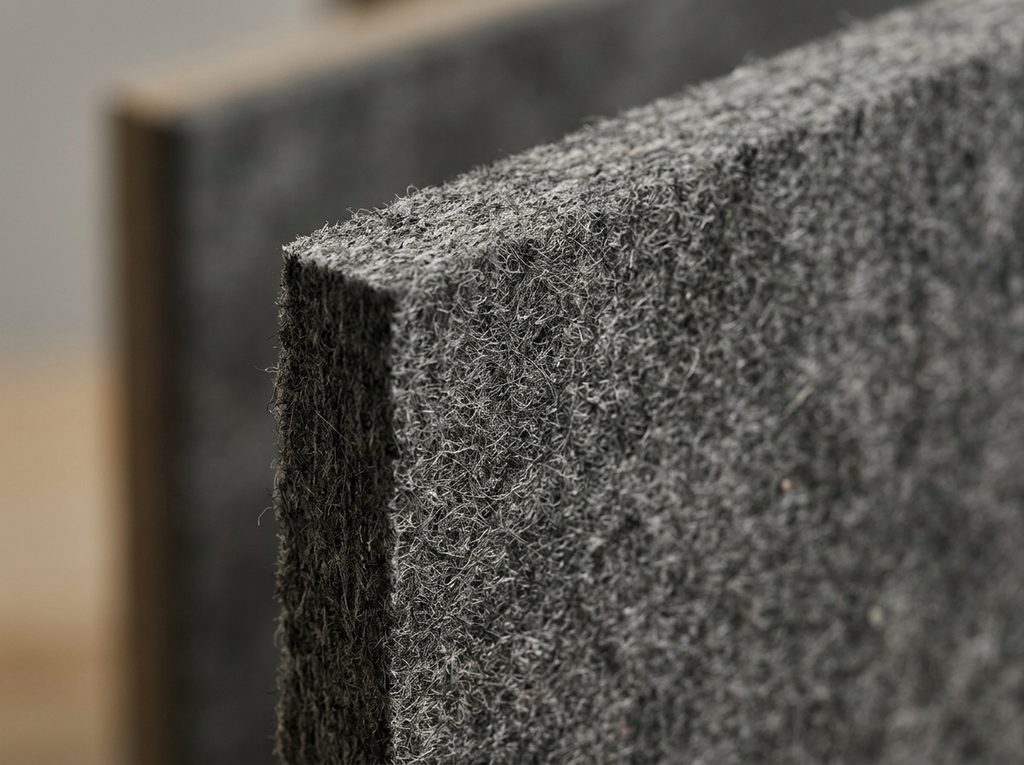
PET stands for polyethylene terephthalate, a polyester material used in textile fibres and various plastic products. Acoustic PET panels are made by forming polyester fibres into a porous, felt-like material that absorbs some of the sound energy reaching its surface.
Some manufacturers incorporate recycled PET content into their products, helping make use of recovered materials. However, recycled content varies by manufacturer and product, so buyers should verify environmental claims through relevant technical documentation.
PET acoustic panels are commonly available in several formats:
- Flat polyester-fibre wall panels.
- Decorative geometric panels.
- Three-dimensional embossed panels.
- Custom-cut acoustic feature walls.
- Ceiling clouds and suspended baffles.
- Acoustic screens and selected partition systems.
- Panels with printed designs or branded graphics.
The versatility of PET panels makes them suitable for projects where acoustic treatment must complement the overall interior design.
For example, GB Acoustics provides technical documentation for its PET felt products, including acoustic test reports, fire test reports, installation guidance, and maintenance information. This illustrates the importance of evaluating a panel through its documented performance rather than its appearance alone. Source: GB Acoustics technical documents
Why Consider PET Acoustic Panels in Moroni?
Different buildings have different acoustic needs. Offices require comfortable working conditions, educational facilities depend on clear speech, and hospitality interiors often need to balance lively social environments with reasonable listening comfort.
PET panels can help address these requirements by reducing reflected sound in suitable interior spaces.
1. Improve Speech Clarity
When sound reflects repeatedly from hard walls and ceilings, spoken words may overlap with their reflections. This can make conversations tiring and reduce speech intelligibility.
PET acoustic panels absorb some of this reflected sound, helping create a clearer listening environment when their thickness, coverage, and placement are appropriate.
They may be useful in meeting rooms, reception areas, classrooms, training facilities, and consultation rooms.
2. Create More Comfortable Commercial Interiors
Offices, shops, restaurants, and other commercial spaces can contain a mixture of conversations, movement, and equipment noise.
Excessive reverberation can make the environment feel louder than necessary. Strategically placed acoustic panels can help control reflections without requiring every wall to be covered.
The objective is to improve the acoustic environment while retaining an attractive and functional layout.
3. Add Decorative Value
One of the main advantages of PET panels is their design flexibility. They can be arranged in repeating patterns, contrasting colours, or custom shapes to create a distinctive interior feature.
For projects in Moroni, designers can select panel colours that complement existing finishes, furniture, lighting, and architectural details.
Decorative layouts should still be designed around acoustic requirements. A visually attractive pattern does not automatically provide sufficient sound absorption.
4. Support More Flexible Interior Planning
PET panels can be used on selected wall sections or integrated into appropriate ceiling arrangements. Depending on the product, they may also be cut to fit around design features or used as part of a freestanding screen.
This flexibility can help designers adapt acoustic treatment to rooms with different dimensions and functions.
5. Offer an Alternative to Conventional Decorative Finishes
Paint, stone, glass, tile, and other hard finishes may contribute to sound reflection. PET panels introduce a porous, sound-absorbing surface into the interior.
Using them on carefully selected areas can balance the room’s reflective finishes while creating a coordinated visual design.
How Do PET Acoustic Panels Absorb Sound?
When sound waves strike a porous PET panel, some of the sound energy enters the material. As air moves through the material’s fibrous structure, friction and other internal losses convert part of that acoustic energy into small amounts of heat.
The sound energy reflected back into the room is consequently reduced.
The amount absorbed depends on several factors:
- Panel thickness and density.
- Fibre structure and material composition.
- Frequency of the incoming sound.
- Installation method.
- Air space behind the panel.
- Total area of acoustic treatment.
- Position of the panels relative to major reflective surfaces.
PET panels are generally most effective when selected according to the frequencies and reverberation problems that need to be addressed. A thin panel installed directly against a wall may perform differently from a thicker panel or one mounted with a suitable air gap.
For this reason, technical test reports should be reviewed before specifying a product for a project.
Applications of Acoustic PET Panels in Moroni
Offices and Business Interiors
Office environments often combine open workstations, meeting rooms, reception counters, and collaborative areas. Conversations and telephone calls can create excessive reflected sound when the space contains many hard surfaces.
PET panels can be installed on selected walls or incorporated into ceiling treatments to help control reverberation.
For meeting rooms, designers should also consider room dimensions, ceiling height, glass partitions, and the location of people speaking and listening.
Schools and Training Facilities
Clear speech is essential in classrooms, training rooms, and learning spaces. When sound continues to reflect after an instructor speaks, learners may find it more difficult to follow explanations.
PET panels can help reduce reverberation when an appropriate quantity is installed in suitable locations.
Schools should also verify durability, cleaning requirements, fixing methods, and fire-performance documentation before choosing a panel system.
Hotels and Hospitality Spaces
Hotels, restaurants, cafés, reception areas, and lounges often use hard surfaces for visual appeal and ease of maintenance. However, these finishes can contribute to unwanted sound reflections.
Decorative PET panels can introduce sound absorption while complementing the interior design.
In restaurants, the amount and placement of treatment should reflect the desired atmosphere. The objective may be to reduce excessive noise while preserving the social character of the space.
Residential Interiors
Homes with tiled floors, large windows, bare walls, and limited soft furnishings may experience noticeable echo.
PET panels can be considered for living rooms, home offices, study areas, entertainment rooms, and other spaces where reflected sound is a concern.
Custom-cut panels may be used as feature walls, allowing acoustic treatment to become part of the interior design rather than an isolated technical addition.
Healthcare and Consultation Rooms
Reception areas, waiting rooms, consultation spaces, and administrative areas may benefit from reduced reverberation.
Before selecting PET panels for these environments, assess cleaning procedures, hygiene requirements, fire performance, and compatibility with the facility’s maintenance practices.
Acoustic treatment can improve the listening environment, but it does not by itself guarantee speech confidentiality between rooms.
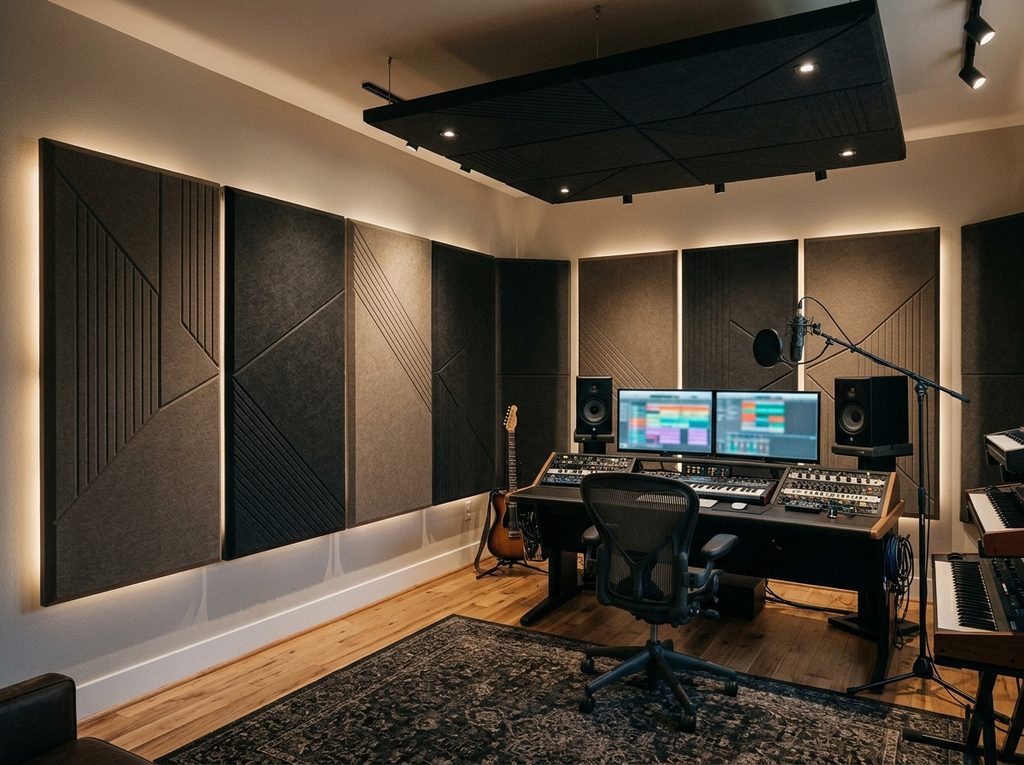
Creative Studios and Media Rooms
Recording rooms, podcast spaces, editing rooms, and media environments often require more detailed acoustic planning.
PET panels can reduce some reflections, particularly in the mid- and high-frequency ranges, depending on their construction and installation.
However, a recording room may also require low-frequency absorption, reflection control, diffusion, or sound isolation. PET panels alone should not be assumed to provide a complete studio acoustic solution.
Understanding NRC and Acoustic Performance
One of the most useful specifications when comparing acoustic panels is the Noise Reduction Coefficient, commonly abbreviated as NRC.
NRC is a single-number rating that summarises sound absorption across specified frequencies. A higher NRC generally indicates greater average absorption within the rating’s frequency range.
However, NRC does not describe every aspect of acoustic performance, particularly low-frequency behaviour. The rating should be considered alongside frequency-specific test results and installation details.
For example, published product information from MMT Acoustix lists NRC values that increase from 0.30 for a 9 mm PET panel to 0.60 for a 24 mm panel in the stated configuration. The same manufacturer lists a higher value for a particular thinner panel installed over an additional backing layer. These figures are product-specific and demonstrate how thickness and mounting conditions can influence performance. Source: MMT Acoustix technical specifications
When comparing panels, check:
- The tested panel thickness.
- The test standard used.
- Whether an air gap or additional backing was included.
- The frequency-specific absorption data.
- The amount of panel coverage required for the room.
- Whether the test configuration matches the intended installation.
Avoid assuming that two panels will perform identically just because they have similar colours, thicknesses, or appearances.
Choosing the Right PET Panel Thickness
Panel thickness is an important selection factor, but the best option depends on the room and the intended acoustic result.
| Panel category | Possible use | What to consider |
|---|---|---|
| Thin PET panels | Decorative wall treatment and selected reflective surfaces | Confirm whether absorption is sufficient for the room |
| Medium-thickness panels | General-purpose acoustic treatment | Review test results and coverage requirements |
| Thicker PET panels | Projects requiring greater absorption from wall-mounted treatment | Compare frequency-specific performance and installation depth |
| Panels with an air gap | Installations where additional depth is available | Verify the performance of the complete mounting assembly |
| Ceiling clouds or baffles | Suitable rooms with appropriate ceiling height and support | Check suspension, fixing, and maintenance requirements |
These categories are general guidance, not universal performance guarantees. The final specification should be based on the chosen manufacturer’s data and the room’s acoustic requirements.
Decorative Design Options for Modern Interiors
PET panels can serve as both an acoustic treatment and a visual design feature.
Geometric Patterns
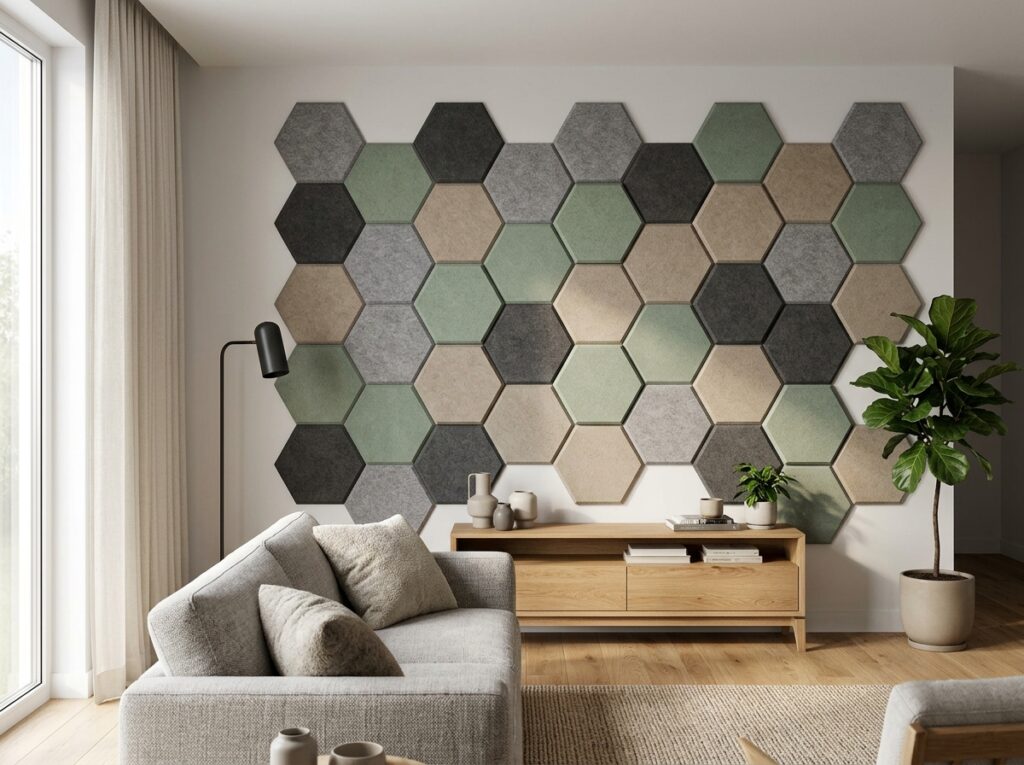
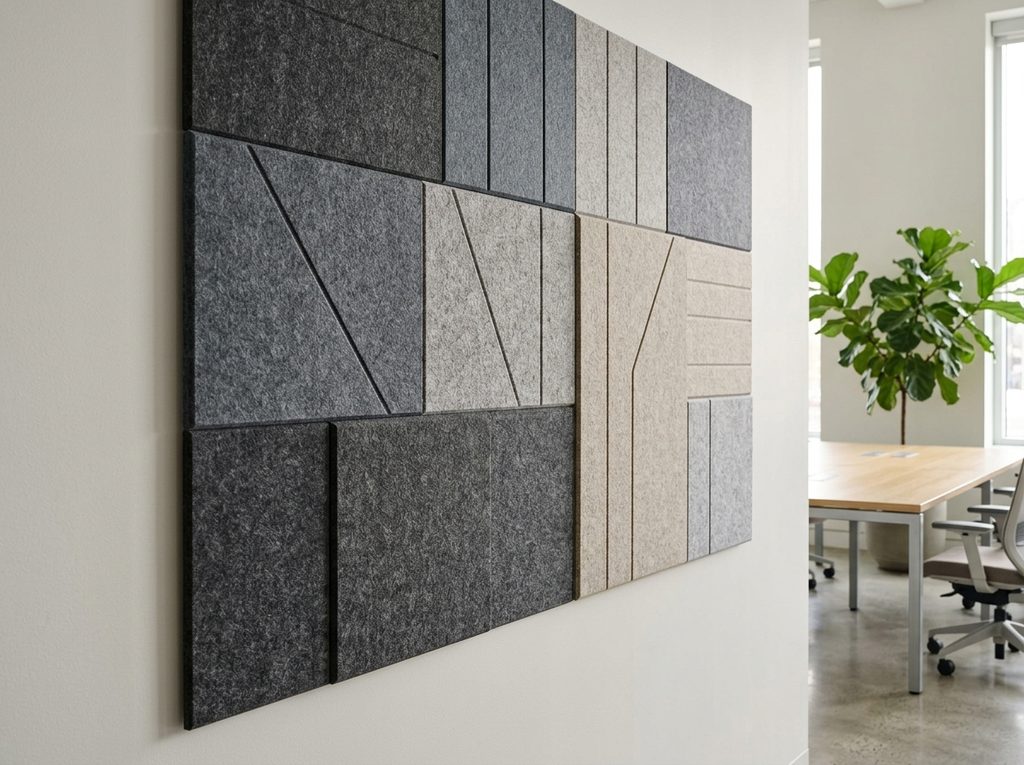
Panels can be arranged in squares, rectangles, triangles, hexagons, or other repeated forms. Different colours can create contrast or help define zones within an office or commercial interior.
Feature Walls
A selected wall can be treated with a coordinated panel layout that adds texture and visual depth. The amount of exposed PET surface should be chosen according to the acoustic objective rather than appearance alone.
Brand-Inspired Interiors
Some manufacturers offer printable or custom-cut panels. These options can support branded reception areas, corporate interiors, and selected commercial environments.
Verify the available surface finishes and whether printing affects cleaning, durability, or acoustic performance.
Ceiling Designs
PET panels may be used in ceiling clouds or suspended baffles where the product is designed for that purpose.
Ceiling-mounted treatment can be useful when wall space is limited, but it requires appropriate support, safe fixing, and coordination with lighting, ventilation, and other ceiling services.
Colour Coordination
Neutral shades can complement understated interiors, while contrasting colours can create a more prominent architectural feature.
Colour selection should also consider maintenance, lighting conditions, and how the panels relate to other finishes.
Installation Considerations for Projects in Moroni
Assess the Room Before Choosing Panels
Identify the room’s dimensions, ceiling height, major reflective surfaces, intended use, and main acoustic concerns.
For projects with demanding performance requirements, an acoustic assessment can help determine the appropriate quantity and placement of treatment.
Select Suitable Fixings
Depending on the product and surface, PET panels may be installed using approved adhesives, mechanical fixings, clips, or suspended systems.
The fixing method must be compatible with the substrate and the panel’s weight. Ceiling installations require particular attention to safe support.
Plan Coverage and Placement
Installing panels only because a wall looks empty may not deliver the best result. Consider the surfaces that contribute most to unwanted reflections and the positions of speakers and listeners.
The ideal arrangement varies between a classroom, a meeting room, a restaurant, and a home office.
Check Fire and Indoor-Air-Quality Documentation
Fire ratings and emissions information vary by product. For commercial, educational, healthcare, and public-use interiors, request documentation for the exact panel being specified.
Do not assume that every PET product has the same fire classification or indoor-air-quality performance.
Consider Cleaning and Maintenance
Cleaning requirements depend on the panel composition and finish. Confirm the manufacturer’s maintenance instructions before selecting panels for busy or hygiene-sensitive environments.
Confirm Supply and Project Timing
For projects in Moroni, check available dimensions, colour options, production lead times, shipping arrangements, packaging, and replacement availability before finalising the specification.
When ordering from overseas, include transport and any applicable import requirements in the project budget and schedule.
Acoustic PET Panels Versus Soundproofing Materials
PET panels and soundproofing materials serve different purposes.
PET acoustic panels primarily absorb reflected sound inside a room. They can help reduce echo and improve speech clarity.
Sound-isolation materials are designed to reduce sound travelling through walls, floors, ceilings, doors, and other building elements. These systems may require mass, airtight construction, decoupling, resilient components, and careful treatment of sound leakage paths.
For example, installing PET panels in a room may make it sound less echo-prone, but it will not automatically prevent music or conversation from travelling into an adjoining room.
Projects in Moroni should therefore begin by identifying whether the main problem is excessive reverberation, sound transmission, vibration, or a combination of these issues.
Common Mistakes to Avoid
- Selecting panels only by appearance: Decorative appeal does not establish acoustic performance.
- Expecting complete soundproofing: PET panels are primarily sound absorbers, not standalone sound-isolation barriers.
- Ignoring mounting conditions: An air gap or additional backing can affect absorption performance.
- Choosing insufficient coverage: Too little treatment may not address the room’s reverberation problem.
- Overlooking fire documentation: Confirm the classification of the exact product and installation.
- Installing panels without checking the substrate: Adhesives and fixings must suit the wall or ceiling.
- Ignoring low-frequency problems: Some bass and vibration issues require additional or different acoustic treatments.
Frequently Asked Questions
1. What are acoustic PET panels used for?
PET panels are primarily used to absorb reflected sound, reduce reverberation, and improve speech clarity in offices, classrooms, hotels, homes, restaurants, and other interior spaces.
2. Are PET acoustic panels suitable for projects in Moroni?
They can be suitable for a range of residential and commercial interiors in Moroni. The correct product depends on the room’s dimensions, acoustic requirements, installation conditions, and maintenance needs.
3. Do PET panels completely block outside noise?
No. PET panels mainly control sound reflections within a room. Reducing outside noise generally requires attention to windows, doors, walls, gaps, and other sound-transmission paths.
4. Are PET acoustic panels available in different colours?
Many manufacturers offer multiple colours, shapes, and decorative configurations. Custom options depend on the product range and supplier.
5. Does a thicker PET panel always perform better?
Not in every situation. Thickness, density, material structure, mounting conditions, and the frequency of the sound all affect performance. Compare the relevant test reports before selecting a product.
6. Are all PET panels manufactured from recycled plastic?
No. Recycled content varies. Check the manufacturer’s material declaration and supporting documentation if recycled content is an important project requirement.
7. Can PET panels be installed on ceilings?
Some products are designed for ceiling clouds or baffles. Confirm the manufacturer’s installation guidance, support requirements, and suitability for overhead use before installation.
8. How can buyers compare PET acoustic panels?
Compare material composition, thickness, density, NRC, frequency-specific absorption data, test standards, mounting conditions, fire documentation, maintenance requirements, dimensions, and total delivered cost.
Conclusion
Acoustic PET panels provide a versatile option for improving indoor sound quality while supporting modern interior design. For projects in Moroni, Comoros, they can help control excessive reverberation in offices, educational facilities, hospitality venues, residential spaces, and other environments where clear communication and acoustic comfort matter.
The most effective selection combines visual preferences with documented acoustic performance. Panel thickness, mounting method, coverage, fire requirements, and maintenance considerations should all be evaluated before installation.
By understanding the difference between sound absorption and sound isolation, comparing product specifications carefully, and planning panel placement around the room’s needs, project teams can make better-informed decisions about acoustic PET panels.
Explore PET acoustic panel options, compare verified performance data, and choose a sound-absorbing design suited to your next interior project in Moroni.