
Noise control is an important consideration in modern buildings, particularly in busy urban environments where residential, commercial and industrial activities often take place close together. In Mogadishu, Somalia, improving indoor acoustic comfort can make a meaningful difference in homes, offices, hotels, educational facilities and commercial properties. Whether the concern is conversations passing between rooms, television noise, equipment sounds or disturbances from neighbouring spaces, choosing suitable sound insulation materials is an important part of building design.
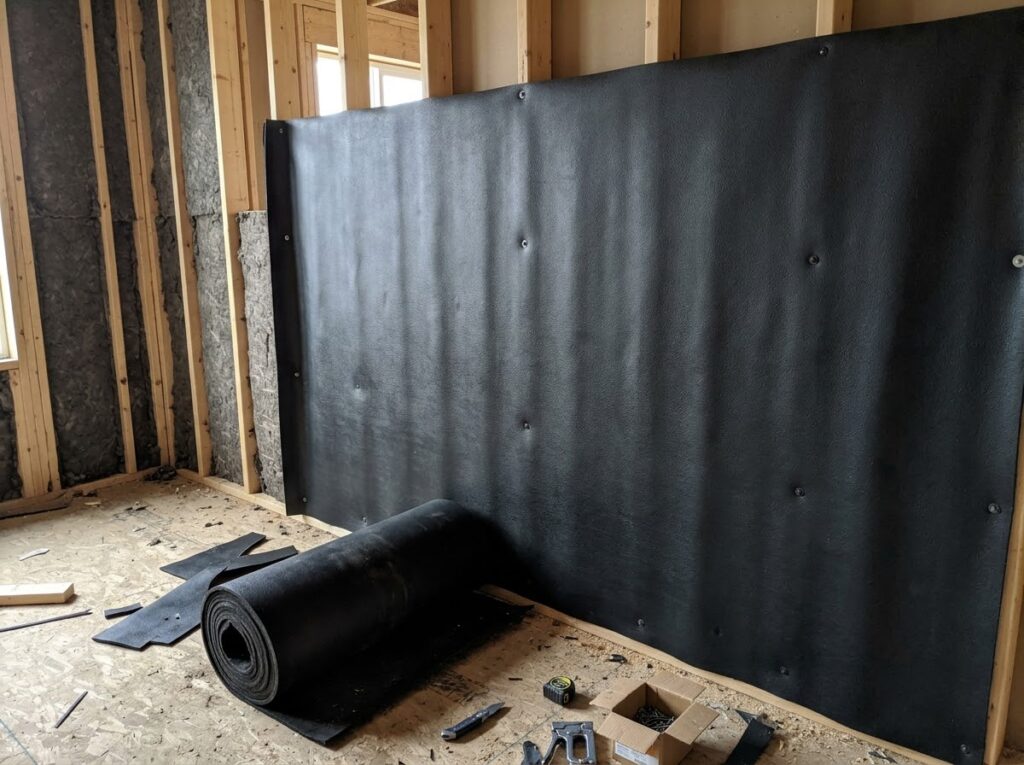
Acoustic Mass Loaded Vinyl (MLV) is a flexible, high-density sound barrier material used in building assemblies to help reduce airborne sound transmission. Its relatively thin construction makes it useful in projects where adding acoustic mass without taking up excessive space is a priority.
For property owners, architects, contractors and interior designers in Mogadishu, understanding how MLV works and where it can be incorporated helps support better decisions when planning sound insulation improvements.
What Is Acoustic Mass Loaded Vinyl?
Mass Loaded Vinyl is a dense, flexible sheet material manufactured using vinyl-based compounds combined with heavy mineral fillers. These fillers give the material substantial mass while allowing it to remain flexible enough for installation in different building assemblies.
Unlike conventional acoustic foam, which is primarily designed to absorb sound reflections inside a room, MLV functions as a sound barrier. Its purpose is to help limit the amount of airborne sound passing through a wall, ceiling, floor or enclosure.
The material is commonly supplied in rolls or sheets and can be incorporated into construction systems behind plasterboard, between suitable building layers or within selected floor and ceiling assemblies.
Its main characteristics include:
- High density: Adds mass to a partition or building assembly.
- Flexible construction: Can be fitted around suitable structural surfaces and building details.
- Relatively low profile: Offers a barrier layer without requiring a thick construction build-up.
- Multiple applications: Can be considered for walls, ceilings, floors and equipment enclosures.
- Compatibility with other materials: Can form part of a larger sound insulation system.
The exact density, thickness, weight and performance vary according to the selected MLV product. Project specifications should therefore be based on the manufacturer’s technical documentation.
Why Is Sound Insulation Important in Mogadishu?
As Mogadishu continues to develop its residential, hospitality, commercial and business infrastructure, acoustic comfort deserves attention alongside other building requirements.
Different properties experience different types of noise. In residential buildings, occupants may want to reduce conversations, television sounds or everyday household noise travelling between rooms. Offices may need better separation between meeting spaces and work areas, while hotels often require greater privacy between guest rooms and shared facilities.
Some common situations where sound insulation may be considered include:
- Noise travelling between neighbouring apartments.
- Conversations passing through lightweight internal partitions.
- Sound transmission between offices and meeting rooms.
- Noise from mechanical and utility rooms.
- Entertainment noise in residential and hospitality properties.
- Airborne noise passing through selected ceiling and floor assemblies.
The correct solution depends on identifying how sound is travelling through the building. Mass Loaded Vinyl can contribute to a suitable sound insulation system, but it should not be treated as a universal solution for every noise problem.
How Does Mass Loaded Vinyl Reduce Sound Transmission?
The working principle behind MLV is relatively straightforward: adding mass to a building assembly can help reduce the amount of airborne sound transmitted through it.
When sound waves reach a wall or partition, they cause the structure to vibrate. Some of that vibration can transfer through the construction and become audible on the opposite side.
MLV adds a dense barrier layer that can help limit this transmission. Its flexibility also makes it suitable for incorporation into certain layered constructions.
However, the effectiveness of MLV depends on more than the material itself. The surrounding wall or ceiling construction, supporting framework, insulation, junctions, openings and installation quality all influence the final result.
For example, a wall containing MLV may still allow considerable sound to pass through an unsealed door, an open service penetration or a poorly detailed ceiling junction.
This is why acoustic design should consider the complete assembly rather than relying on a single material.
Applications of Acoustic Mass Loaded Vinyl in Residential Buildings
Residential properties are among the common environments where sound insulation improvements are considered. In apartments, villas and multi-storey buildings, occupants may want to reduce airborne noise travelling between rooms or neighbouring spaces.
1. Internal Partition Walls
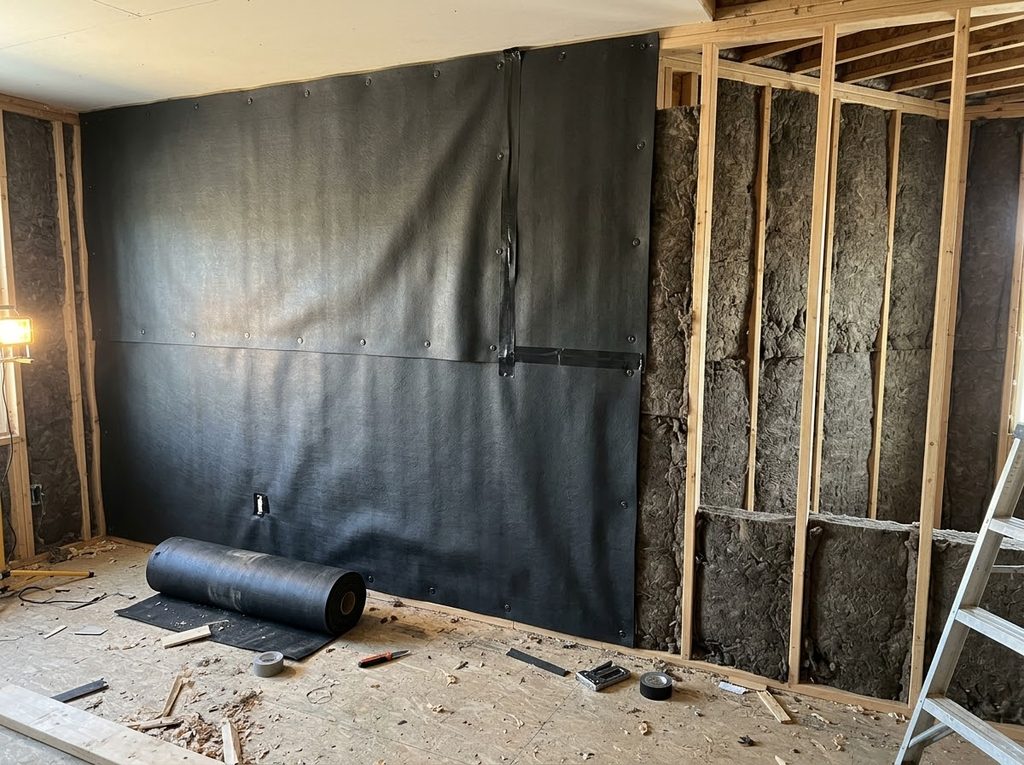
MLV can be incorporated into suitable internal partition systems to help reduce sound transmission between adjoining rooms.
It may be considered for:
- Bedroom and living room partitions.
- Home offices.
- Shared walls between residential units.
- Entertainment rooms.
- Internal walls separating private and common areas.
A typical installation may involve placing MLV within a framed wall assembly, alongside suitable cavity insulation and plasterboard layers. The precise arrangement should be selected according to the acoustic requirements and structural design.
2. Home Theatres and Entertainment Rooms
Home theatres and media rooms can generate considerable sound, particularly when speakers and subwoofers are used.
MLV may be incorporated into the walls or other suitable building elements to help limit airborne sound transmission into adjoining rooms.
For effective results, the complete room design should also address doors, windows, ceiling connections, ventilation openings and other potential sound paths.
3. Ceiling and Floor Assemblies
Sound can travel between different levels of a building through floor-ceiling constructions.
MLV may be included in selected floor or ceiling assemblies where additional barrier mass is required. However, it is important to distinguish airborne sound from impact noise.
Footsteps, dropped objects and furniture movement generate impact noise that travels through the building structure. These problems often require resilient underlay, isolation systems or other impact-control measures rather than relying on MLV alone.
Commercial Applications of MLV in Mogadishu
Commercial properties often contain multiple activities within the same building. Meeting rooms, offices, retail spaces, restaurants and hospitality facilities may benefit from properly designed acoustic separation.
1. Offices and Meeting Rooms
Workplaces require environments where employees can concentrate and conversations can take place without unnecessary disturbance.
MLV can be considered within suitable partition assemblies separating meeting rooms, private offices and shared working areas.
It may be particularly useful where a project requires additional barrier mass without significantly increasing the thickness of the partition.
2. Hotels and Hospitality Properties
Guest comfort is an important part of hospitality design. Noise travelling between rooms, corridors and service areas can affect the overall indoor experience.
MLV may form part of selected wall and ceiling constructions where sound transmission needs to be controlled.
The overall design should also consider acoustic doors, perimeter seals, service openings and the connection between partitions and structural elements.
3. Restaurants and Commercial Interiors
Restaurants and commercial spaces often contain a combination of conversations, kitchen equipment and operational noise.
Where noise needs to be prevented from travelling into adjoining rooms or neighbouring properties, MLV may be incorporated into suitable sound barrier assemblies.
For internal echo and reverberation, however, absorptive materials such as acoustic ceiling panels, wall panels and other sound-absorbing treatments may also be necessary.
Using MLV for Mechanical Rooms and Equipment Enclosures
Mechanical equipment can generate unwanted noise that travels into occupied areas.
Generators, pumps, compressors and ventilation equipment are examples of sources that may require acoustic treatment.
MLV can be incorporated into appropriately designed equipment enclosures or partitions to add sound barrier mass.
However, mechanical noise can involve both airborne sound and structural vibration. If equipment vibration transfers into the building structure, additional measures such as vibration isolation mounts, resilient connections and equipment supports may be necessary.
The enclosure must also maintain appropriate ventilation, access and equipment safety requirements. Acoustic materials should never be installed in a way that interferes with equipment cooling or safe operation.
MLV Compared With Other Acoustic Materials
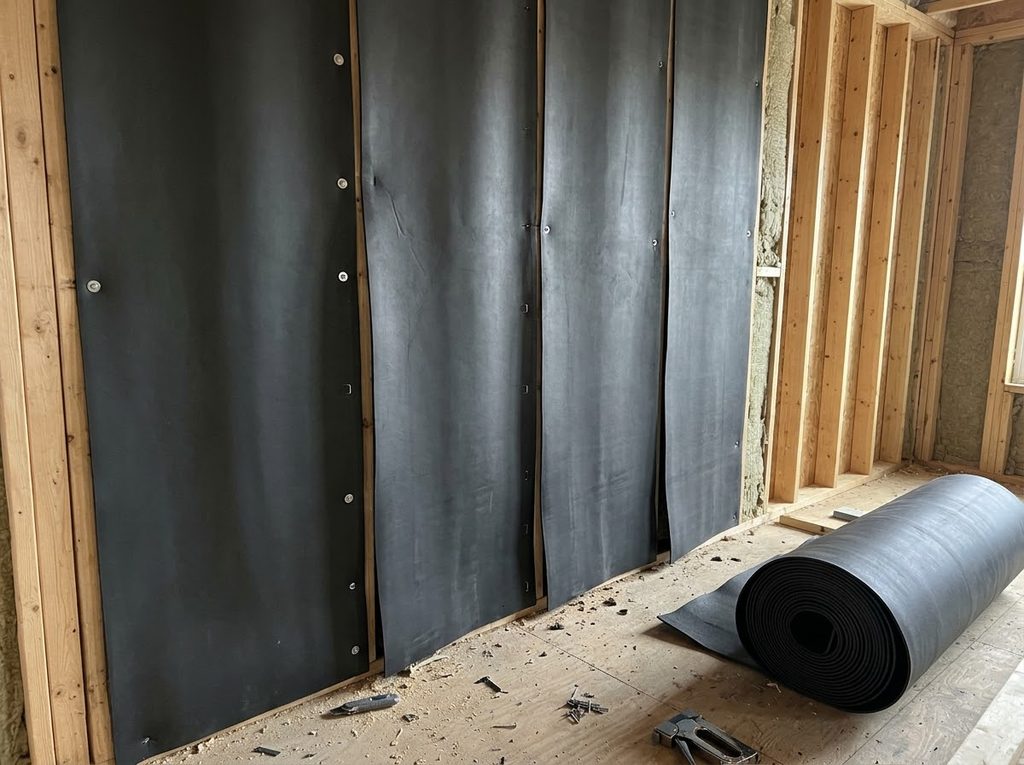
Different acoustic materials perform different functions. Selecting the right option requires understanding whether the main concern is sound transmission, echo or impact noise.
| Material | Main function | Common application |
|---|---|---|
| Mass Loaded Vinyl | Adds barrier mass to reduce airborne sound transmission | Walls, ceilings and selected floor assemblies |
| Acoustic Foam | Absorbs sound reflections | Studios and internal room treatment |
| Mineral Wool | Provides cavity absorption and thermal insulation | Partition and ceiling cavities |
| Acoustic PET Panels | Helps reduce reverberation | Offices, meeting rooms and interiors |
| Rubber Underlay | Helps control impact noise and vibration transfer | Flooring systems |
MLV is not a replacement for every other acoustic material. In many projects, combining a barrier layer with cavity insulation, suitable board layers and correctly sealed construction details provides a more complete approach.
Important Factors When Selecting Mass Loaded Vinyl
Before choosing MLV for a project in Mogadishu, several technical and practical considerations should be reviewed.
Material Thickness and Density
Different MLV products are manufactured with different thicknesses and surface weights. A heavier product may add more mass, but the correct specification depends on the intended wall, floor or ceiling assembly.
Intended Application
The material should be suitable for the location where it will be installed. Wall, ceiling and floor applications may require different installation details and supporting construction.
Compatibility With Other Materials
MLV is commonly used alongside plasterboard, framing systems, mineral wool and other construction materials. Compatibility should be checked before installation.
Fire and Safety Documentation
Building projects should review the product’s fire performance documentation and any relevant local requirements. These properties should never be assumed to be identical across all MLV products.
Installation Requirements
Because MLV can be relatively heavy, suitable mechanical support and fastening methods are important. The supporting structure must be capable of carrying the material’s weight.
Installation Considerations for MLV Sound Barriers
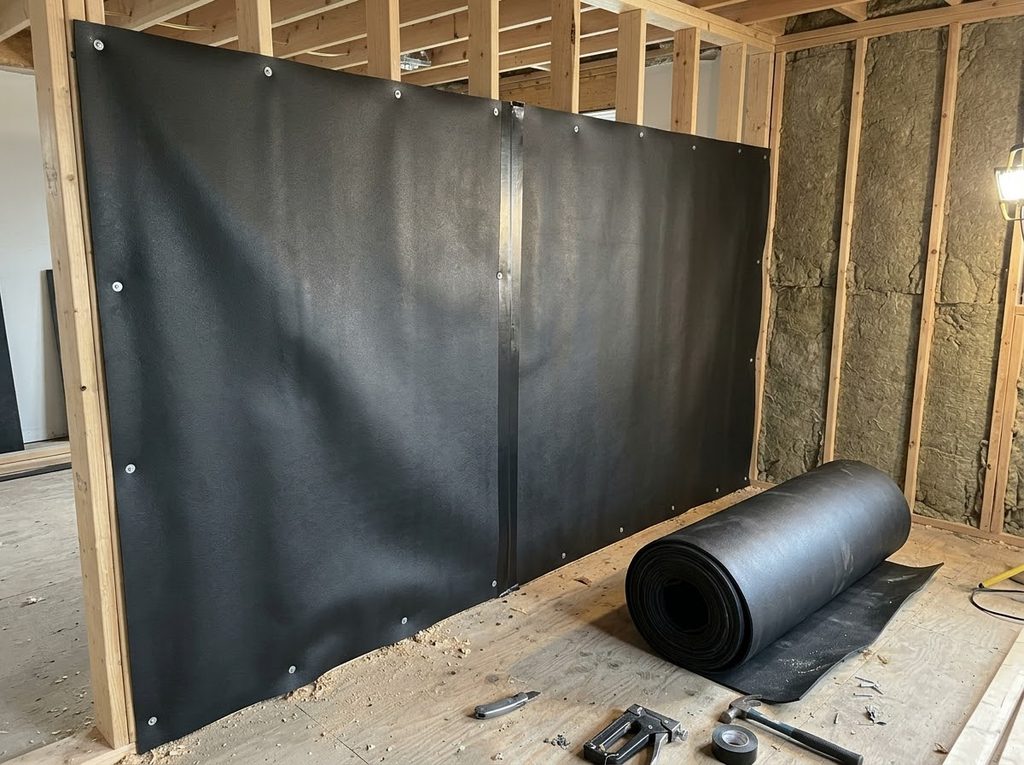
Correct installation is essential to achieving the intended performance of an MLV system.
A typical installation process may include the following stages:
1. Inspecting the Surface
The installer checks the substrate, framing or supporting structure to ensure it is suitable for the selected material.
2. Measuring and Cutting
The MLV is measured and cut according to the dimensions of the wall, ceiling or floor assembly.
3. Positioning the Barrier
The material is placed within the specified construction layers and supported using suitable fasteners or fixing methods.
4. Sealing Seams and Edges
Joints, perimeters and relevant penetrations must be carefully detailed. Acoustic sealants and suitable tapes may be required to maintain continuity.
5. Completing the Assembly
The remaining construction layers, such as plasterboard or floor finishes, are installed according to the approved design.
6. Inspecting the Finished Work
The completed system should be checked for gaps, unsupported areas and poorly sealed junctions.
Electrical boxes, ventilation openings and other service penetrations require particular attention. Any installation near electrical equipment or heat-producing components must follow the manufacturer’s instructions and applicable safety requirements.
Common Mistakes to Avoid When Using MLV
Even a suitable acoustic barrier may deliver disappointing results if the overall installation is poorly designed.
Some common mistakes include:
- Leaving gaps between sheets or around the perimeter.
- Using unsuitable fasteners for the material’s weight.
- Ignoring sound paths through doors and windows.
- Assuming MLV will eliminate every type of noise.
- Using a barrier material to solve an echo problem.
- Overlooking vibration transmission through the building structure.
- Selecting a product without checking its technical documentation.
- Installing MLV without considering the complete wall or ceiling assembly.
A properly planned system should address the actual source of the noise and the route through which it travels.
Choosing Acoustic Mass Loaded Vinyl for Projects in Mogadishu
Selecting the right MLV solution begins with understanding the building and its acoustic requirements. A residential apartment may need a different construction approach from a hotel, office, restaurant or mechanical enclosure.
Before specifying a product, project teams should consider the existing wall construction, available installation space, expected noise sources and required acoustic performance.
For architects, contractors, property developers and interior designers in Mogadishu, incorporating acoustic planning early in a project can help avoid costly modifications later.
It is also important to request product documentation covering weight, thickness, installation recommendations and relevant test results. Where specific sound insulation targets are required, the complete proposed assembly should be assessed rather than relying on the performance of the MLV sheet alone.
Conclusion
Acoustic Mass Loaded Vinyl offers a flexible way to add sound barrier mass to suitable building assemblies. Its applications can include residential partitions, office walls, hospitality properties, selected floor and ceiling constructions, and equipment enclosures.
For projects in Mogadishu, Somalia, MLV can form part of a wider sound insulation strategy designed to improve privacy and reduce unwanted airborne noise.
The best results come from selecting an appropriate product, designing the complete construction system and ensuring that seams, edges and service penetrations are properly addressed. With careful planning, Mass Loaded Vinyl can contribute to more comfortable and functional indoor environments across residential and commercial buildings.