
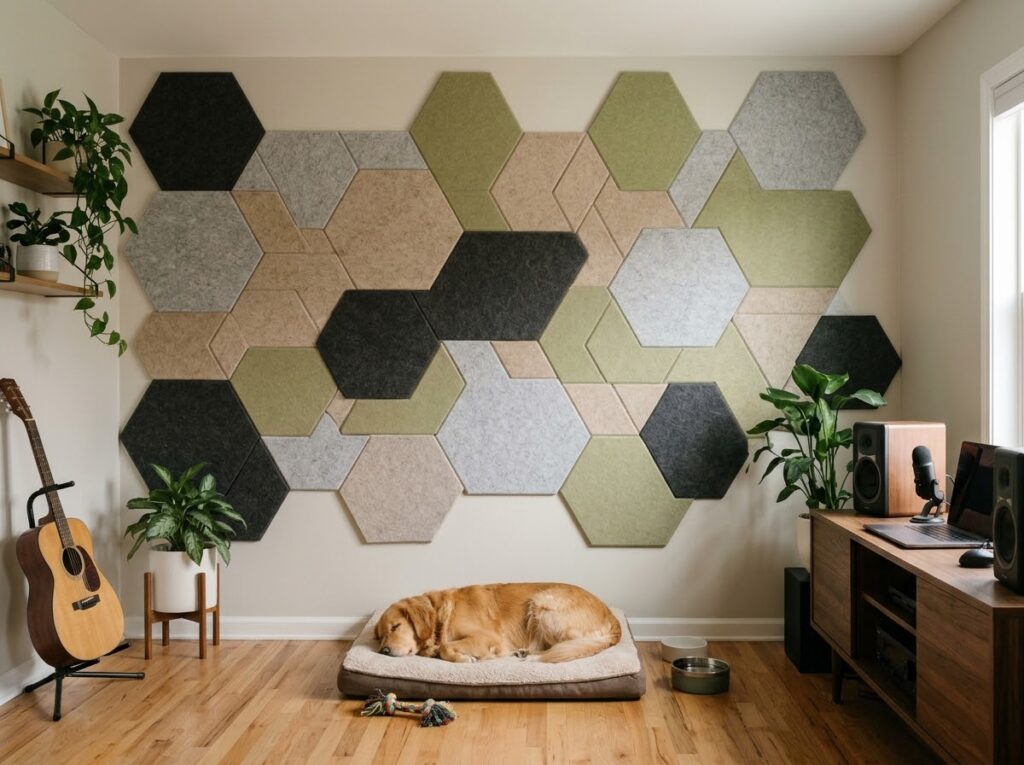
The way a room sounds can have a major influence on how comfortable and functional it feels. In offices, restaurants, classrooms, hotels and residential interiors, excessive echo can make conversations difficult and create an uncomfortable indoor environment.
Modern interior design increasingly considers acoustics alongside appearance, lighting and furniture. One material that supports this approach is the acoustic PET panel. Made from polyester fibres, these panels are designed to absorb sound reflections and help control reverberation inside a room.
For architects, contractors, interior designers and property owners in Praia, Cape Verde, acoustic PET panels offer a practical option for combining sound absorption with contemporary interior finishes.
Whether the project involves a professional workspace, hospitality interior, educational facility or private residence, understanding how PET panels work can help determine where they are most useful.
What Are Acoustic PET Panels?
Acoustic PET panels are sound-absorbing products manufactured from polyester fibres, commonly using polyethylene terephthalate (PET). Depending on the product, the fibres may include recycled polyester content.
The fibres are processed into a dense, porous panel that allows sound energy to enter the material. As sound moves through the fibre structure, some of its energy is dissipated, helping reduce reflections within the room.
Unlike conventional decorative wall coverings, acoustic PET panels are selected partly for their sound-absorption properties. They can be installed on walls, suspended from ceilings, used as baffles or incorporated into decorative interior features.
They are available in different thicknesses, densities, colours, shapes and finishes. Some products are supplied as flat sheets, while others are digitally cut into geometric patterns, decorative shapes and custom designs.
The acoustic performance of each panel depends on its construction, thickness, density and mounting arrangement. Buyers should always review the technical information for the exact product being considered.
Why Are PET Acoustic Panels Useful for Interiors in Praia?
Praia has a variety of indoor environments, from residential spaces and workplaces to hospitality venues, retail interiors and educational facilities. Each type of space has different acoustic requirements.
Rooms with hard surfaces such as glass, tile, concrete and plasterboard can reflect sound rather than absorb it. When several reflective surfaces are present, sound may continue bouncing around the room, creating excessive reverberation.
This can make speech less clear, increase listening fatigue and affect the overall experience of the space.
Acoustic PET panels help address this issue by adding absorptive surfaces to the interior.
Potential benefits include:
- Reducing unwanted echo and reverberation
- Improving speech clarity in meeting rooms
- Creating more comfortable restaurant and hospitality interiors
- Supporting better listening conditions in classrooms
- Improving the acoustic environment of home offices
- Adding decorative features to walls and ceilings
- Offering flexible options for custom interior designs
It is important to understand that PET panels primarily absorb sound within a room. They are not a replacement for a sound-isolating wall or a complete soundproofing system.
How Do PET Panels Absorb Sound?
Sound travels through the air in the form of pressure waves. When these waves reach hard surfaces, such as glass, concrete or tiled floors, some of the sound energy is reflected back into the room.
These repeated reflections create reverberation.
PET acoustic panels use a porous fibre structure to absorb a portion of this sound energy. Instead of reflecting all the sound back into the space, the panel allows sound to enter its structure, where energy is dissipated through friction and other material interactions.
The result can be a reduction in excessive reflections and improved acoustic comfort.
However, absorption is not identical across all frequencies. Panel thickness, density, mounting method and the presence of an air cavity behind the panel can influence performance.
For this reason, a product’s Noise Reduction Coefficient (NRC) or other published acoustic rating should be checked against its test report and mounting conditions. A rating from one installation arrangement should not automatically be applied to another.
Different Types of Acoustic PET Panels
1. Flat PET Wall Panels
Flat PET panels provide a simple way to introduce sound absorption into an interior. They are commonly installed on selected wall areas in offices, meeting rooms, classrooms and residential spaces.
They can be arranged in large sections or smaller decorative layouts. Colour selection can also help the panels blend into an existing interior scheme or create a contrasting feature wall.
2. Decorative and Geometric PET Panels
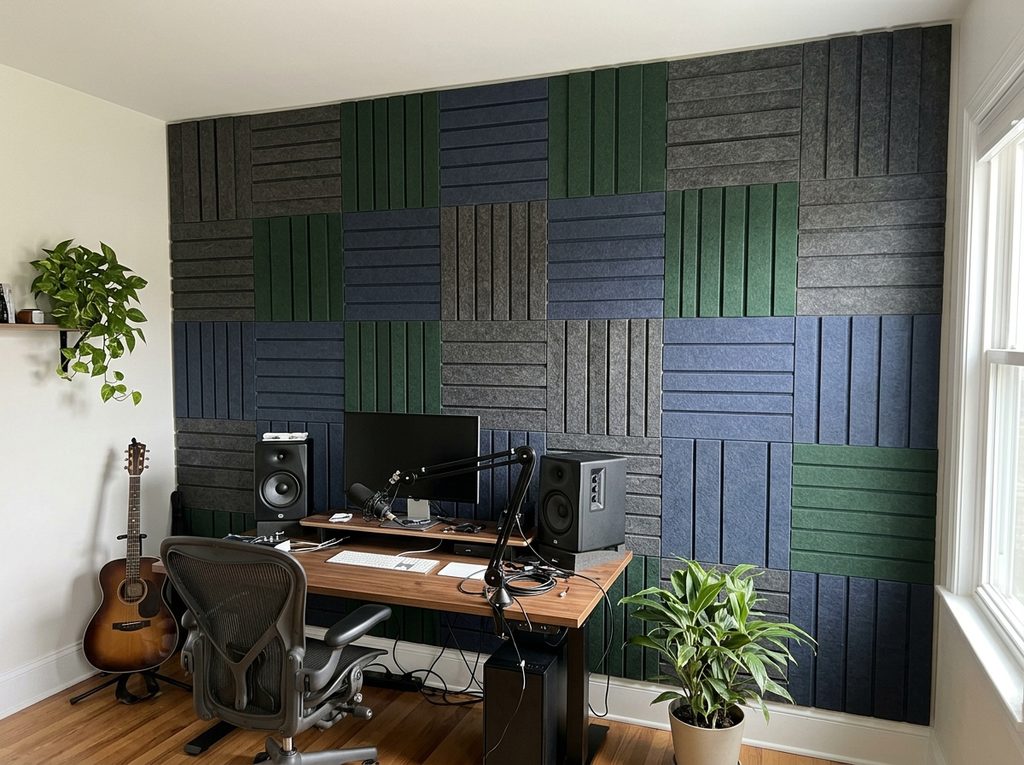
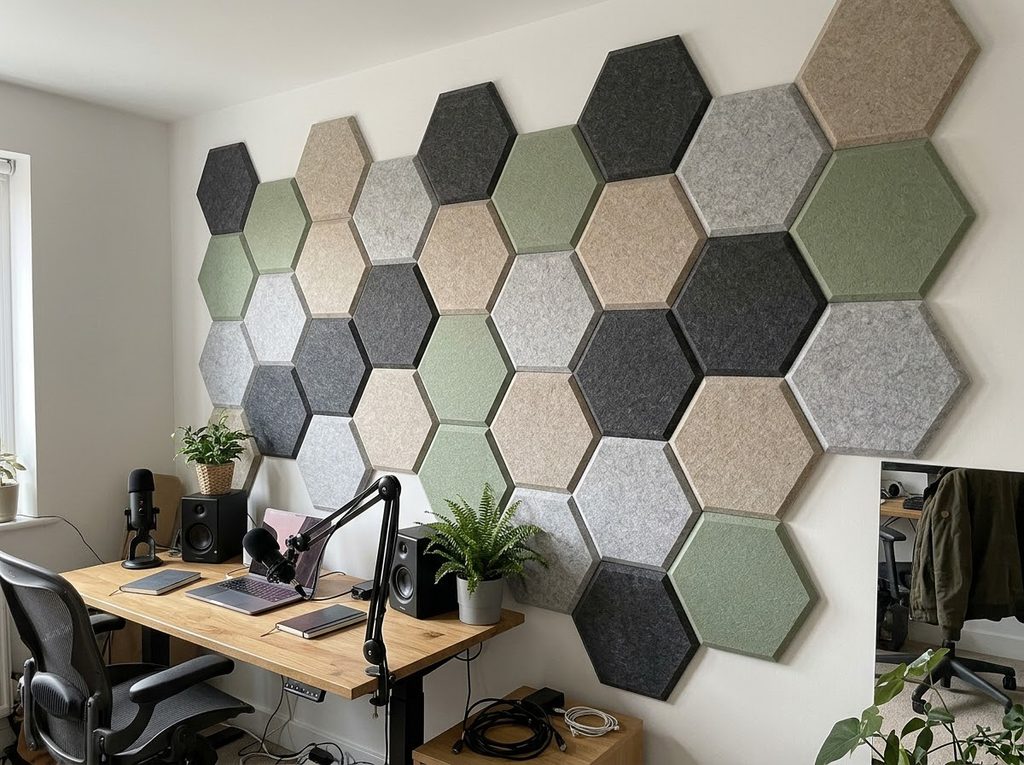
Decorative PET panels are available in shapes such as hexagons, rectangles, circles and other geometric patterns.
These panels can create visual interest while adding absorptive surface area. They are suitable for feature walls, reception areas, collaborative offices and other spaces where interior appearance is important.
3. 3D PET Acoustic Panels
Three-dimensional PET designs introduce depth and texture to wall surfaces. Their profiles can create a distinctive visual effect, particularly when arranged in repeated patterns.
Their acoustic performance still depends on the underlying material and tested construction rather than the decorative shape alone.
4. PET Ceiling Panels and Baffles
Ceiling-mounted PET products can be useful when wall space is limited or when sound reflections from above are a concern.
Panels may be suspended horizontally as acoustic clouds or vertically as baffles. The final performance depends on the panel specification, spacing, suspension height and total installed coverage.
5. Custom-Cut PET Panels
Digital cutting allows PET sheets to be shaped into custom patterns, branded designs, partitions and decorative installations.
This flexibility can help interior designers coordinate acoustic treatment with a project’s visual identity. Before ordering custom shapes, it is important to confirm the panel’s cutting requirements, minimum dimensions and available colour options.
Where Can Acoustic PET Panels Be Used?
PET panels can be considered for many indoor environments in Praia.
Offices and Corporate Workspaces
Open-plan offices often contain multiple conversations, movement and equipment sounds. Hard surfaces can increase reverberation, making it more difficult for employees to concentrate.
PET wall panels, ceiling baffles and acoustic screens can help reduce sound reflections and create a more comfortable working environment.
In meeting rooms, appropriately positioned panels may improve speech clarity during discussions and presentations.
Hotels and Hospitality Interiors
Hotels, restaurants, lounges and reception areas benefit from a comfortable acoustic environment.
In restaurants, excessive reverberation can make conversations difficult, particularly when several groups are speaking at the same time. PET panels can be installed on selected walls or ceilings to help manage reflections.
For hotel interiors, decorative acoustic panels can also contribute to the visual identity of reception areas, conference rooms and shared spaces.
Educational Facilities
Classrooms and training rooms require clear communication between teachers and students. Excessive echo can make spoken instructions harder to understand.
PET panels can be incorporated into suitable wall and ceiling layouts to help control reverberation.
The quantity, placement and type of panel should be selected according to the room’s size, ceiling height, occupancy and acoustic requirements.
Residential Interiors
In homes, hard flooring, large windows and minimal furnishings can contribute to sound reflections.
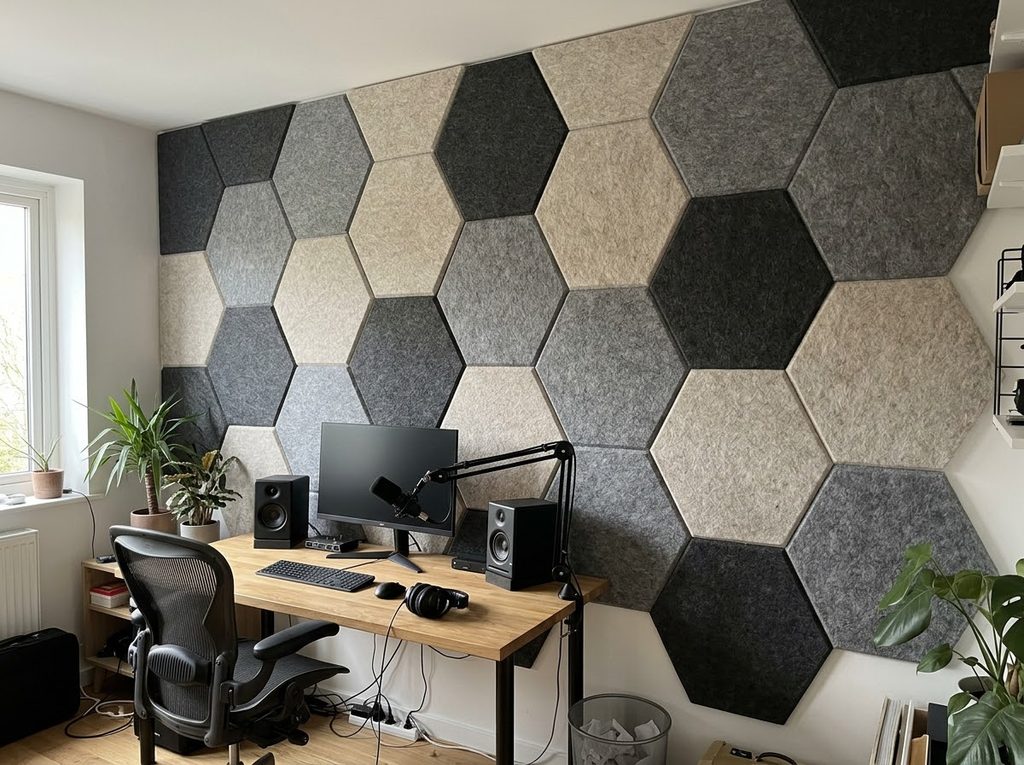
PET panels may be used in home offices, entertainment rooms, study areas and shared living spaces where better acoustic comfort is desired.
Decorative options allow homeowners to introduce sound absorption without relying on purely industrial-looking acoustic products.
Studios and Media Rooms
Studios and media rooms require careful acoustic planning. PET panels can contribute to controlling reflections, but they should not be treated as a complete studio treatment system.
Low-frequency behaviour, room modes, isolation from external noise and monitoring requirements may require additional acoustic measures.
Important Factors When Choosing PET Panels
Selecting the right PET panel requires more than choosing a colour or decorative pattern. The product should be suitable for the room and the acoustic problem being addressed.
Thickness and Density
PET panels are manufactured in different thicknesses and densities. Thicker panels can provide greater absorption in certain frequency ranges, but performance depends on the complete product construction.
The best choice should be based on test data rather than thickness alone.
Acoustic Performance Ratings
Look for independently tested acoustic information, including NRC or frequency-specific absorption coefficients where available.
Always check the test method and mounting arrangement. Direct-mounted panels may perform differently from panels installed with an air gap.
Colour and Design
PET panels are available in a variety of colours and can be cut into decorative shapes.
For commercial projects, colour selection can be coordinated with furniture, branding, lighting and wall finishes.
Fire Performance
Fire classifications vary between PET products. For offices, hotels, educational facilities and other commercial interiors, request documentation for the exact panel and confirm that it meets the applicable project requirements.
Material Composition
Some PET panels contain recycled polyester fibres. If recycled content is important to the project, request a manufacturer declaration or product specification rather than assuming all PET panels have the same composition.
Maintenance and Durability
Review the manufacturer’s cleaning and maintenance instructions. Consider the location of the panels, the likelihood of physical contact and the possibility of dust or staining.
Panels installed in high-traffic areas may need additional protection or a more suitable mounting arrangement.
PET Panels vs. Other Acoustic Materials
Different materials are designed for different acoustic purposes. Comparing their functions can help avoid selecting the wrong product.
| Material | Main purpose |
|---|---|
| PET acoustic panels | Absorb sound and reduce room reverberation |
| Acoustic foam | Absorb reflections in selected interior applications |
| Mass Loaded Vinyl | Add mass to help reduce sound transmission |
| Mineral wool | Provide cavity absorption in suitable wall and ceiling assemblies |
| Acoustic wood panels | Combine decorative finishes with absorption when designed with suitable backing and openings |
PET panels are particularly useful when the objective is to improve the sound inside a room. If the main concern is noise travelling from one room to another, a suitable sound-isolation construction will also be required.
Planning PET Panel Installation
A successful acoustic treatment starts with understanding the room.
Before installation, consider the room dimensions, ceiling height, surface materials, furniture layout and main source of unwanted reflections.
The installation process generally involves:
- Assessing the room: Identify the areas where sound reflections are most noticeable.
- Selecting the panel type: Choose the thickness, density, shape and finish based on the project requirements.
- Planning coverage: Determine how much absorptive surface is needed and where it should be positioned.
- Preparing the mounting surface: Confirm that walls or ceilings are suitable for the selected fixing method.
- Installing the panels: Use the manufacturer’s recommended adhesive, mechanical fixings or suspension system.
- Checking the finished space: Review the acoustic result and determine whether additional treatment is required.
For large commercial spaces, an acoustic assessment can help avoid unnecessary material use and improve panel placement.
Common Mistakes to Avoid
One common mistake is expecting PET panels to completely soundproof a room. Their main function is sound absorption, not blocking sound from passing through walls.
Another mistake is selecting panels based only on their appearance. Two panels with similar designs may have different thicknesses, densities and acoustic performance.
Installing too few panels or placing them without considering the room’s reflective surfaces can also limit the overall improvement.
Buyers should avoid assuming that every PET panel is fire-rated, made entirely from recycled material or suitable for every installation method. Product-specific technical documentation is essential.
Conclusion
Acoustic PET panels offer a practical combination of sound absorption and decorative flexibility for modern interiors. In Praia, Cape Verde, they can be considered for offices, hospitality venues, classrooms, residential spaces and other environments where excessive echo affects comfort and communication.
Their effectiveness depends on choosing the right panel construction, understanding the room’s acoustic needs and following the correct installation method.
For projects where appearance and acoustic comfort are equally important, PET panels provide a versatile option for creating more balanced indoor environments.