
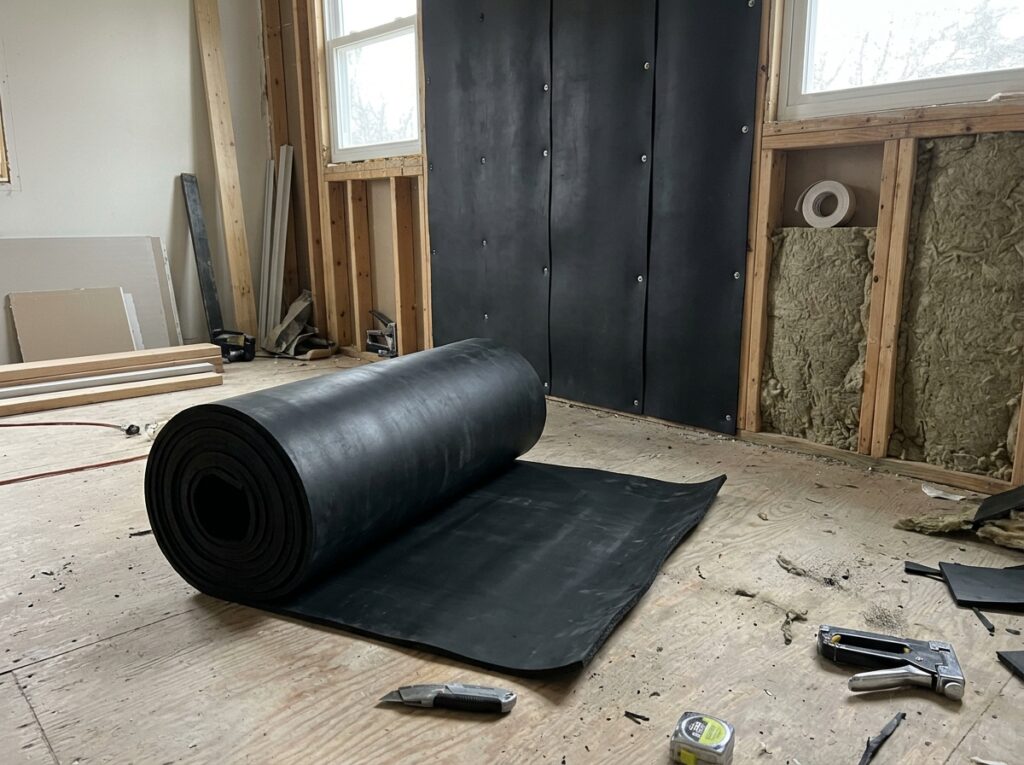
Noise control is becoming an important consideration in modern residential, commercial, and industrial spaces. Whether the goal is to improve privacy between rooms, reduce sound transmission through partitions, or manage equipment noise, choosing the right acoustic material can make a significant difference. Acoustic mass loaded vinyl (MLV) is a flexible, high-density sound barrier designed to help reduce airborne noise passing through building elements.
For projects in Dammam, Saudi Arabia, MLV can be considered for applications ranging from office partitions and residential walls to mechanical enclosures and HVAC systems. Its relatively thin profile makes it particularly useful when a project needs additional sound insulation without relying exclusively on thick, heavy construction.
This guide explains how mass loaded vinyl works, its main benefits, where it can be installed, and what to consider before selecting a product for your project.
What Is Acoustic Mass Loaded Vinyl?
Mass loaded vinyl is a dense, flexible sheet material engineered to reduce sound transmission. It is commonly manufactured using vinyl or other polymer-based compounds combined with dense mineral fillers. The exact composition varies by manufacturer.
Unlike conventional acoustic foam or decorative sound-absorbing panels, MLV is primarily a sound barrier. Its mass helps resist airborne sound passing through a wall, ceiling, partition, or other building element.
Common MLV applications include:
- Residential walls and partitions
- Office and meeting-room walls
- Recording studios and media rooms
- Ceilings and selected floor assemblies
- HVAC ducts and mechanical enclosures
- Equipment rooms and industrial noise-control systems
- Pipework and other applications where a flexible barrier is suitable
Product specifications differ, so buyers should check the actual material composition, surface mass, thickness, fire performance, and independent acoustic test documentation before choosing a particular roll.
Why Consider Mass Loaded Vinyl in Dammam?
Dammam is an important urban and industrial centre in Saudi Arabia’s Eastern Province. Buildings in the wider area can include homes, apartments, offices, hospitality facilities, workshops, and industrial premises, each with different noise-control requirements.
A single soundproofing product will not solve every noise problem. However, MLV can form part of a properly designed assembly when sound travels through lightweight partitions, ceilings, ductwork, or equipment housings.
1. Improve Privacy Between Rooms
Speech, television audio, and other everyday sounds can travel through insufficiently insulated partitions. Adding an appropriate barrier layer to a wall assembly may help reduce this transmission.
For example, an office partition could incorporate MLV between board layers, alongside cavity insulation and suitable framing details. The effectiveness of the completed wall depends on the entire assembly rather than the membrane alone.
2. Support Residential Noise Control
In apartments and villas, occupants may want to reduce conversations, entertainment noise, or other airborne sounds travelling between rooms or adjoining properties.
MLV may be useful when incorporated into a suitable wall or ceiling system. Nevertheless, noise can also travel through doors, windows, service penetrations, floor structures, and adjoining walls. Those pathways should be considered before selecting the material.
3. Help Manage Equipment Noise
Mechanical rooms, workshops, and plant areas can contain generators, pumps, compressors, ventilation equipment, and other noise-producing machinery.
MLV can be used as a barrier component in certain equipment enclosures or ductwork systems. Equipment mounts, vibration isolation, absorptive linings, silencers, and structural design may also be required, particularly where low-frequency or vibration-related noise is involved.
4. Add a Barrier Without Excessive Wall Thickness
Traditional sound-isolation designs often rely on mass, multiple layers, and separation between structural elements. MLV offers a flexible way to add mass without using a thick masonry layer.
This can be useful in renovation projects where available space is limited. However, the membrane’s weight must be considered when specifying fixings, supporting structures, and overhead installations.
How Does Mass Loaded Vinyl Work?
Sound travels through the air as pressure variations. When those sound waves reach a building element, some energy is reflected, some is absorbed, and some may pass through the structure.
MLV helps resist airborne sound transmission by adding mass to the assembly. It is flexible, allowing it to be fitted into certain layered constructions and around suitable irregular surfaces.
Its performance depends on several factors:
- Surface mass: Heavier material per square metre can provide greater transmission resistance under comparable test conditions.
- Assembly design: The surrounding boards, framing, cavity, insulation, and mounting method all affect the finished result.
- Sealing: Gaps around joints, sockets, pipes, and edges can allow sound to bypass the barrier.
- Structural separation: Decoupling layers or independent framing may improve isolation in some wall and ceiling designs.
- Frequency range: Performance varies with sound frequency and the construction being treated.
Published product data illustrates why specifications matter. For example, Acoustical Surfaces provides different transmission-loss figures for different MLV surface weights, while Armacell publishes technical data for its own mass-loaded barrier products. These figures apply to the relevant products and test conditions; they should not be treated as universal performance values for every MLV sheet. Acoustical Surfaces product data and Armacell technical specifications.
Mass Loaded Vinyl vs. Acoustic Panels
One of the most important steps in selecting acoustic materials is understanding the difference between sound isolation and sound absorption.
| Feature | Mass loaded vinyl | Sound-absorbing acoustic panels |
|---|---|---|
| Primary purpose | Help reduce sound transmission through an assembly | Reduce sound reflections and reverberation inside a room |
| Typical construction | Dense, flexible barrier sheet | Porous or engineered absorptive panel |
| Common placement | Within wall, ceiling, floor, or enclosure assemblies | On walls, ceilings, or other room surfaces |
| Main benefit | Adds mass to a sound-isolation system | Helps improve room sound quality and speech clarity |
| Standalone result | Depends on the installation and surrounding construction | Depends on the panel’s tested absorption performance and coverage |
These materials are not direct substitutes. A meeting room may need absorptive panels to reduce echo, while a partition between that room and an adjacent office may need additional sound isolation. In some projects, both approaches are appropriate.
Common Applications of Acoustic MLV
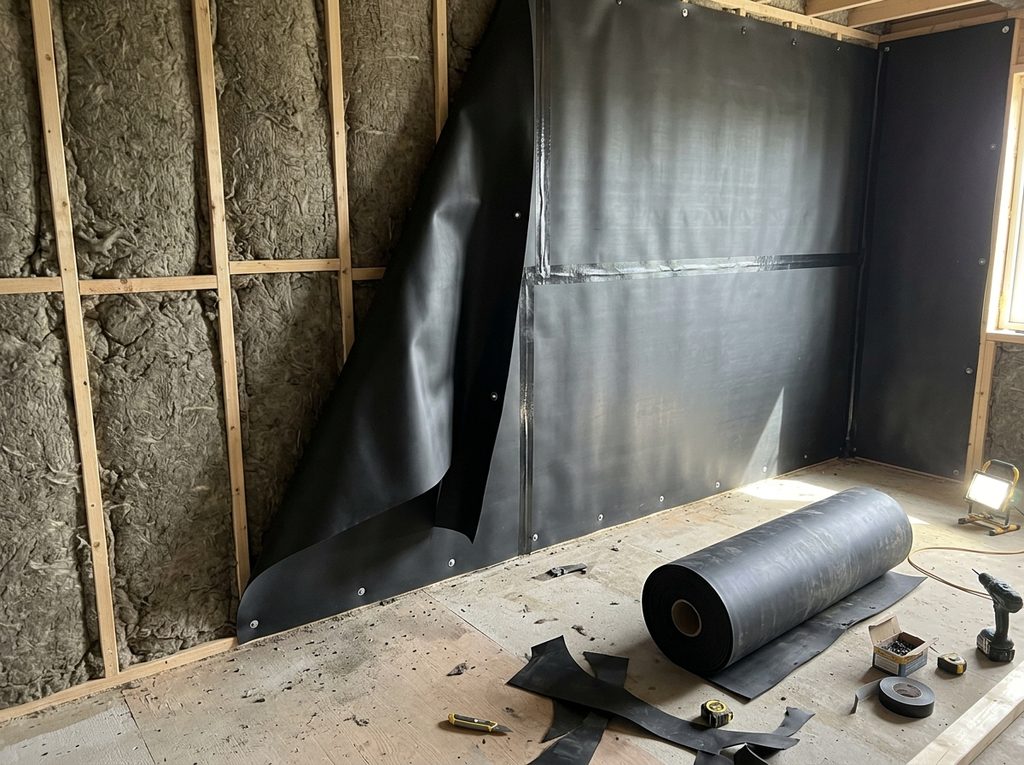
1. Walls and Internal Partitions
MLV can be incorporated into timber or metal stud partitions and other suitable wall systems. Depending on the design, it may be installed beneath gypsum board or between layers of a wall assembly.
For a more complete solution, a designer may combine the barrier with cavity insulation, resilient components, and additional board layers. The objective is to reduce sound transmission while controlling weak points such as junctions and penetrations.
Before retrofitting an existing wall, consider whether the noise is passing through the wall itself or travelling around it through adjacent structures.
2. Ceilings and Floor Assemblies
MLV can be included in selected ceiling and floor constructions to help limit airborne sound transmission. The correct installation method depends on the assembly and the manufacturer’s guidance.
Footsteps and dropped objects are different from airborne sounds such as voices. Impact noise can travel through the building structure, so resilient underlays, isolation mounts, floating floors, or other decoupling measures may be necessary. MLV alone should not be expected to eliminate impact noise.
For overhead applications, the membrane’s weight and the suitability of the supporting system are especially important.
3. HVAC Ducts and Pipework
Air-conditioning and ventilation systems can carry sound from one area to another. A suitable MLV barrier may be used in a designed duct-lagging or pipe-noise-control system.
The complete construction may need a decoupling layer, an absorptive layer, secure mechanical support, and sealed joints. Installation must also account for temperature, condensation, access for maintenance, and the requirements of the equipment.
Do not wrap MLV around components that require ventilation or have temperature restrictions unless the system has been specifically designed for that application.
4. Machinery Enclosures
Manufacturing equipment, pumps, compressors, and generators can produce noise that affects nearby workers or occupied spaces.
MLV may form part of an enclosure that adds mass to the barrier. Other elements, such as vibration-isolated supports, absorptive internal linings, access doors, and ventilation silencers, may be required.
Where vibration travels through the floor or equipment mounts, a flexible sheet alone is unlikely to resolve the entire problem. The source, transmission path, and receiving space should be assessed together.
5. Studios and Media Rooms
Home theatres, editing rooms, and recording spaces often need both sound isolation and acoustic treatment.
MLV may contribute to the isolation of a wall or ceiling, but it does not automatically prevent all sound from entering or leaving the room. Doors, glazing, ventilation openings, and structural connections can limit the performance of an otherwise well-built partition.
Inside the room, additional absorptive treatment may be needed to control reflections and improve audio clarity.
How to Choose the Right Mass Loaded Vinyl
Selecting MLV involves more than comparing roll prices or choosing the thickest available product. The material should suit the acoustic target, the supporting construction, and the installation conditions.
Check Surface Mass and Thickness
Surface mass, commonly expressed in kilograms per square metre, is a useful specification for comparing barrier materials. Thickness alone is not enough to establish performance because different products can have different densities and compositions.
Ask for the product’s technical data sheet and verify the stated surface mass and thickness tolerances.
Request Relevant Acoustic Test Reports
Look for documented test results that clearly identify the tested product, test method, and construction. If a supplier quotes a Sound Transmission Class (STC) or weighted sound reduction index (Rw), confirm what was tested.
A rating for a complete wall or ceiling assembly should not be presented as the rating of a loose MLV sheet. Likewise, results from one product cannot automatically be applied to another manufacturer’s membrane.
Review Fire and Safety Documentation
Fire performance and suitability for a particular building depend on the exact product and how it is installed. Request relevant test certificates and check local project requirements before specifying MLV in residential, commercial, healthcare, or industrial spaces.
Do not assume that every vinyl-based acoustic barrier has the same fire classification, emissions profile, or temperature tolerance.
Consider the Installation Method
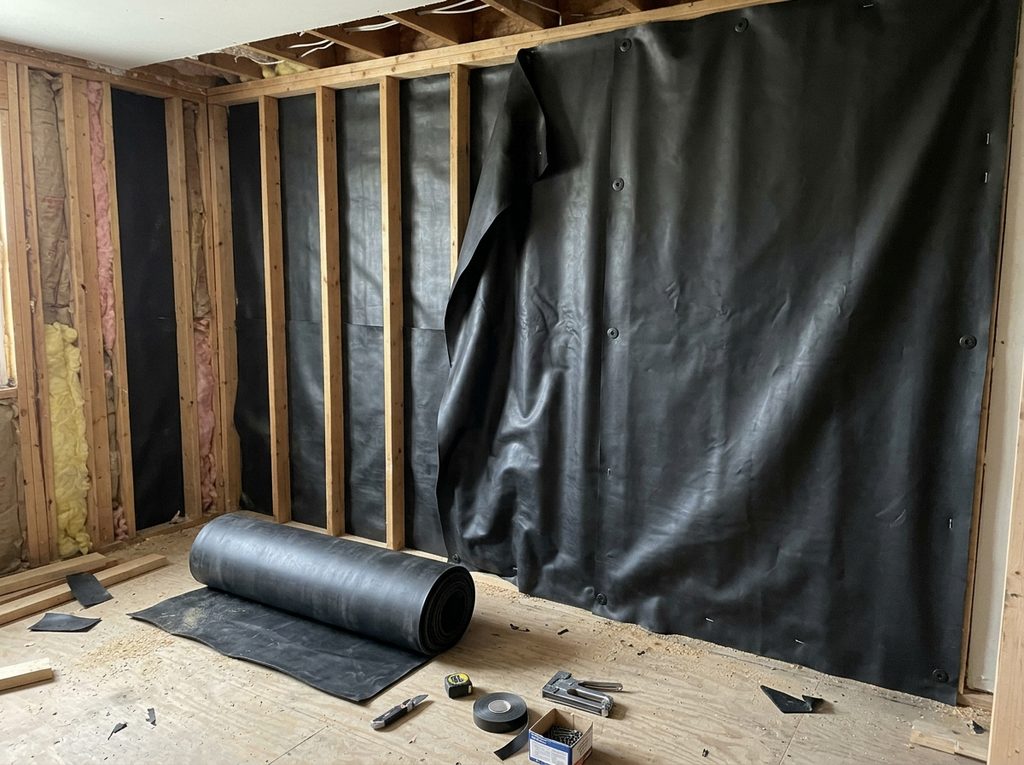
Confirm whether the product is designed for mechanical fixing, adhesive installation, a concealed cavity, or a specific layered assembly. The method should follow the manufacturer’s instructions and account for the material’s weight.
Match the Product to the Noise Problem
Identify whether the main issue is airborne sound, impact noise, equipment vibration, duct-borne noise, or reverberation inside a room. Different problems can require different materials and construction methods.
Installation Considerations for Better Results
Correct installation is essential to the performance of a sound barrier. Even a suitable material can deliver disappointing results if it is installed with gaps or incorporated into an unsuitable construction.
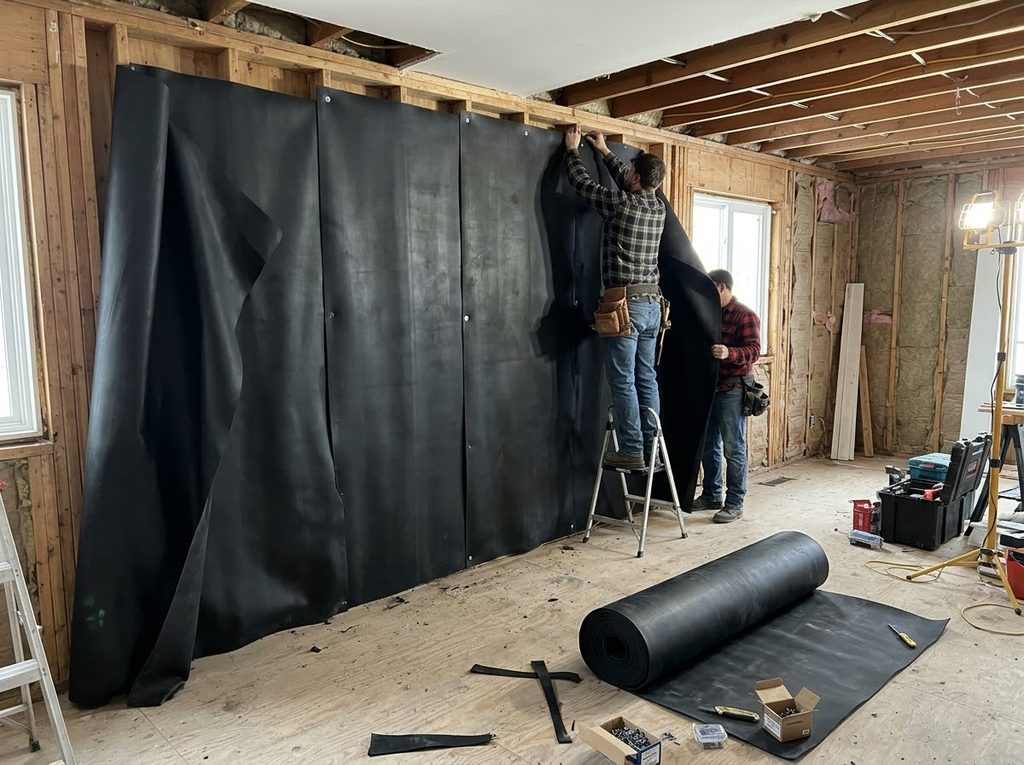
A typical MLV installation process may include the following steps, subject to the manufacturer’s instructions and the approved design.
- Inspect the substrate. Confirm that the surface and supporting structure are suitable, clean, and ready for installation.
- Plan the coverage. Measure the area and determine how sheets will meet at corners, edges, and openings.
- Install the membrane correctly. Use the specified fixing or adhesive method and provide appropriate support, particularly for walls and ceilings.
- Seal seams and penetrations. Treat joints, perimeter gaps, service openings, and other potential sound-leak paths with compatible materials.
- Complete the designed assembly. Install the required board layers, resilient components, finishes, or protective coverings.
- Inspect before closing the wall. Check continuity, fixings, joints, and penetrations before concealed layers become inaccessible.
Manufacturer guidance for AudioSeal MLV, for example, highlights the importance of suitable substrate conditions and acoustical sealing around openings and service components. Read the installation specification.
Large rolls can be heavy, so installation teams should plan safe lifting and overhead handling. Product storage, temperature limits, compatibility with adhesives, and any required protective layers should also be checked in advance.
Common Mistakes to Avoid
Assuming MLV Will Stop Every Type of Noise
MLV is principally a barrier against sound transmission. It is not a universal fix for vibration, impact noise, or echo. Identify the actual noise path before choosing a solution.
Leaving Gaps at Joints and Edges
Sound can bypass a barrier through unsealed seams and openings. Proper detailing is an essential part of the overall acoustic design.
Ignoring Doors, Windows, and Ventilation
A treated wall may still perform poorly if sound passes through a lightweight door, a poorly sealed window, or an unattenuated ventilation path. The whole room boundary should be considered.
Choosing a Product Based Only on Thickness
Thickness, surface mass, flexibility, fire performance, and compatibility with the assembly all matter. Request technical documentation rather than relying on a single specification.
Using Absorption Ratings as Soundproofing Ratings
A sound-absorption coefficient or Noise Reduction Coefficient (NRC) describes absorption behaviour, not the sound-isolation performance of an entire wall. For transmission control, look for relevant barrier or assembly test data.
What Affects the Cost of MLV?
The cost of an MLV project in Dammam depends on the selected product and the construction in which it will be used. Without a confirmed specification and supplier quotation, a reliable price per square metre cannot be stated.
Typical cost factors include:
- Product surface mass and thickness
- Roll dimensions and total quantity
- Required test reports and fire documentation
- Additional insulation, board layers, or resilient components
- Adhesives, acoustic sealants, fixings, and finishing materials
- Labour, access requirements, and site conditions
- Transport and delivery arrangements
For a useful comparison, request a quotation based on the same surface mass, area, installation method, and required documentation. A lower-cost membrane may not be equivalent to a heavier or independently tested alternative.
Frequently Asked Questions
What is mass loaded vinyl used for?
MLV is used as a flexible sound barrier in suitable wall, ceiling, floor, partition, ductwork, and equipment-enclosure systems. Its main purpose is to help reduce airborne sound transmission.
Is mass loaded vinyl suitable for homes in Dammam?
It can be suitable for residential projects when the chosen product and installation system meet the building’s requirements. The right design depends on the noise source, the existing construction, fire requirements, and the desired level of isolation.
Does MLV reduce echo inside a room?
Not primarily. MLV is a barrier material, whereas absorptive acoustic panels are designed to reduce reflections and reverberation. A room may need both products for different purposes.
Can mass loaded vinyl be installed on an existing wall?
In some cases, yes, but the best method depends on the wall and the required performance. Directly adding a membrane to an existing surface may produce a different result from integrating it into a properly designed layered or decoupled assembly.
Does thicker MLV always provide better soundproofing?
Not necessarily in every finished application. Greater surface mass can improve barrier performance under comparable conditions, but the result also depends on the complete assembly, sealing, frequency range, and installation quality.
Can MLV stop footsteps from an upper floor?
MLV alone should not be expected to eliminate footsteps. Impact noise often requires resilient flooring, a suitable underlay, structural isolation, or a properly designed ceiling system.
What documentation should I request before purchasing?
Ask for the technical data sheet, surface mass, thickness, acoustic test reports, fire-performance documentation, installation instructions, and confirmation that the documentation applies to the exact product being offered.
Choose Acoustic Mass Loaded Vinyl for Your Project
Mass loaded vinyl can be a useful part of a sound-isolation strategy for residential, commercial, and industrial projects in Dammam, Saudi Arabia. Its flexible, high-density construction allows it to be incorporated into suitable assemblies where additional barrier mass is needed without adding a thick masonry layer.
The best results come from matching the material to the actual noise problem, selecting a product with clear technical documentation, and ensuring that joints, penetrations, and surrounding construction are properly addressed.
Looking for acoustic mass loaded vinyl for your next project? Review the available product specifications, compare documented acoustic performance, and choose a barrier that fits your wall, ceiling, floor, or equipment-enclosure design. A well-planned system can help improve sound isolation while avoiding the cost and disappointment of using the wrong material for the job.