
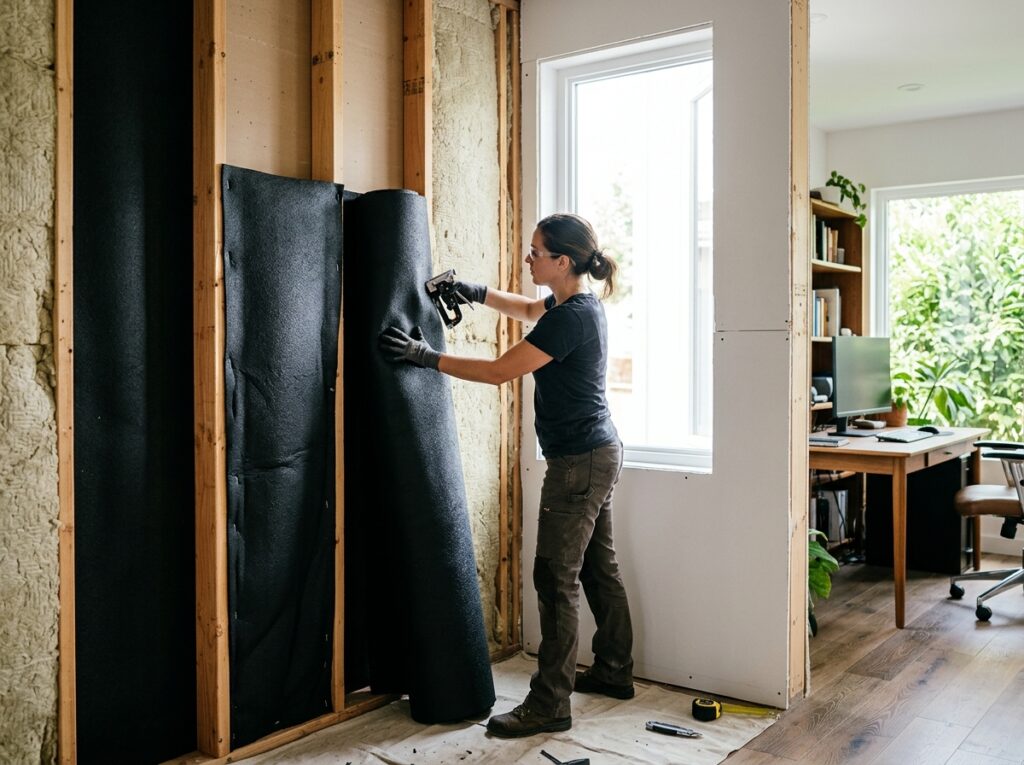
Soundproofing a building does not always mean rebuilding the entire wall, ceiling, or floor.
In many residential, commercial, hospitality, and industrial projects, there is limited space for adding bulky construction materials. Existing walls may already be finished, ceiling heights may be restricted, and renovation projects often need acoustic improvements without major structural changes.
This is one of the situations where Mass Loaded Vinyl (MLV) can become an important component of a sound isolation system.
Mass Loaded Vinyl is a dense, flexible acoustic barrier designed primarily to reduce the transmission of airborne sound. Because it provides substantial surface mass in a relatively thin flexible sheet, it can be incorporated into walls, floors, ceilings, partitions, equipment enclosures, ducts, and other assemblies.
For projects in Blantyre, Malawi, MLV can be considered as part of professionally designed soundproofing systems for offices, homes, hotels, studios, entertainment spaces, mechanical areas, and other environments where controlling sound transmission is important.
Why Adding Mass Helps With Sound Isolation
One of the fundamental principles of sound isolation is mass.
When airborne sound reaches a lightweight partition, the partition can vibrate and transmit part of that acoustic energy to the other side.
Increasing the mass of the construction can make it more resistant to this vibration.
MLV is designed around this principle.
Unlike a rigid board, MLV is a flexible, limp-mass barrier. It can add significant surface weight without requiring a very thick layer of conventional construction material.
Commercial MLV products are available in different surface weights. For example, published specifications include approximately 0.6, 1 and 2 lb/ft² versions, with the heavier products generally showing greater standalone transmission loss in the manufacturer’s tested data.
This makes MLV useful when an acoustic project needs additional mass but available construction depth is limited.
What Is Mass Loaded Vinyl?
Mass Loaded Vinyl is a flexible sheet material manufactured specifically for acoustic barrier applications.
It is commonly supplied in rolls and can be cut to suit different construction areas.
Unlike acoustic foam or PET panels, its primary function is not to absorb reflections inside a room.
Instead, MLV is intended to reduce sound transmission through a building element.
It can be installed as part of:
- Wall assemblies
- Ceiling assemblies
- Floor systems
- Partitions
- Machinery enclosures
- HVAC systems
- Pipe treatments
- Equipment barriers
- Soundproofing retrofits
Manufacturers describe MLV as a dense, flexible barrier that can be incorporated into residential and commercial assemblies.
MLV and Acoustic Absorption Are Different
This is one of the most important distinctions in acoustic design.
MLV
Primarily helps with sound isolation.
Its purpose is to reduce sound transmission through an assembly.
PET Panels, Fabric Panels and Wood Wool
Primarily help with sound absorption.
Their purpose is to reduce reflections and reverberation inside a room.
For example, imagine an office where employees can clearly hear conversations from an adjacent room.
The problem is sound transmission.
MLV may become part of the wall sound-isolation solution.
Now imagine the same office has excessive echo and conversations inside the room are difficult to understand.
That is primarily an internal acoustic treatment problem.
PET panels, wood wool, acoustic ceilings, carpets, curtains, and other absorptive materials may be more relevant.
In larger projects, both sound isolation and acoustic treatment can be required.
Why MLV Works Well in Retrofit Projects
Retrofitting an existing building presents different challenges from designing a new building.
The structure already exists.
Walls have already been built. Floors have already been installed. Electrical and HVAC systems are already present.
Completely rebuilding the construction may be expensive or impractical.
MLV offers another possibility.
Because the material is flexible and relatively thin compared with many rigid mass layers, it can be incorporated into selected areas without necessarily requiring a complete reconstruction.
This makes it worth considering for:
- Existing offices
- Apartment renovations
- Hotel upgrades
- Recording rooms
- Home theatres
- Meeting rooms
- Commercial renovations
- Mechanical rooms
The actual suitability depends on the existing construction and the required sound-isolation target.
Mass Loaded Vinyl for Walls
Walls are one of the most common applications for MLV.
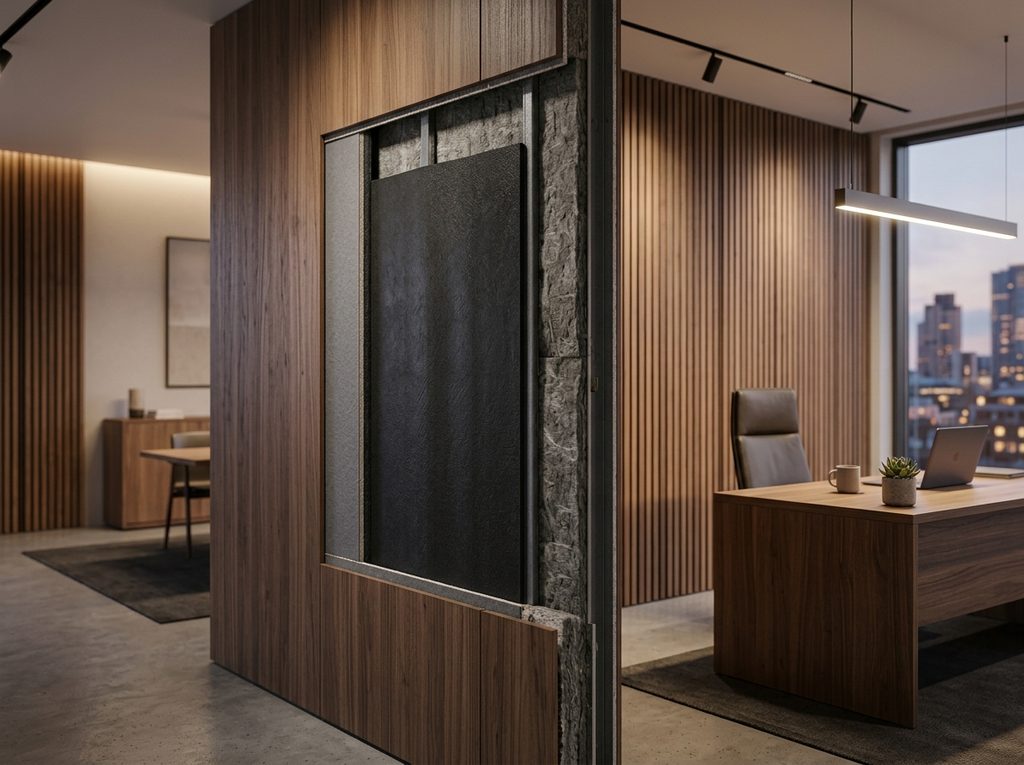
A typical soundproof wall may combine several acoustic principles rather than relying on one material.
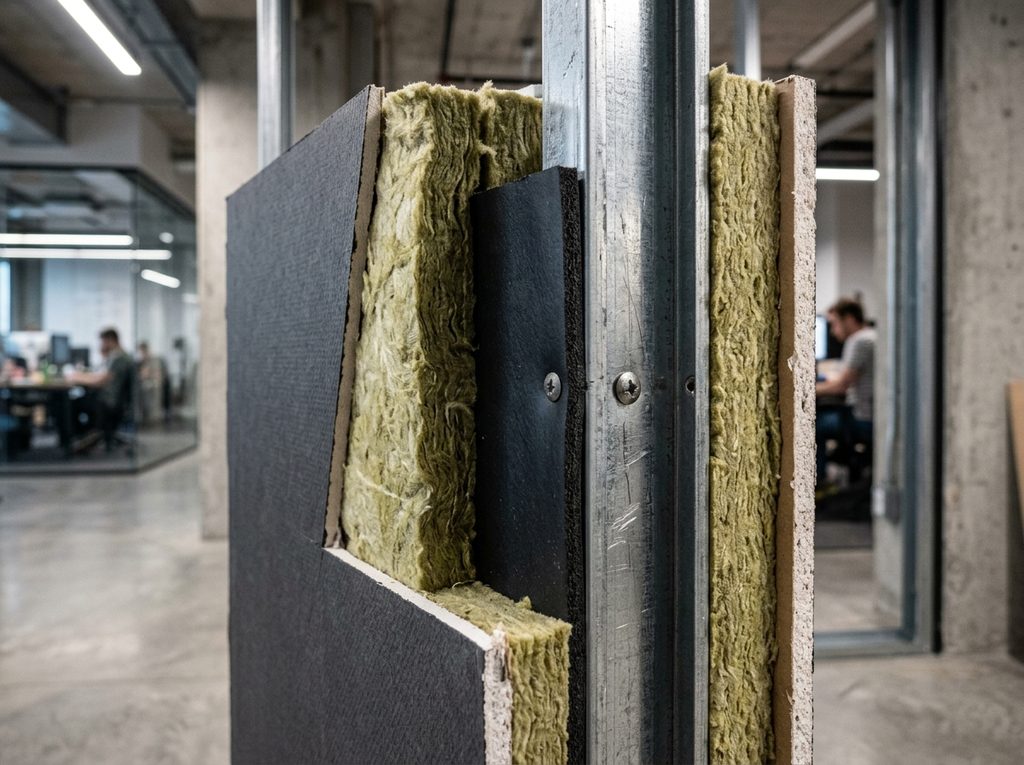
A system could involve:
- Existing wall or framing
- Acoustic insulation within the cavity
- MLV barrier
- Gypsum board or another finishing layer
- Acoustic sealant around critical joints and penetrations
The exact construction should be designed according to the existing wall and project requirements.
MLV can be installed directly to studs in some assemblies or positioned between layers of drywall. Manufacturer technical information specifically describes both approaches.
The objective is to create a continuous sound barrier while maintaining the integrity of the complete wall assembly.
Why Seams and Penetrations Matter
Adding MLV to a wall does not automatically guarantee excellent sound isolation.
Sound can find weak points.
Small openings around:
- Electrical boxes
- Pipes
- HVAC ducts
- Doors
- Junctions
- Wall edges
- Service penetrations
can compromise the acoustic integrity of the construction.
Published MLV installation specifications emphasize maintaining the acoustic integrity of the assembly and using acoustic sealants, tape, sound-rated putty, and appropriate isolation materials around openings and penetrations.
This is why professional installation matters.
The barrier needs to form part of a continuous acoustic envelope rather than simply being placed somewhere inside the wall.
MLV for Ceilings
Noise from an upper floor can be a major problem in multi-storey buildings.
A ceiling soundproofing system may use MLV as one component of the construction.
Depending on the existing structure, a system could incorporate:
- Existing slab
- Resilient or isolated framing
- Acoustic insulation
- MLV
- Gypsum board
- Acoustic sealants
- Additional ceiling finishes
MLV manufacturers list ceilings among its common sound-isolation applications.
However, ceiling soundproofing needs to distinguish between airborne noise and impact noise.
A conversation from the floor above is different from footsteps, furniture movement, or objects being dropped.
Impact noise can require additional isolation strategies beyond simply adding MLV.
MLV for Floors
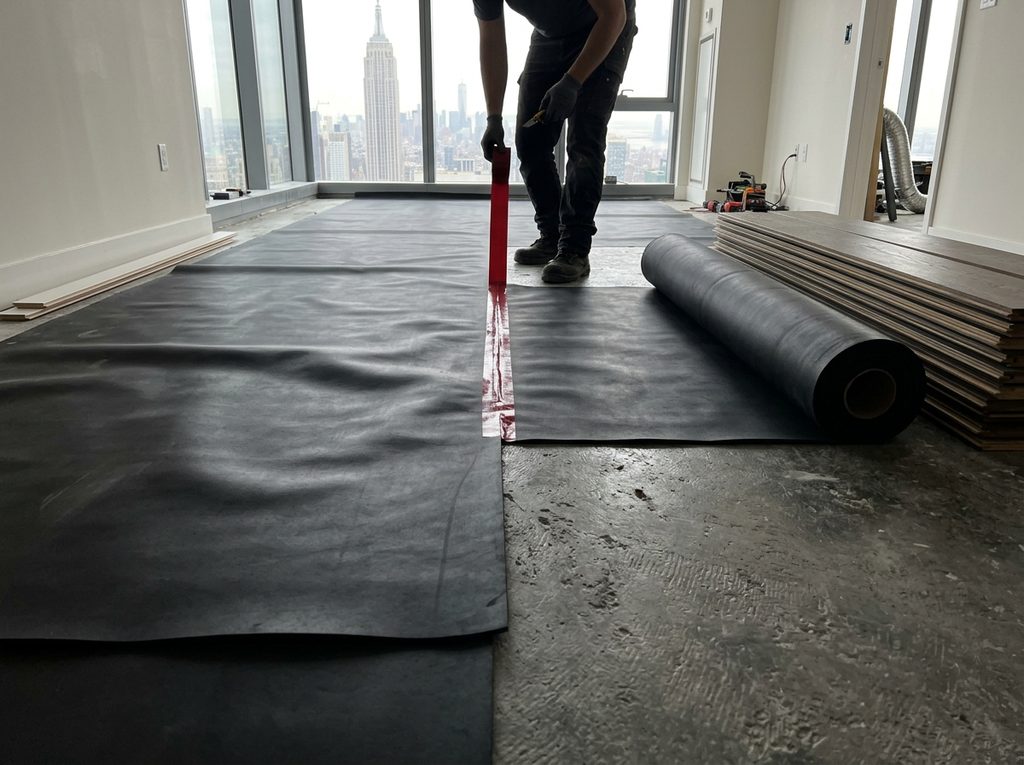
MLV can also be incorporated into floor assemblies.
It may be considered where airborne sound transmission through a floor is a concern.
Applications can include:
- Apartment floors
- Hotel rooms
- Home theatres
- Offices
- Recording environments
- Multi-unit buildings
Certain MLV products are specifically designed for floor applications, while others are intended primarily for walls or ceilings.
The selected product should therefore be checked against the intended application.
A floor system must also consider:
- Impact isolation
- Structural loading
- Finished-floor height
- Moisture
- Compression
- Underlayment requirements
MLV should not automatically be treated as a replacement for a dedicated impact-noise isolation system.
Soundproofing Offices in Blantyre
Modern offices increasingly include meeting rooms, private workspaces, open-plan areas, and collaborative zones.
This creates different acoustic requirements within the same building.
A confidential meeting may require greater sound isolation from an adjacent office.
A manager’s office may need improved speech privacy.
A conference room may require better isolation to prevent conversations from travelling into circulation areas.
MLV can be incorporated into wall and ceiling assemblies where airborne sound transmission is an important consideration.
It can also be combined with acoustic doors, sealed partitions, glazing, insulation, and other construction measures.
Hotels and Hospitality Buildings
Hotels need acoustic privacy because guests expect sleeping and relaxation areas to remain separated from unwanted noise.
Potential noise paths include:
- Adjacent rooms
- Corridors
- Service areas
- Mechanical equipment
- Plumbing
- Restaurants
- Entertainment areas
MLV may be incorporated into selected wall, floor, ceiling, duct, or equipment treatments as part of a wider acoustic strategy.
For hotel projects, however, acoustic performance should be considered at the building-design stage whenever possible.
A barrier cannot compensate for every weak point in a poorly isolated construction.
MLV for Home Theatres and Entertainment Rooms
Home theatres contain powerful sound systems capable of generating significant low-frequency energy.
The objective is often twofold:
Keep the sound inside the theatre.
Prevent outside noise from interfering with the viewing experience.
MLV can form part of the wall or ceiling assembly by adding mass to the construction.
It can be combined with:
- Acoustic insulation
- Decoupled framing
- Multiple board layers
- Acoustic sealant
- Solid-core acoustic doors
- Appropriate glazing
- Floating floor systems
The exact combination depends on the room and the desired isolation level.
Recording Studios and Music Rooms
Music spaces can create particularly demanding acoustic conditions.
A recording studio may need to prevent sound from entering the room while also preventing music from escaping.
MLV can contribute to the sound isolation portion of the design.
It should not be confused with the acoustic treatment used inside the studio.
A professional studio may therefore have two separate systems:
Sound Isolation
MLV, mass layers, decoupled construction, acoustic doors and other barriers.
Internal Acoustic Treatment
Broadband absorbers, bass control, diffusers, ceiling treatment, and other room-acoustic elements.
Both objectives need to be considered separately.
MLV Around Mechanical Equipment
Noise from mechanical equipment can travel through both airborne and structural paths.
Equipment such as:
- Generators
- Compressors
- Pumps
- HVAC equipment
- Fans
- Blowers
- Industrial machinery
may require specialized acoustic enclosures or barriers.
MLV products are available for applications involving machinery enclosures, HVAC equipment, ducts, pipes, and other mechanical systems.
In these applications, however, vibration isolation can be just as important as airborne sound control.
A heavy barrier alone may not eliminate structure-borne vibration.
MLV for Ducts and Pipes
Noise can sometimes bypass a wall entirely through building services.
HVAC ducts can carry sound between rooms.
Waste pipes can transmit plumbing noise.
MLV can be used in certain applications to wrap or treat these pathways.
Published product information specifically lists ductwork, PVC waste pipes, HVAC systems, and plumbing-related applications for acoustic vinyl barriers.
This demonstrates why a proper acoustic survey should consider the entire building rather than focusing on the wall alone.
How MLV Thickness and Weight Affect Performance
MLV is commonly described according to its surface weight rather than simply thickness.
Examples include:
| Approx. Surface Weight | Example Published STC* |
|---|---|
| 0.6 lb/ft² | 22 |
| 1 lb/ft² | 26 |
| 2 lb/ft² | 32 |
*Values above are from a specific manufacturer’s tested MLV product and should not be generalized to every MLV product or complete building assembly.
Another manufacturer’s published data lists 0.5, 1, and 2 lb/ft² barriers with standalone STC values of 20, 27, and 31 respectively.
This illustrates an important point:
More mass can improve transmission loss, but the performance of the final building system depends on the complete assembly.
Why STC Alone Does Not Tell the Whole Story
Sound Transmission Class, or STC, is useful for comparing certain sound-isolation performance characteristics.
But real-world buildings contain many frequencies and many possible sound paths.
For example, low-frequency noise from:
- Subwoofers
- Machinery
- Generators
- Heavy vehicles
- HVAC equipment
may require more detailed consideration than a basic STC figure provides.
A professional acoustic design should therefore consider the actual noise source and its frequency characteristics.
MLV Should Be Part of a System
MLV works best when its role within the building assembly is clearly understood.
A high-performing sound-isolation system may combine:
Mass
MLV and board layers add weight.
Absorption
Cavity insulation helps control acoustic energy within the wall.
Decoupling
Separating structural layers can reduce vibration transfer.
Damping
Appropriate damping materials can reduce panel vibration.
Sealing
Acoustic sealants and properly treated penetrations prevent leakage paths.
This combination is generally more effective than expecting one material to solve every acoustic problem.
Installation Considerations in Blantyre
Before installation, the existing construction should be assessed.
Important factors include:
- Wall type
- Stud spacing
- Existing board layers
- Floor construction
- Ceiling structure
- Electrical services
- HVAC routes
- Plumbing
- Doors and windows
- Existing cracks or openings
The MLV should then be installed according to the manufacturer’s requirements.
Typical installation may involve cutting the material to size and attaching it with appropriate mechanical fasteners or other approved methods. Some MLV products can be installed directly to studs or between drywall layers.
Edges and joints need careful attention so that the barrier remains continuous.
Common Mistakes With MLV
Several mistakes can reduce the benefit of an MLV installation.
Treating MLV as Acoustic Foam
MLV is primarily a sound-isolation barrier, not a room-absorption product.
Leaving Gaps
A gap around the perimeter can compromise the continuity of the barrier.
Ignoring Penetrations
Electrical, plumbing, and HVAC openings can become significant sound paths.
Focusing Only on the Wall
Noise may travel through ceilings, floors, doors, windows, ducts, and structural connections.
Ignoring Structure-Borne Noise
Footsteps, machinery vibration, and impact noise require different isolation strategies.
Assuming the MLV Rating Equals the Wall Rating
A material’s standalone transmission-loss or STC data does not automatically equal the performance of the completed wall or floor.
Where Can MLV Be Used?
| Application | Main Purpose |
|---|---|
| Residential walls | Reduce airborne sound transmission |
| Office partitions | Improve speech privacy |
| Hotel walls | Reduce room-to-room noise |
| Ceilings | Help control airborne transmission |
| Floors | Add mass within floor assemblies |
| Home theatres | Support sound isolation |
| Recording studios | Reduce sound leakage |
| Machinery enclosures | Reduce equipment noise transmission |
| HVAC ducts | Reduce duct-borne noise |
| Plumbing | Help control pipe-related noise |
| Industrial partitions | Add flexible sound barrier mass |
| Retrofit projects | Increase mass without major structural changes |
A Better Approach to MLV Soundproofing
The most effective acoustic projects begin with the noise problem rather than the product.
Instead of asking:
“How much MLV do I need?”
the better questions are:
Where is the noise coming from?
Where is it travelling?
Is it airborne or structure-borne?
Which building element is transmitting it?
What level of isolation is required?
Once those questions are answered, MLV can be evaluated as one component of the solution.
This approach avoids unnecessary material use and helps ensure that the selected soundproofing system addresses the actual transmission path.
Professional Mass Loaded Vinyl Solutions in Blantyre
For residential, commercial, hospitality, studio, and industrial projects in Blantyre, MLV can be incorporated into professionally designed acoustic systems for walls, floors, ceilings, partitions, ducts, and equipment areas.
A complete service can involve:
- Site assessment
- Noise-path identification
- Existing construction review
- Acoustic system design
- MLV specification
- Coordination with other acoustic materials
- Professional installation
- Sealing of joints and penetrations
- Final inspection
This creates a complete sound-isolation approach rather than treating MLV as a standalone product.
Final Thoughts
Mass Loaded Vinyl is valuable because it provides substantial acoustic barrier mass in a flexible, relatively thin format.
For projects in Blantyre, Malawi, it can be considered for offices, homes, hotels, studios, entertainment rooms, mechanical areas, industrial spaces, and renovation projects where reducing airborne sound transmission is an important objective.
Its flexibility makes it useful in situations where conventional heavy construction is difficult to introduce.
But MLV is not a universal soundproofing solution.
Its effectiveness depends on the complete construction, including mass, cavity insulation, decoupling, damping, sealing, doors, glazing, floors, ceilings, and potential flanking paths.
The best results therefore come from treating MLV as one component of a professionally planned acoustic system.
When the source of the noise is identified correctly and the barrier is installed continuously within an appropriate assembly, MLV can provide a practical way to strengthen sound isolation without requiring unnecessarily bulky construction.
Frequently Asked Questions
What is Mass Loaded Vinyl used for?
MLV is primarily used as a flexible sound barrier to reduce airborne sound transmission through walls, ceilings, floors, partitions, machinery enclosures, ducts, and other assemblies.
Does MLV absorb sound?
MLV’s primary role is sound isolation, not room absorption. It adds flexible mass to resist sound transmission.
Can MLV be installed inside walls?
Yes. Depending on the product and assembly, MLV can be installed directly to studs or between layers of drywall.
Can MLV be used for ceilings?
Yes. MLV is available for ceiling sound-isolation applications and can be incorporated into suitable ceiling assemblies.
Is thicker MLV always better?
Increasing surface weight can improve transmission loss, but the complete wall, floor, or ceiling assembly determines the actual installed performance.
Can MLV stop low-frequency noise?
MLV can contribute to reducing airborne sound transmission, but low-frequency noise can be difficult to control and may require a combination of mass, decoupling, damping, and vibration isolation.
Can MLV be used for machinery?
Yes. MLV barriers are used in some machinery enclosures, equipment barriers, HVAC applications, and industrial sound-control systems.
Is MLV suitable for retrofit projects?
It can be particularly useful in retrofit situations where additional mass is required but there is limited space for thick rigid construction.
Does MLV alone completely soundproof a room?
No. Soundproofing depends on the complete construction. Doors, windows, ventilation, wall junctions, electrical openings, ceilings, floors, and flanking paths can all affect the final result.
Should MLV be combined with other acoustic materials?
Often, yes. A complete sound-isolation system may combine MLV with cavity insulation, additional board layers, decoupling, damping, acoustic sealants, and other construction measures depending on the project.
Can MLV be used under flooring?
Certain MLV products are designed for floor applications, but the system must also account for impact noise, structural loading, floor height, and the selected finished-floor construction.
How is MLV installed?
Installation varies by product and application. MLV can be mechanically fastened, installed between construction layers, or attached using approved installation methods. Joints and penetrations should be carefully treated to maintain acoustic continuity.