
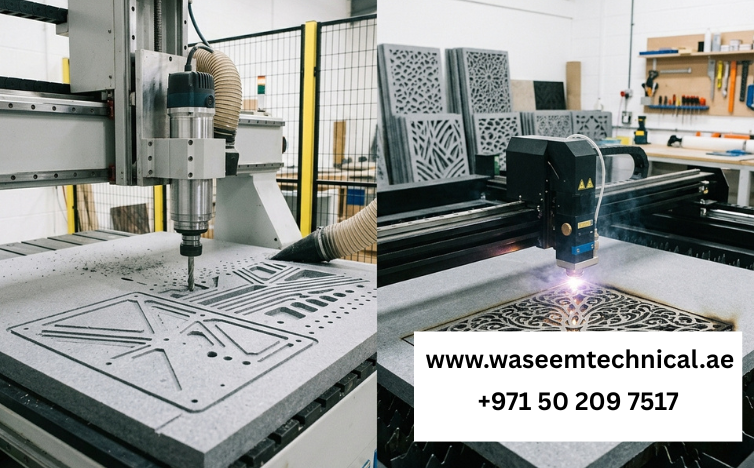
At first glance, CNC cutting and laser cutting seem almost identical. Both are computer-controlled processes, both deliver high precision, and both are widely used in modern fabrication. But once you look deeper, the difference becomes very clear—and it directly affects quality, cost, and the final result of your project.
The fundamental difference lies in how the material is cut. CNC machines use physical tools like rotating bits or drills to remove material, while laser cutting uses a high-powered focused beam of light to melt or vaporize material along a programmed path . This single distinction changes everything—from the type of materials you can cut to the level of detail you can achieve.
How CNC Cutting Actually Works
CNC (Computer Numerical Control) cutting is a mechanical process. A cutting tool spins at high speed and physically removes material layer by layer. The machine follows a digital design using multiple axes (X, Y, and Z), which allows it to create not just flat shapes but also deep cuts, grooves, and complex 3D structures .
Because it is a contact-based process, CNC cutting is extremely strong when it comes to handling thick and dense materials. It works efficiently on wood, metals, plastics, and even composites. This is why CNC is widely used for structural components, furniture parts, molds, and industrial applications.
How Laser Cutting Works
Laser cutting, on the other hand, is a non-contact thermal process. Instead of using a tool, it uses a concentrated beam of light to heat the material until it melts, burns, or vaporizes. The laser follows a precise digital path, cutting through the material with minimal physical interaction .
This process allows for extremely fine detail and smooth edges. Laser cutting is especially effective for thin materials like acrylic, MDF, sheet metal, fabric, and decorative panels. Because there is no physical contact, there is also less mechanical stress on the material.
Precision and Detail: Which One Performs Better?
When it comes to fine detailing, laser cutting has a clear advantage. The laser beam can create extremely small radii and sharp corners, making it ideal for intricate designs and patterns. In fact, laser systems can achieve much tighter internal cuts compared to CNC tools, which are limited by the diameter of the cutting bit .
However, CNC cutting offers better dimensional control for structural parts. Since it physically removes material, it maintains consistent depth and shape across thicker sections. This makes CNC more suitable for applications where strength and exact measurements matter more than fine detailing.
Material Thickness and Capability
One of the biggest differences between CNC and laser cutting is how they handle material thickness. CNC machines can cut very thick materials, often exceeding 25mm or more depending on the setup. Laser cutting, in contrast, performs best on thinner materials and becomes less efficient as thickness increases .
CNC also supports a wider range of materials, including metals, stone, and dense plastics. Laser cutting is more limited in this area, especially when dealing with certain materials that can burn or release harmful gases during the process .
Speed and Efficiency in Production
Laser cutting is generally faster for 2D designs and sheet-based work. Since it does not require tool changes or physical contact, it can quickly process multiple parts with minimal setup time. This makes it highly efficient for mass production of flat components.
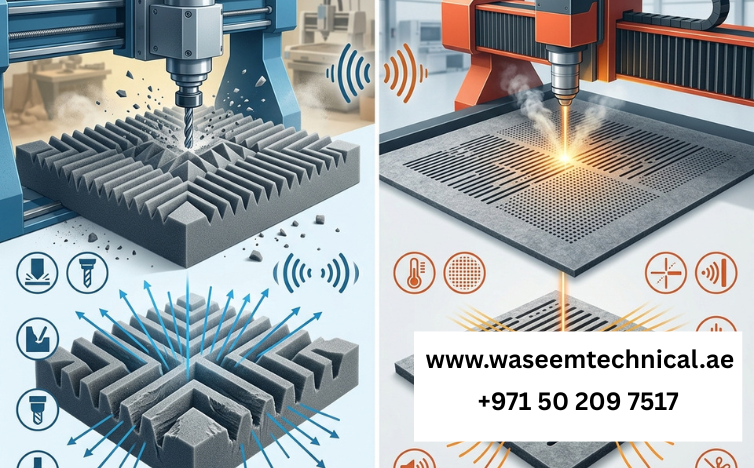
CNC cutting, while slightly slower in comparison for flat cuts, excels in complex and multi-dimensional work. It requires more setup, including tool selection and material clamping, but delivers better results for detailed structural components and deeper cuts.
Edge Quality and Finishing
Laser cutting often produces smooth, clean edges that may not require additional finishing. However, it can create a heat-affected zone (HAZ), especially on metals, which may slightly alter the material properties near the cut .
CNC cutting produces clean edges as well but may require additional finishing depending on the material and tool used. The advantage is that it does not introduce heat damage, making it more suitable for materials where structural integrity is critical.
Applications: Where Each Method Works Best
CNC cutting is ideal for:
- Furniture manufacturing and woodwork
- Thick panels and structural components
- Industrial parts and molds
- 3D designs and deep cuts
Laser cutting is ideal for:
- Decorative panels and signage
- Thin sheet materials
- Intricate patterns and engraving
- High-speed production of flat parts
Both technologies are essential, but they serve different purposes. Choosing the wrong one can lead to poor results, unnecessary costs, or limitations in design.
Which One Should You Choose?
The choice between CNC and laser cutting depends entirely on your project requirements. If your project involves thick materials, structural strength, or 3D shaping, CNC cutting is the better option. If you need fine detailing, sharp edges, and fast production for thin materials, laser cutting is the more efficient solution.
In many professional setups, both technologies are used together. CNC handles the structural work, while laser cutting is used for finishing, detailing, or decorative elements. This combined approach ensures maximum efficiency and the best possible results.
Call us: Contact Waseem Technical Soundproofing Expert in Dubai: +971 50 209 7517
Conclusion
CNC and laser cutting are not competitors—they are complementary technologies. The real difference lies in how they cut, what they cut, and where they perform best. CNC offers strength, depth, and versatility, while laser cutting delivers speed, precision, and fine detailing.