
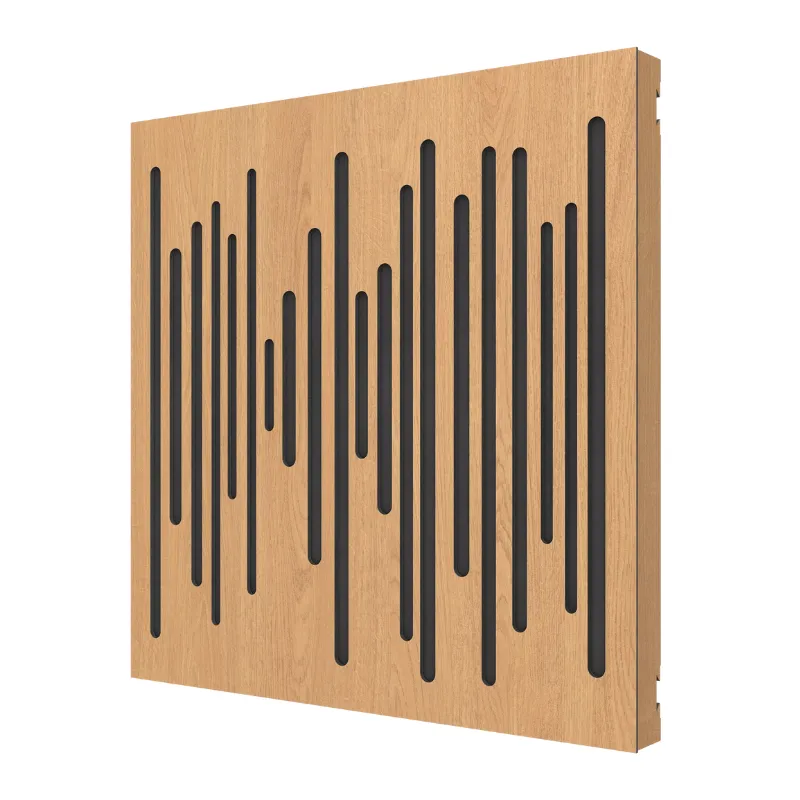
Sound Diffuser Panels
Sound diffuser panels are acoustic treatment panels designed to control sound reflections by scattering sound evenly across a space. Unlike acoustic panels that absorb sound, diffusers break up sound waves and redistribute them in multiple directions. This helps maintain natural sound energy while improving clarity, balance, and spatial sound quality.
Sound diffusers are commonly used in studios, home theaters, conference rooms, and performance spaces where sound quality is more important than sound reduction.
Specifications
Type: Wall Panels & Corner Panels
Sizes: Custom sizes as per project requirement
Acoustic Function: Sound diffusion (reflection control)
Application: Walls and ceilings
Get a Free Acoustic Check!
Get a detailed report on your space with soundproofing solutions!
Sound diffuser panels are used to manage how sound behaves inside a room. Instead of removing sound energy, they scatter reflections so sound spreads evenly throughout the space. This prevents harsh echoes and uneven sound build-up without making the room feel dull.
They are often used together with acoustic panels to create a balanced acoustic environment. When placed correctly, sound diffusers improve listening comfort, speech clarity, and overall sound quality in both professional and residential spaces.
Why Use Sound Diffuser Panels?
Improves Sound Quality in Treated Spaces
Many studios and media rooms already use acoustic panels. Sound diffusers help complete the system by balancing sound reflections and improving overall sound quality.
Reduces Harsh Echo Without Deadening the Room
Instead of absorbing sound completely, diffusers control reflections while keeping the space lively and natural.
Supports Professional Audio Environments
Recording studios, control rooms, and performance spaces require accurate sound behavior. Diffusers help achieve consistent sound distribution.
Enhances Comfort in Meeting and Presentation Rooms
In conference rooms and training spaces, diffusers improve speech clarity and reduce listener fatigue.
Works Well with Modern Interior Designs
Sound diffusers can be integrated into walls and ceilings without disturbing interior design finishes.
Features of Sound Diffuser Panels
Even Sound Scattering
The diffuser surface breaks sound waves and spreads them evenly across the room, preventing direct reflections.
Improved Acoustic Balance
By redistributing sound energy, diffusers help maintain consistent sound levels throughout the space.
Reduced Flutter Echo
Diffusers help control flutter echo and sharp reflections commonly found in hard-surfaced rooms.
Rigid and Stable Construction
The panel structure maintains its shape and depth, which is essential for reliable diffusion performance.
Compatible with Acoustic Systems
Sound diffusers work best when combined with acoustic panels and insulation systems.
Applications of Sound Diffuser Panels
Recording studios
Control rooms
Music studios
Podcast rooms
Practice rooms
Home theaters
Listening rooms
Performance halls
Conference rooms
Meeting rooms
Lecture halls
Training rooms
High-end offices
Public spaces
Installation of Sound Diffuser Panels
Sound diffuser installation requires correct positioning to ensure effective sound scattering.
Tools Needed:
Measuring tape
Drill and fixings
Level
Mounting brackets
Safety gloves
Installation Steps:
1. Acoustic Assessment
Identify reflection points such as rear walls, side walls, or ceiling areas.
2. Panel Positioning
Mark diffuser placement based on room size and listening positions.
3. Secure Fixing
Fix panels securely to walls or ceilings to avoid vibration or movement.
4. Alignment Check
Ensure correct spacing and alignment for balanced sound distribution.
5. Final Testing
Check sound behavior to confirm even reflection control.
Frequently Asked Questions
It is used to scatter sound evenly and control reflections inside a room.
Diffusers scatter sound, while acoustic panels absorb sound.
They are usually installed on rear walls, side walls, or ceilings.
No. They improve sound quality but do not block or absorb noise.
Yes. They are commonly used in home theaters and listening rooms.