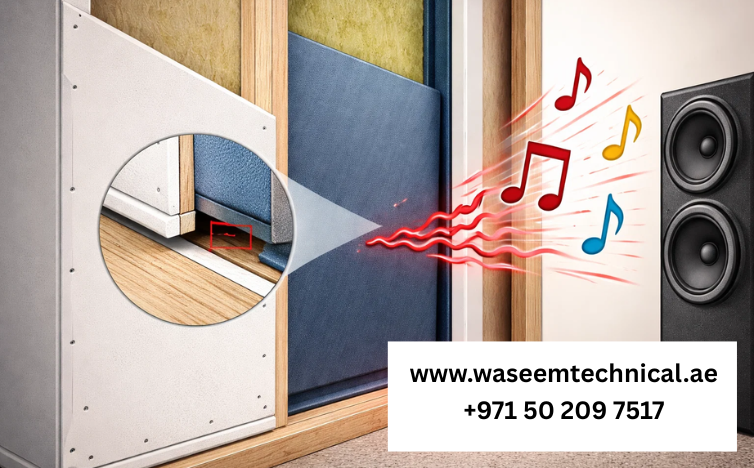
Most people think soundproofing fails because of poor materials. That’s not usually true. In reality, even the smallest gaps can completely undermine an otherwise perfect soundproofing setup.
A wall could be fully insulated. A door could be heavy and solid. The materials might be top quality. But if there are tiny openings left unsealed, sound will find its way through—every single time.
This is where most soundproofing projects go wrong.
The Weakest Point Controls Everything
Sound doesn’t behave like water—it’s faster, more aggressive, and far less forgiving. It travels through air, vibrations, and even structural elements. But here’s the key principle: sound always exploits the weakest point.
A single 1% opening in a surface can reduce sound insulation performance by up to 30–40%. That’s not guesswork. Acoustic research and building standards consistently show that even minimal leakage significantly impacts performance.
So even if 99% of your room is properly treated, that remaining 1% can make the entire system feel ineffective.
Why Small Gaps Matter More Than You Think
Gaps act like acoustic tunnels. Instead of forcing sound to pass through dense, soundproof materials, they give it a direct path.
Common problem areas include:
- Door edges and frames
- Window seals
- Electrical outlets
- Air vents and ducts
- Ceiling and wall joints
According to the U.S. Department of Energy, air leaks can account for up to 25–40% of energy loss in buildings—and sound behaves similarly, escaping through the same weak points.
In practical terms, that means noise from outside traffic, machinery, or neighboring rooms can easily enter or escape through these tiny openings.
The Door Gap Problem Nobody Notices
Doors are one of the biggest culprits.
You might install a solid-core door expecting excellent soundproofing. But if there’s even a small gap at the bottom or sides, it can completely cancel out the benefit.
A gap as small as 5–10 mm under a door can allow a significant amount of sound to pass through. That’s why professional soundproofing systems always include:
- Door seals
- Drop-down bottom seals
- Acoustic thresholds
Without these, the door becomes a weak barrier instead of a strong one.
Walls Aren’t Always the Problem
Many people invest heavily in wall insulation—acoustic panels, foam, or double drywall systems. But then they ignore structural gaps.
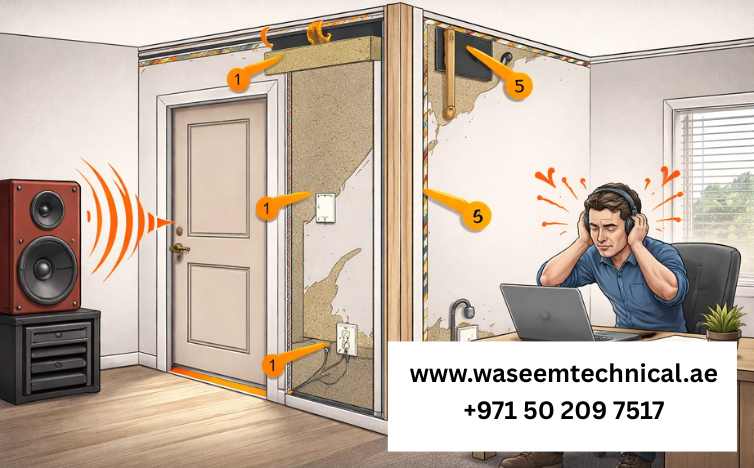
Here’s what typically happens:
- The wall blocks most sound
- But sound leaks through edges, corners, and joints
- Result: disappointing overall performance
Research published in building acoustics journals shows that flanking paths—where sound travels around barriers instead of through them—are a major reason for soundproofing failure.
And most flanking paths exist because of gaps.
Windows: The Silent Leakage Point
Windows are another critical area. Even high-quality glazing systems can fail if sealing isn’t done properly.
Small gaps around window frames allow:
- External noise to enter
- Internal sound to escape
- Vibrations to transfer through air gaps
This is why advanced systems like acoustic laminated glass are always paired with airtight installation techniques.
Without proper sealing, even the best glass won’t perform as expected.
Industrial Spaces: Where the Problem Gets Worse
In industrial and commercial environments, the impact of small gaps becomes even more serious.
Factories, workshops, and mechanical rooms generate high-decibel noise. If gaps are present:
- Noise spreads to nearby areas
- Worker safety is affected
- Compliance issues may arise
According to WHO guidelines, prolonged exposure to noise above 85 dB can lead to hearing damage. Poor soundproofing caused by gaps can easily push environments beyond safe limits.
This is why industrial acoustic solutions always focus heavily on sealing, not just insulation.
Why Most DIY Soundproofing Fails
DIY soundproofing often focuses on visible elements—panels, foam, or curtains. But it ignores invisible weaknesses.
Typical mistakes include:
- Not sealing edges properly
- Ignoring door and window gaps
- Overlooking vents and service openings
- Using low-density sealing materials
The result? Money spent, but minimal improvement.
Soundproofing is not just about adding materials—it’s about controlling every possible path sound can travel through.
How to Fix the Gap Problem Properly
Effective soundproofing always includes airtight sealing as a core step.
Professional solutions typically involve:
- Acoustic sealants for joints and cracks
- Rubber or silicone gaskets for doors and windows
- Backer rods for larger gaps
- Specialized acoustic barriers for vents
The goal is simple: eliminate every possible air path.
Because if air can pass through, sound will too.
Why Professional Acoustic Solutions Work Better
This is where professional acoustic suppliers make a real difference.
Instead of just selling products, they:
- Identify hidden leakage points
- Design complete soundproofing systems
- Combine materials with proper sealing techniques
Companies like Waseem Technical provide integrated acoustic products and solutions that address both insulation and sealing—ensuring the system works as a whole rather than in parts.
The Real Truth About Soundproofing
Soundproofing doesn’t fail because materials are bad. It fails because systems are incomplete.
And small gaps are the biggest reason those systems break down.
You can install the best acoustic panels, glass, or insulation—but if gaps are left untreated, the results will always fall short.
Call us: Contact Waseem Technical Soundproofing Expert in Dubai: +971 50 209 7517
Final Thought
Before upgrading your soundproofing setup or investing in new materials, take a closer look at the details. The smallest gaps often create the biggest problems.
Seal them properly, and you’ll notice a dramatic improvement.