The moment a client reclines in a treatment chair, closes their eyes, and hears the conversation from the next station clearly enough to follow — the experience has already failed. Not the therapist. Not the product. Not the ambiance the interior designer spent months perfecting. The sound environment undermined everything else before anything else had a chance to work.
Dubai’s beauty and wellness sector is enormous, competitive, and increasingly sophisticated about every dimension of the client experience — except, consistently, the acoustic one. Walk into most of the salons along JBR Walk, the spas in DIFC, the nail studios in Jumeirah and Mirdif, and the acoustic environment is an afterthought at best. Hard tile floors, glass partitions, high ceilings, marble surfaces. Beautiful. Loud. And fundamentally at odds with the service being sold.
What Sound Does to a Relaxation Experience
This isn’t subjective preference. Neuroscience is quite clear about what auditory environments do to the human stress response. Research from the University of Sussex found that natural, controlled sound environments reduce cortisol and blood pressure measurably — while unpredictable, uncontrolled noise keeps the sympathetic nervous system in a partial alert state regardless of what else the environment is doing to signal calm.
A client lying on a massage table in a Dubai spa with tiled floors and bare walls is physiologically responding to the acoustic chaos around them even when their eyes are closed. The treatment is working against the environment rather than with it. The therapist’s skill, the quality of the products, the carefully dimmed lighting — all of it competes against a sound environment that the client’s nervous system is processing as mildly threatening, continuously, throughout the treatment.
The acoustic environment isn’t background. For a service that exists specifically to reduce physiological stress, sound is clinical infrastructure.
The Specific Noise Problems Dubai Salons Face
Dubai beauty salons and spas occupy a range of space types — mall units, villa conversions, purpose-built wellness centres, and floors within mixed-use commercial buildings. Each creates its own noise profile, and understanding which problem is actually present determines which treatment is correct.
Mall-based salons deal with external noise intrusion from the mall corridor — footfall, music from adjacent retailers, announcement systems. The primary transmission path is usually the entrance — the gap around the salon door and the lightweight partition between the salon and the corridor. Acoustic door seals and Mass Loaded Vinyl on the shared partition wall address this specifically and cost-effectively.
Villa-converted spas face the internal reverberation problem almost universally. Residential spaces converted to commercial wellness use have rooms designed for domestic occupancy — not for the density of equipment, staff movement, and client activity that a functioning spa creates. The hard surfaces that came with the villa amplify everything. Acoustic wall panels and ceiling treatment reduce the reverberation time to the range where the space starts feeling genuinely calm rather than just looking calm.
Mall and commercial building spas dealing with floor-to-floor noise — treatment rooms on upper floors with activity above, or ground floor spaces with basement mechanical rooms — need acoustic floor underlay or floating floor systems to interrupt the impact transmission path that tiled direct-bond floors make extremely efficient.
Treatment Rooms Are the Priority — Not the Reception
The instinct when designing acoustic treatment for a beauty salon or spa is to treat the most visible space first. The reception area. The waiting zone. These are high-visibility, design-conscious spaces and it feels logical to start there.
The commercial and clinical priority is exactly the opposite. Treatment rooms are where the client spends the most time, in the most vulnerable and relaxed state, with the highest sensitivity to acoustic intrusion. A noisy reception desk is mildly irritating. Conversation from the adjacent treatment room audible through the wall during a facial or massage is an experience-destroying failure that no five-star review survives.
Treatment room acoustic treatment requires wall panel coverage on at least two opposing walls to control internal reverberation, acoustic door seals to eliminate under-door and perimeter transmission from the corridor, and — where treatment rooms share walls with active stations, equipment rooms, or other treatment spaces — MLV on the shared wall to add blocking mass between them. PET acoustic panels are the default wall treatment specification for treatment rooms because they are non-toxic, non-allergenic, produce no VOC off-gassing, and present no material safety concern in enclosed spaces where clients spend extended periods breathing normally in close proximity to surfaces.
The Salon Floor Problem — Why Tile Is Costing You Reviews
The floor finish in most Dubai beauty salons is large-format porcelain tile. It looks premium. It’s hygienic. It’s standard for the sector. It is acoustically one of the worst floor materials in existence for an environment designed around client relaxation.
Every footstep on hard tile generates an impact sound that transmits through the floor structure and radiates into adjacent spaces. Trolley wheels on tile create a sustained mechanical sound that carries throughout the salon. Dropped implements produce sharp, startling impact sounds that reset the nervous system of any client in a nearby treatment room. The cumulative effect is a constant low-level acoustic disruption that no amount of ambient music fully masks — because the acoustic event is structural, not airborne.
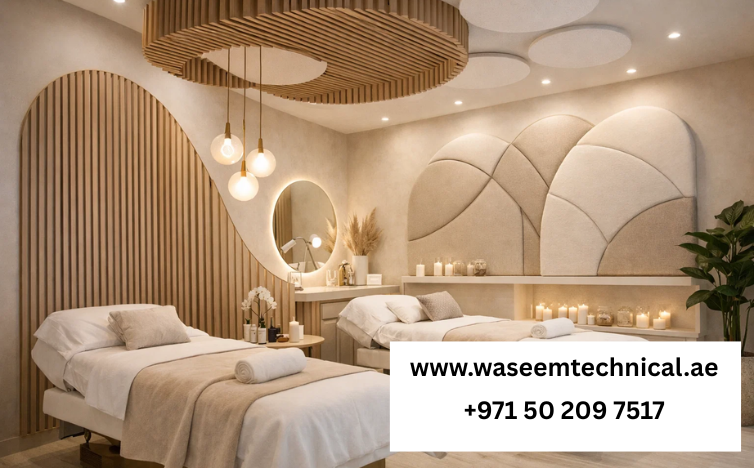
Acoustic carpet in treatment rooms and relaxation areas directly addresses this. The fibres absorb impact energy before it reaches the floor structure, and the carpet surface absorbs airborne sound within the room simultaneously. The shift from tile to acoustic carpet in a treatment room is audible from the first footstep — the space changes character immediately in a way that clients register as “quieter” and “more relaxing” even before any specific noise event occurs. For salons where full reflooring is impractical, acoustic floor underlay beneath a vinyl or carpet overlay achieves comparable results without requiring removal of the existing tile.
Hairdryer Stations, Equipment Noise, and the Open Plan Problem
There’s a specific acoustic challenge in full-service hair salons that distinguishes them from pure spa environments: the operational noise of the salon itself. Hairdryers running simultaneously. Colour processing equipment. Basins with running water. Conversation at multiple stations at once. These are not controllable noise sources — they’re the sounds of the service being delivered.
The acoustic treatment goal in a working hair salon is not silence. It’s containment and control. The target reverberation time for a hair salon is 0.6 to 0.9 seconds — enough absorption to prevent the noise of each station from compounding across the entire salon floor, without making the space so acoustically dead that it feels clinical and uncomfortable.
Acoustic ceiling baffles are particularly effective in open-plan salon layouts with high ceilings — the category that applies to a significant number of Dubai’s premium salon brands that favour warehouse-aesthetic or loft-style spaces. Hanging baffles address the ceiling plane absorption that’s impossible to achieve with wall treatment alone in tall-volume spaces, and they do it without requiring any permanent ceiling modification — the suspension cables and fixings are the only structural interface. For salons in leased spaces where ceiling modification isn’t permitted, baffles are the practical route to ceiling plane treatment that landlord agreements don’t prevent.
Privacy — The Dimension That Generates Trust
There’s a conversation dimension to salon and spa acoustic treatment that goes beyond comfort and enters the territory of business ethics and client trust.
Beauty treatments involve intimate conversations. Clients discuss personal concerns, health conditions, relationship issues, and professional pressures with therapists they trust. These conversations are part of the service — the therapeutic relationship that distinguishes a great salon or spa from a transactional one. When those conversations are audible from adjacent spaces, the client’s sense of safety and privacy is compromised in a way that damages the relationship and, eventually, retention.
Acoustic glass doors for treatment rooms — where visibility is valued for staff supervision but conversation privacy is equally valued — resolve this tension effectively. Acoustic glass achieves high STC ratings while maintaining the visual openness that salon operations require. Combined with acoustic door perimeter seals and MLV on shared walls, an acoustic glass door system contains treatment room conversations to the treatment room without compromising the open, supervised environment that both clients and operators benefit from.
For consultation areas — where colour consultations, skin assessments, and treatment planning conversations happen — the same logic applies with even more direct relevance. A client discussing their hair loss, their skin condition, or any other personal concern deserves an acoustic environment that actually contains that conversation. The standard consultation chair positioned at a station on an open salon floor does not provide this. A lightly screened, acoustically treated consultation zone does — and it communicates that the business takes client privacy seriously as an operational value, not just a stated one.
Call us: Contact Waseem Technical Soundproofing Expert in Dubai: +971 50 209 7517
What are the Investment Returns in a Competitive Market
Dubai’s beauty and wellness market generates significant revenue — industry estimates place the UAE beauty sector among the top five globally per capita. It is also intensely competitive, with new salon and spa openings consistently outpacing market growth. In that environment, differentiation through experience quality is the sustainable competitive strategy — not price competition, not service range alone.
Acoustic quality is a differentiation lever that almost no Dubai salon or spa has fully pulled. The competitor down the road has the same marble counter, the same Italian furniture, possibly the same product brands. They almost certainly have the same noisy tile floors and the same echoey treatment rooms. A salon that invests in acoustic treatment and delivers a genuinely quiet, private, acoustically considered experience is delivering something the market isn’t saturated with — which is exactly the kind of differentiation that builds the word-of-mouth reputation and five-star review profile that Dubai’s beauty market rewards.
The treatment investment for a mid-size Dubai beauty salon or spa — covering treatment rooms, the main salon floor, and key shared wall partitions — typically runs from AED 15,000 to AED 40,000 depending on the size and complexity of the space. Against the lifetime value of retained clients and the review-driven growth that a genuinely superior acoustic experience enables, that’s one of the more defensible investments a salon owner in Dubai can currently make.