
Noise control is an important consideration in residential, commercial and industrial buildings. In a busy city such as Durban, unwanted sound may come from traffic, neighbouring properties, mechanical equipment, workshops, generators and building services. Whether the goal is to improve privacy, create a more comfortable indoor environment or manage equipment noise, selecting the right sound insulation materials is essential.
Acoustic mass loaded vinyl (MLV) is a flexible, high-density sound barrier designed to help reduce airborne sound transmission through building assemblies and selected equipment enclosures. Its relatively thin, adaptable form makes it useful in projects where adding barrier mass is necessary but space is limited.
For homeowners, contractors, architects, interior designers and facility managers in Durban, MLV can be considered for new construction, renovation and targeted noise-control upgrades. It is commonly integrated into walls, ceilings, floors, partitions and mechanical systems as part of a wider acoustic design.
Understanding how mass loaded vinyl works—and what it can and cannot do—helps project teams make informed decisions before specifying or installing the material.
What Is Acoustic Mass Loaded Vinyl?
Mass loaded vinyl is a dense, flexible membrane made from a vinyl or polymer-based compound combined with mineral fillers that add mass. The material is designed to resist the passage of airborne sound through a partition.
Unlike lightweight acoustic foam, which is primarily used to absorb sound reflections inside a room, MLV is mainly used as a sound barrier. It adds mass to a construction and can be incorporated into layered assemblies to help reduce sound transmission.
Because it remains flexible, MLV can be fitted into different construction arrangements, including wall cavities, ceiling systems and certain machinery enclosures. Some products are supplied as rolls, while others may be available in sheets or reinforced configurations.
Product composition, weight, thickness, fire performance and acoustic test results vary. These properties should always be checked against the specific product’s technical documentation.
How Does Mass Loaded Vinyl Reduce Noise?
Airborne sound causes building elements to vibrate. When sound reaches a wall, ceiling or other partition, some energy may pass through the structure and be heard on the other side.
Adding mass to a suitable assembly can make it more difficult for airborne sound to excite and pass through that construction. MLV provides additional barrier mass in a flexible format.
However, acoustic performance depends on the complete system—not just the membrane. Factors that influence the final result include:
- MLV surface weight and thickness.
- The construction and number of layers in the wall or ceiling.
- Insulation within cavities, where specified.
- The quality of joints and perimeter sealing.
- Gaps around doors, windows, electrical boxes and service penetrations.
- Structural connections that allow sound or vibration to bypass the barrier.
Manufacturer test results for a standalone barrier should not be treated as the rating of an entire wall or ceiling. The complete assembly must be considered when estimating performance. <Cite refs={[“turn706628search12″,”turn706628search15″,”turn706628search16”]}/>
Why Consider Acoustic Mass Loaded Vinyl in Durban?
Durban has a mix of residential properties, offices, hospitality spaces, retail environments, workshops and industrial facilities. These settings can have different sound insulation requirements.
MLV can be useful when a project needs additional barrier mass without relying solely on thick, rigid construction materials.
1. Residential Sound Insulation
In apartments, townhouses and multi-unit properties, noise may travel through shared walls, ceilings and floors. Everyday sounds such as conversations, television audio and household activities can affect neighbouring occupants.
MLV may be incorporated into a suitable partition to help reduce airborne sound transmission. In retrofit projects, the installation method depends on the existing wall construction, available space and access to the surface.
For better results, the complete assembly should also address gaps, doors, ceiling junctions and other potential sound leakage paths.
2. Offices and Meeting Rooms
Office environments often require privacy between meeting rooms, workspaces and administrative areas. Sound travelling through lightweight partitions can affect concentration and confidentiality.
MLV can be installed as a barrier layer within selected wall systems. It may be combined with cavity insulation, plasterboard and acoustic sealing details to form a more effective partition.
Door seals, ceiling connections and service openings should also be reviewed, as sound can bypass the wall through these weak points.
3. Hotels and Hospitality Buildings
Guest comfort is a priority in hotels, lodges and other hospitality properties. Noise from adjoining rooms, corridors and service areas can interfere with rest and privacy.
Mass loaded vinyl may be used within selected wall or ceiling assemblies separating guest rooms from other spaces. Its suitability depends on the required performance, the construction design and the product’s documented specifications.
4. Industrial Workshops and Equipment Rooms
Workshops and industrial facilities may contain compressors, pumps, generators, fans and other noise-producing equipment.
MLV can be incorporated into selected machinery enclosures, barrier panels or removable acoustic jackets to help reduce airborne noise escaping from equipment. The design must consider ventilation, heat, access for maintenance and the equipment’s operating conditions.
The material should not obstruct cooling airflow, emergency access or safety-related components.
5. HVAC and Building Services
Ductwork, pipes and mechanical systems can transmit or radiate noise into occupied spaces. Certain MLV products are designed for use in duct and mechanical noise-control assemblies.
Product selection should consider temperature, moisture, vibration, mechanical protection and access for inspection or maintenance. <Cite refs={[“turn706628search4″,”turn706628search16”]}/>
Common Applications of MLV Sound Barriers
MLV for Walls
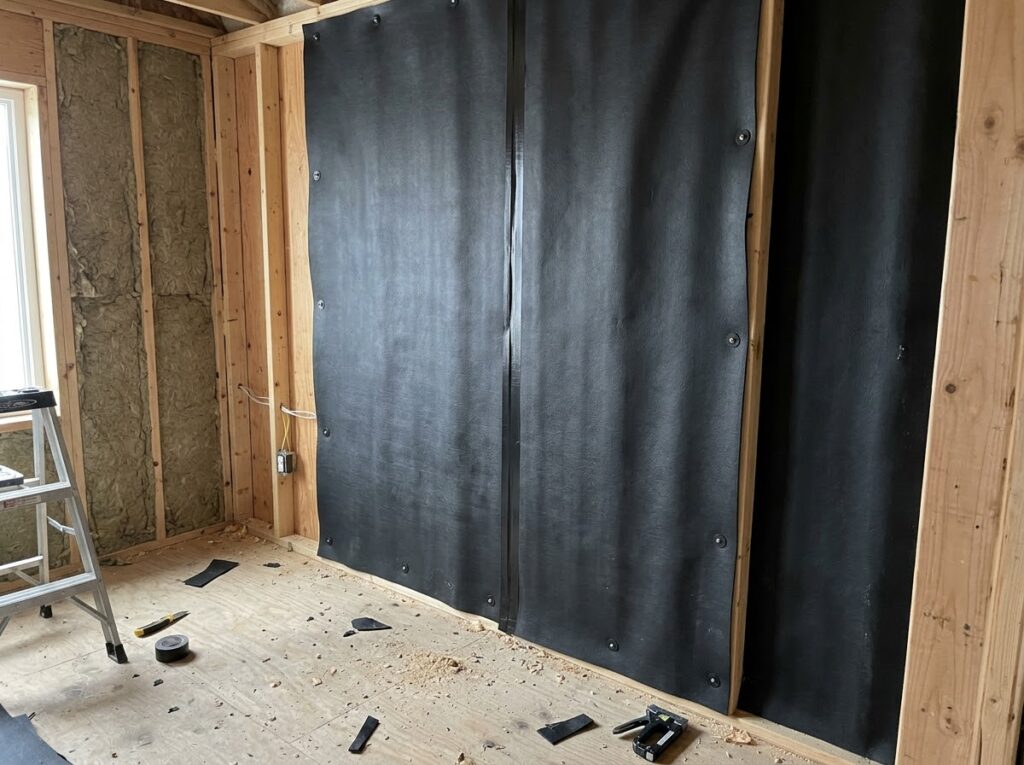
Wall systems are one of the most common applications for mass loaded vinyl. The membrane may be installed over framing before plasterboard is fitted or integrated into a suitable retrofit arrangement.
A typical layered wall system may include:
- Timber or metal framing.
- Cavity insulation, where required.
- Mass loaded vinyl.
- Plasterboard or another specified finishing layer.
- Acoustic sealant at relevant joints and perimeter details.
The exact construction should be selected according to the required sound insulation, structural conditions and available space.
MLV for Ceilings
Sound can travel through lightweight ceiling constructions and ceiling voids, especially where mechanical equipment is installed above occupied spaces.
MLV may be incorporated into a ceiling assembly to increase barrier mass. Because it is heavier than many acoustic treatment materials, overhead installations require appropriate support and careful planning.
The ceiling structure must be assessed for the additional load, and the installation must follow the product manufacturer’s instructions.
MLV for Floors
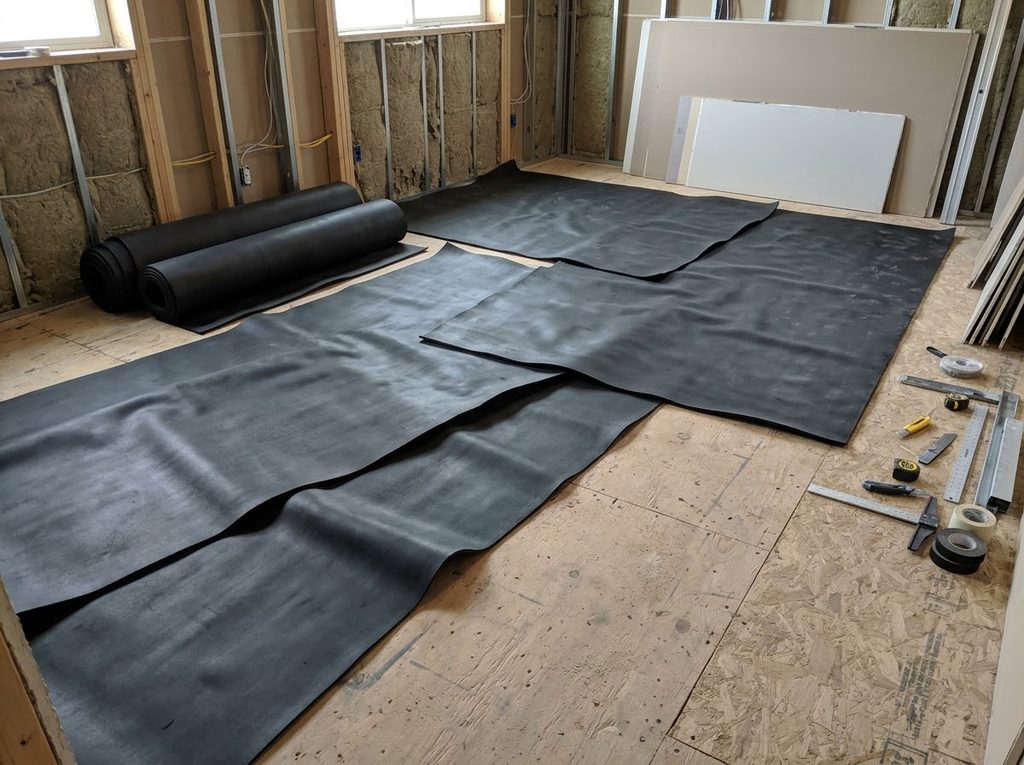
MLV can be used in selected floor assemblies to help reduce airborne sound transmission. It may form part of a layered construction involving subfloor materials and other acoustic components.
Impact noise—such as footsteps or dropped objects—requires a different approach. Resilient underlays, floating floor systems and isolation details may be needed depending on the source and structure.
MLV alone should not be assumed to solve impact-noise problems.
MLV for Machinery Enclosures
Equipment enclosures often use lightweight panels that may allow airborne noise to escape. MLV can add barrier mass to suitable enclosure surfaces or layered panels.
The design should maintain access for service work and account for operating temperatures, ventilation and vibration. Where vibration is transmitted through equipment mounts or structural supports, additional isolation measures may be necessary.
MLV for Ductwork and Pipes
Some MLV products are intended for mechanical-service applications such as duct wraps, pipe wraps and removable noise-control jackets.
The product must be suitable for the temperature and environmental conditions of the service. Installation should also preserve access to valves, inspection points and maintenance areas. <Cite refs={[“turn706628search4″,”turn706628search16”]}/>
Choosing the Right Mass Loaded Vinyl
Not all mass loaded vinyl products have the same properties. Before selecting a product for a Durban project, review the technical documentation and confirm that it matches the application.
Surface Weight and Thickness
MLV is commonly specified by its surface weight, such as pounds per square foot or kilograms per square metre. Products with different weights and thicknesses can have different acoustic and handling characteristics.
A heavier product may provide more barrier mass, but the correct specification depends on the complete assembly, available support and performance objective.
Acoustic Test Documentation
Ask for relevant test results, such as transmission loss by frequency or ratings for a tested assembly.
A rating for a standalone MLV sample should not be presented as the sound insulation rating of an entire wall, floor or ceiling. Assembly performance depends on all materials, joints and connections.
Reinforcement and Flexibility
Some MLV products are non-reinforced, while others include a scrim or reinforcement layer. Reinforced products may be suitable for certain hanging or exposed applications, depending on their design.
The choice should reflect how the membrane will be installed and whether it needs additional tear resistance or support.
Fire and Temperature Performance
Fire classifications and temperature limits vary between products. Confirm the exact product documentation before specifying MLV for commercial, hospitality or industrial applications.
Do not assume that a fire rating or temperature range applies to every MLV product.
Environmental Suitability
Durban’s coastal environment may expose materials to humidity and other environmental conditions. Check the manufacturer’s recommendations for storage, moisture exposure, installation temperature and compatibility with adjoining materials.
Installation Guidelines for Effective Sound Insulation
Proper installation is critical. A dense barrier can underperform if joints are left open or sound can bypass the treated area.
Prepare the Surface
Ensure the receiving surface is clean, dry and suitable for the selected fixing method. Identify service openings, electrical boxes, pipes and other details before installing the membrane.
Plan the Sheet Layout
Plan the layout to reduce unnecessary joints and cutting waste. Handle the membrane carefully to avoid tears or damage during installation.
Fix the Membrane Correctly
Depending on the product and application, MLV may be mechanically fixed or installed using an approved adhesive system. Follow the manufacturer’s instructions for fixing methods and spacing.
For wall applications, the membrane is often installed against the framing before the finishing board is fitted.
Seal Joints and Penetrations
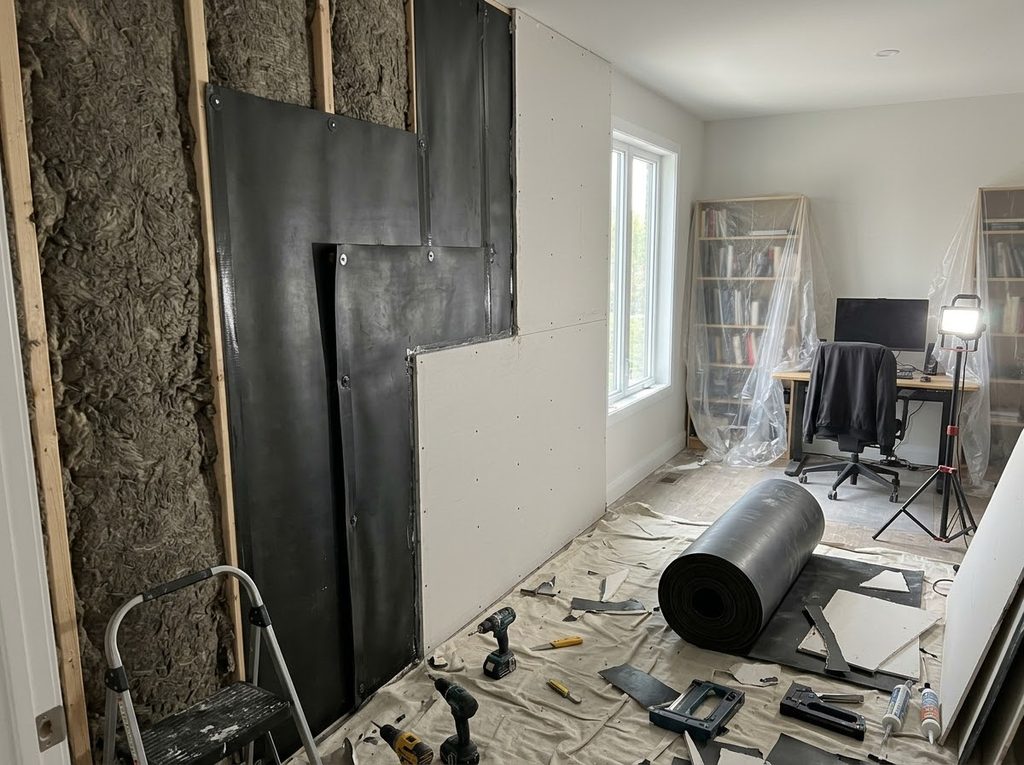
Joints, overlaps and perimeter connections should be treated using compatible acoustic tape, sealant or other specified accessories.
Pay particular attention to:
- Sheet joints and overlaps.
- Wall-to-floor and wall-to-ceiling junctions.
- Electrical boxes and service openings.
- Pipe and duct penetrations.
- Door and window perimeter details.
Installation specifications commonly emphasise sealing openings and maintaining the acoustic integrity of the complete assembly. <Cite refs={[“turn706628search15”]}/>
Protect the Finished Barrier
MLV is often covered by plasterboard, a protective layer or another specified finish. Avoid puncturing or damaging the membrane during later construction work.
For overhead and machinery applications, confirm that the material is properly supported and remains accessible where required.
Mass Loaded Vinyl vs. Acoustic Foam
MLV and acoustic foam are designed for different acoustic tasks.
| Feature | Mass Loaded Vinyl | Acoustic Foam |
|---|---|---|
| Main purpose | Helps reduce sound transmission | Absorbs sound reflections |
| Typical form | Dense, flexible membrane | Lightweight porous material |
| Common location | Inside walls, ceilings and enclosures | Exposed room walls and ceilings |
| Main acoustic role | Sound barrier | Sound absorption |
| Typical objective | Improve separation between spaces | Reduce echo and reverberation |
A project may require both materials. MLV can help improve the sound insulation of a partition, while acoustic absorbers can reduce reflections inside the room.
The first step is to identify whether the main problem is sound travelling between spaces or excessive echo within a room.
Benefits of Mass Loaded Vinyl for Acoustic Projects
When correctly specified and installed, MLV can offer several practical advantages:
- Flexible barrier format: Adds mass without requiring a thick rigid panel.
- Versatile installation: Can be incorporated into different wall, ceiling and enclosure designs.
- Space-conscious construction: Useful where available wall depth is limited.
- Multiple applications: Suitable for selected residential, commercial and industrial noise-control systems.
- Compatibility with layered assemblies: Can be combined with insulation, plasterboard and other construction materials.
- Retrofit potential: May be considered for upgrading existing partitions, depending on access and construction conditions.
These benefits depend on the specific product and the design of the complete system. <Cite refs={[“turn706628search12″,”turn706628search16”]}/>
What Influences the Cost of MLV in Durban?
The total cost of an MLV project depends on more than the membrane’s unit price. Factors that can affect the budget include:
Product weight and thickness: Different surface weights and constructions have different material and handling requirements.
Coverage area: The quantity required depends on the dimensions of the wall, ceiling, floor or enclosure, including overlaps and cutting waste.
Installation complexity: Overhead work, irregular surfaces, machinery enclosures and service penetrations can increase labour requirements.
Supporting materials: Acoustic sealants, tapes, insulation, framing, plasterboard and protective finishes may be required.
Project access: Existing building conditions and the need to work around occupied spaces or equipment can affect installation planning.
Supply and delivery: Product origin, order quantity and delivery arrangements may influence the overall project budget.
For a useful quotation, provide the application, dimensions, material requirements, project drawings and any available acoustic performance targets.
How to Plan an MLV Sound Insulation Project
Before selecting mass loaded vinyl, identify the source of the noise and how it travels.
A planning process should consider:
- Whether the problem is airborne sound, impact noise or vibration.
- The existing wall, ceiling, floor or equipment construction.
- The available installation space.
- The required level of sound insulation.
- Fire, temperature and environmental requirements.
- The need for additional absorption, isolation or sealing.
- The relevant product test documentation.
For complex applications, an acoustic consultant or experienced sound insulation contractor can help specify the complete assembly and identify potential sound leakage paths.
Conclusion: Acoustic Mass Loaded Vinyl in Durban
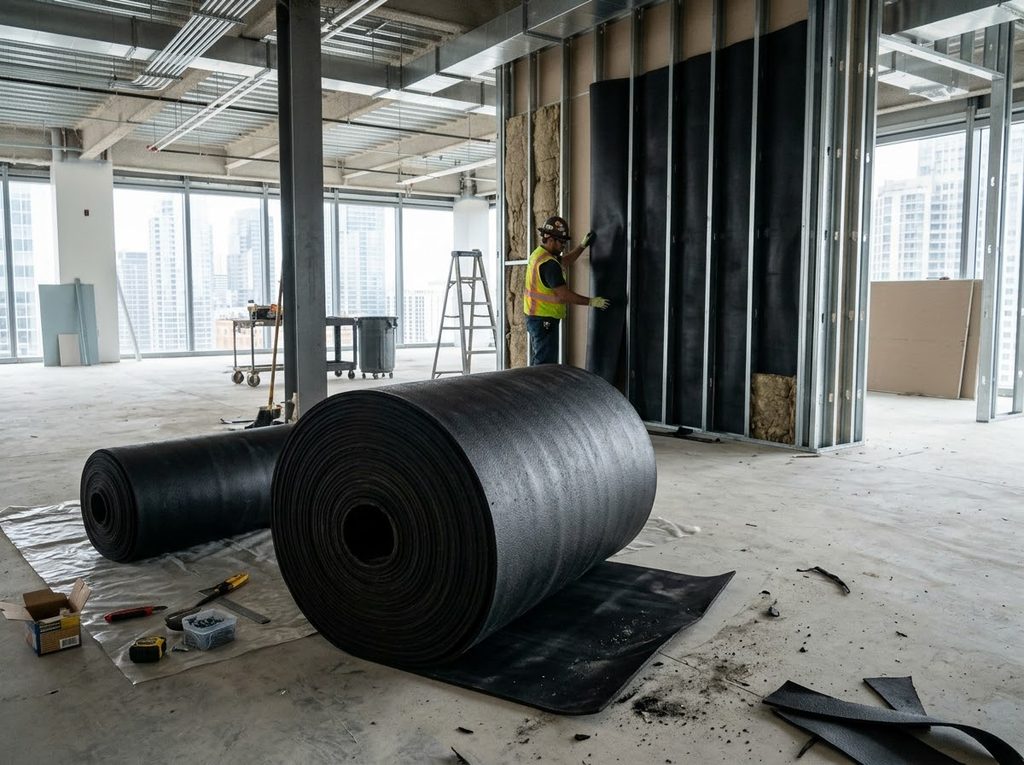
Acoustic mass loaded vinyl is a flexible, high-density barrier that can help reduce airborne sound transmission when incorporated into a properly designed construction system.
For residential buildings, offices, hotels, workshops and industrial facilities in Durban, MLV may be used in selected walls, ceilings, floors, machinery enclosures and mechanical-service applications. Its performance depends on the product’s properties, installation quality and the surrounding construction.
When selecting MLV, review technical specifications, confirm relevant test results and consider the complete assembly rather than relying on the membrane alone. Careful planning, suitable sealing and correct installation can help create more comfortable and functional indoor environments.
Frequently Asked Questions
1. What is mass loaded vinyl used for?
Mass loaded vinyl is a dense, flexible sound barrier used to help reduce airborne sound transmission through walls, ceilings, floors, machinery enclosures and selected mechanical systems.
2. Does MLV completely soundproof a room?
No. MLV can improve sound insulation as part of a suitable assembly, but it does not make a room completely soundproof. Doors, windows, gaps, structural connections and other weak points can still allow noise to pass through.
3. Can mass loaded vinyl be installed inside walls?
Yes. It is commonly incorporated into wall systems, often over framing and behind plasterboard. The installation method should follow the product instructions and the design of the complete wall assembly.
4. Is MLV suitable for industrial noise control?
It can be used in selected machinery enclosures, barrier panels and mechanical-service applications. Product compatibility with temperature, ventilation, moisture and operating conditions must be verified.
5. Is mass loaded vinyl the same as acoustic foam?
No. MLV is mainly used as a sound barrier to help reduce transmission between spaces. Acoustic foam is mainly used to absorb reflections and reduce echo inside a room.
6. Can MLV help reduce generator noise?
It may help reduce airborne noise when incorporated into a properly designed generator enclosure or barrier. The design must also account for ventilation, heat management, access and vibration.
7. What should I check before specifying MLV in Durban?
Review surface weight, thickness, acoustic test documentation, fire performance, temperature limits, installation requirements and suitability for the intended environment.
8. Can MLV be used in ceiling systems?
Yes, where the ceiling assembly is designed to support its weight. Proper fixing, structural assessment and careful sealing are important for overhead installations.