

Noise pollution has become a major issue in Dubai’s residential and commercial buildings. From busy roads and construction activity to shared office spaces and apartment living, unwanted sound can easily travel through standard doors.
What Are Acoustic Doors?
Acoustic doors are specially designed soundproof doors built to block and absorb noise transmission between spaces.
Unlike regular hollow-core or lightweight doors, acoustic doors use:
- Dense core materials
- Multi-layer construction
- Acoustic seals
- Soundproof insulation
- Heavy-duty framing systems
According to Waseem Technical acoustic door solutions, these doors can provide sound insulation ratings up to 40 dB with STC ratings between 45–55.
Why Regular Doors Fail at Soundproofing
Most standard doors are not designed for acoustic control.
Regular doors often contain:
- Hollow cores
- Lightweight materials
- Large edge gaps
- Weak seals
These features allow sound waves to pass easily between rooms.
Common problems with standard doors include:
- Poor privacy
- Speech leakage
- Office noise transfer
- External traffic noise
- Echo movement between rooms
Even well-treated rooms can lose acoustic performance through poorly insulated doors.
How Acoustic Doors Outperform Regular Doors
1. Better Sound Insulation
The biggest advantage of acoustic doors is superior noise reduction.
Acoustic doors use dense internal cores made from materials such as:
- Solid wood
- MDF
- Compressed fiberglass
- Mineral wool insulation
These heavy materials absorb and block sound transmission far more effectively than standard lightweight doors.
This helps reduce:
- Conversations
- TV noise
- Music
- Traffic noise
- Office chatter
2. Precision Acoustic Seals
One of the biggest weaknesses of regular doors is air gaps around the edges.
Acoustic doors include specialized perimeter seals and threshold systems that block sound leakage around:
- Door frames
- Bottom gaps
- Side edges
- Locking areas
Precision-engineered seals dramatically improve overall sound isolation performance.
3. Higher STC Ratings
STC (Sound Transmission Class) measures how effectively a structure blocks airborne sound.
Regular doors often provide very low STC performance, while acoustic doors achieve significantly higher ratings.
Wooden acoustic doors by Waseem Technical offer STC ratings between 45–55 for advanced sound insulation.
Higher STC ratings mean:
- Better privacy
- Reduced noise transfer
- Improved indoor comfort
4. Better Performance in Dubai Buildings
Dubai buildings commonly feature:
- Open layouts
- Shared walls
- Glass interiors
- Large commercial spaces
- High external noise exposure
Standard doors struggle to control sound in these environments.
Acoustic doors are specifically designed for:
- Apartments
- Hotels
- Offices
- Studios
- Conference rooms
- Hospitals
They help maintain quieter interiors despite busy surrounding environments.
5. Improved Privacy
Privacy is critical in:
- Meeting rooms
- Executive offices
- Recording studios
- Hotel rooms
- Clinics
- Residential apartments
Regular doors allow conversations and noise to pass through easily.
Acoustic doors create stronger sound barriers that improve confidentiality and reduce distractions.
6. Superior Construction Quality
Acoustic doors are built using durable and high-density materials designed for long-term performance.
Features often include:
- Heavy-duty hinges
- Reinforced frames
- Acoustic core insulation
- Fire-resistant options
- Durable finishing systems
This gives acoustic doors longer lifespan and stronger structural performance than many standard doors.
Acoustic Doors vs Regular Doors
| Feature | Acoustic Doors | Regular Doors |
|---|---|---|
| Sound Insulation | Excellent | Low |
| STC Rating | High | Low |
| Acoustic Seals | Yes | Minimal |
| Privacy Performance | Strong | Limited |
| Noise Reduction | Advanced | Basic |
| Construction Quality | Heavy-duty | Standard |
| Studio Compatibility | Excellent | Poor |
| Office Sound Control | Excellent | Weak |
Why Acoustic Doors Are Popular in Dubai
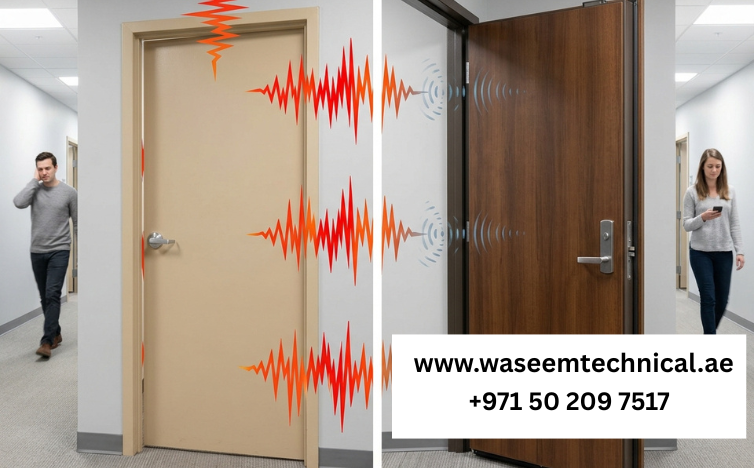
Construction and Traffic Noise
Dubai’s ongoing urban development creates constant environmental noise.
Acoustic doors help block:
- Traffic sound
- Construction noise
- Hallway noise
- Shared office disturbances
Luxury Interior Design
Modern acoustic doors combine soundproofing with elegant finishes such as:
- Veneer wood
- Laminate finishes
- Paint-grade surfaces
- Glazed acoustic panels
This allows them to blend seamlessly into premium interiors.
Climate Durability
Dubai’s humidity and temperature variations require durable acoustic materials.
Acoustic doors are engineered to maintain performance under local climate conditions.
Best Applications for Acoustic Doors
Offices
Reduce meeting room noise and improve workplace privacy.
Recording Studios
Prevent sound leakage during recording and mixing sessions.
Hotels
Improve guest comfort and room privacy.
Apartments and Villas
Reduce neighbor noise and outside disturbances.
Hospitals and Clinics
Support quieter healing and consultation environments.
Importance of Professional Installation
Even high-quality acoustic doors can fail if installed incorrectly.
Professional installation ensures:
- Proper frame alignment
- Correct seal compression
- Threshold sound isolation
- Gap-free installation
- Long-term acoustic performance
Acoustic specialists carefully install door systems to maximize soundproofing efficiency.
Call us: Contact Waseem Technical Soundproofing Expert in Dubai: +971 50 209 7517
Final Thoughts
Acoustic doors significantly outperform regular doors when it comes to sound insulation, privacy, durability, and overall acoustic comfort. Their dense construction, precision seals, and advanced soundproofing design make them ideal for Dubai’s noisy residential and commercial environments.
Whether for offices, apartments, studios, hotels, or conference rooms, professionally installed acoustic doors help create quieter and more comfortable spaces without compromising aesthetics.